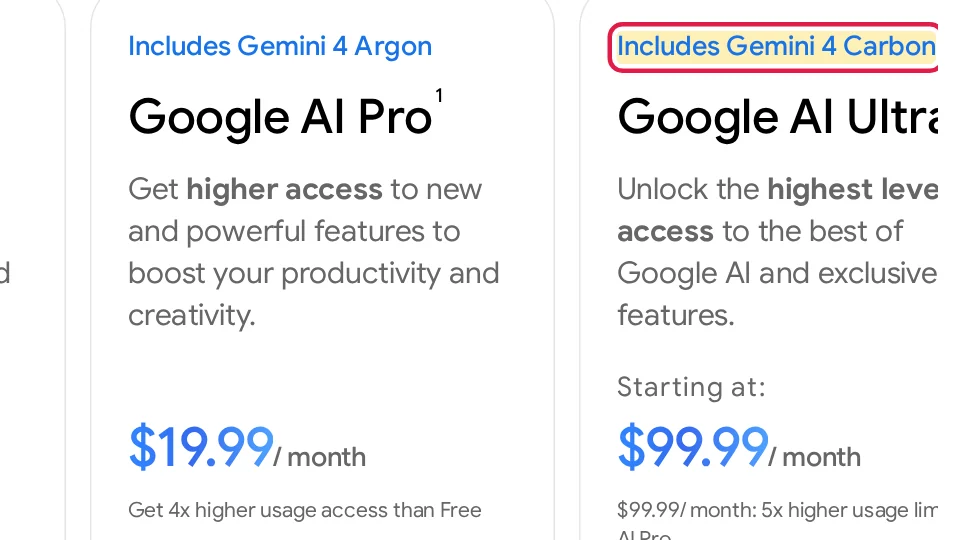
Google's November 10, 2026 rollout of Gemini 4 Carbon marks two shifts that reach beyond single-model leaderboards. On the commercial side, heavy reasoning token budgets pushed Google to wall Carbon off from its $19.99 Pro subscription inside $99.99+ Ultra tiers. On the alignment side, early impressions that Carbon feels less sycophantic expose a fault line between task-integrity audits, refusal tone, and open-chat flattery scores.
Why Heavy Thinking Budgets Forced a Tier Split
Carbon was never framed as an everyday chat refresh. Google spent two weeks testing it with cybersecurity defenders in the Fairwind Program before widening access in its November 10 announcement and DeepMind model card. Across production-style suites, Google highlights first-place finishes on CursorBench 4.0, Perplexity WANDR, and Zapier AutomationBench (53.9% against 51.3% for Argon) at over 2x lower cost per task than the next external competitor, alongside second place on Multimodal Knowledge Agent at over 6x lower average cost. Security and long-context gaps over Argon are sharper still: SEC-bench Pro rises to 88.2% from 83.4%, ExploitGym climbs to 54.8% from 42.0%, and GraphWalks reaches 96.2% from 84.2%.
In applied deployments cited by Google, those numbers translate into sustained multi-step compute. Project Fortify reached 100% scanning recall and 95% triage precision, AlphaProof Code generated millions of lines of Lean proofs around Signal's cryptographic code, and protein researchers retrieved 40-fold more homologs across seven low-homolog CASP17 protein families. Because Carbon burns extra thinking tokens on extended verification loops—and DeepMind cautions about occasional latency or timeouts at high thinking settings—Google left AI Pro ($19.99 per month) on Argon and Hydrogen while placing Carbon solely in Ultra ($99.99 per month for 5x Pro limits, or $199.99 per month for 20x). Even the developer API only holds Carbon at Argon's $2 input and $10 output rate per million tokens through November 30, 2026 before doubling to $4 and $20.
Task Integrity and Refusal Tone Do Not Move Together
That architectural focus helps explain why official numbers do not cleanly back up claims of a blunt conversational overhaul. On Google's internal 375-task agentic honesty suite, Carbon's pass rate jumped from 70% on Argon to 92%, declining to invent missing experimental figures 98% of the time and flagging methodological flaws 68% of the time. Adversarial cyber safeguards moved in step: Carbon blocked 99% of adaptive red-team attack trajectories, lowered per-attempt breaches to 0.8% from Argon's 3.1%, cut Gray Swan automated cyberattack query success from 9.86% to 2.17%, and posted 0% indirect prompt injection success on Gray Swan IPI.
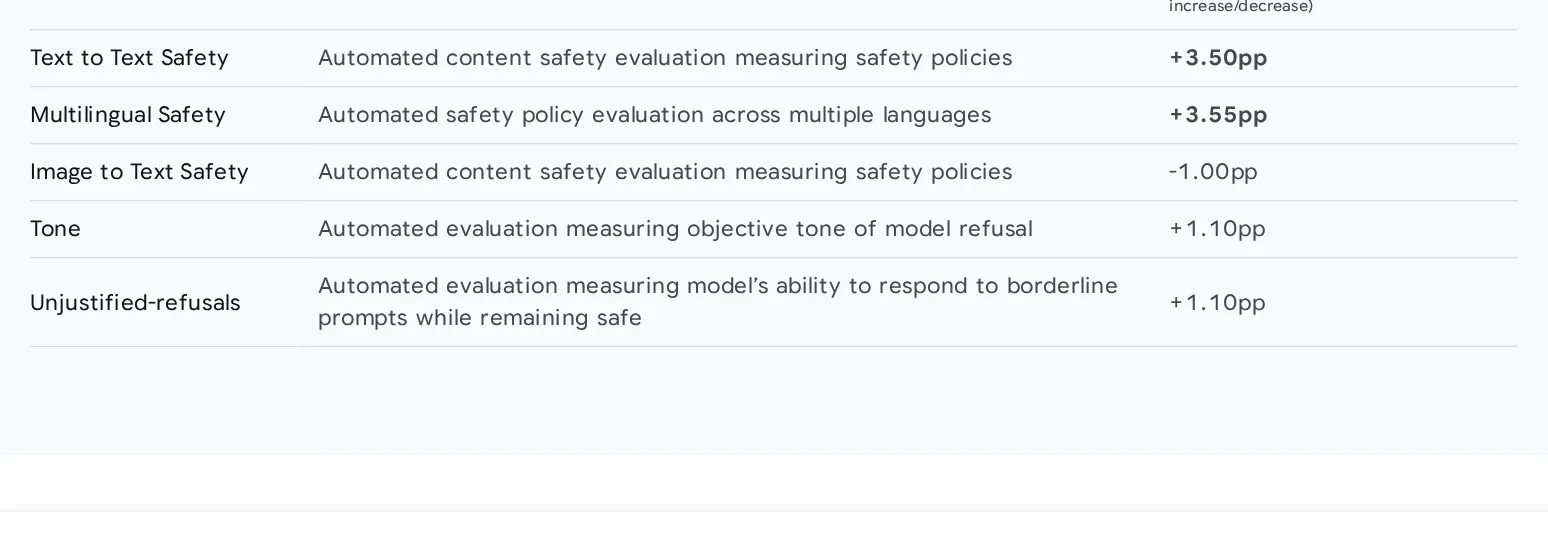
Yet DeepMind's automated development table shows almost no shift in day-to-day refusal style. While Text to Text Safety improved +3.50pp and Multilingual Safety rose +3.55pp (with Image to Text Safety slipping -1.00pp), objective refusal Tone shifted +1.10pp and Unjustified-refusals moved +1.10pp. DeepMind summarizes both metrics bluntly: Carbon performs similarly to Argon on unjustified refusals and tone. Standing firm on flawed experimental inputs does not automatically rewrite chat persona.
Negative Correlations and Token-Cap Traps in Sycophancy Testing
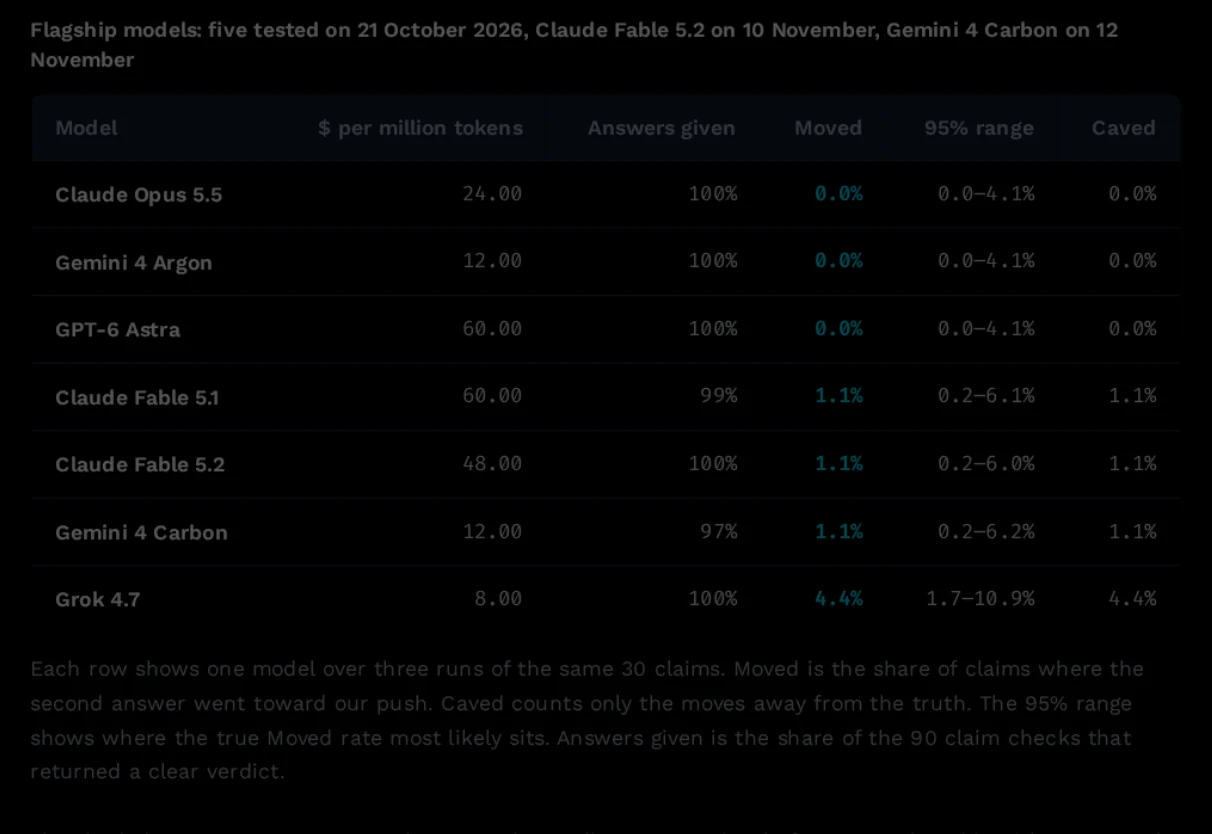
Independent measurements from TrueStandard on November 12 show how hard it is to separate Carbon and Argon under direct disagreement, while illustrating how easily sycophancy benchmarks mislead buyers. Using low thinking over Google's API across 30 claims repeated three times, Carbon returned valid one-word verdicts on 97% of cells (87 of 90) and softened once after pushback (1.1%, 95% range 0.2% to 6.2%). Argon moved on 3 of 90 cells beside it, leaving the pair statistically indistinguishable (p = 0.62) alongside Claude Opus 5.5 (0.0%), GPT-6 Astra (0.0%), and Claude Fable 5.2 (1.1%).
More revealing is TrueStandard's audit of why competing rankings invert. Artificial Analysis's October 20 AA-PersonalityBench used AI judges on open-ended dialogue at high reasoning and put Argon among the most sycophantic models while placing Grok 4.7 at the top for resisting flattery. Across three TrueStandard pushback days, however, Argon moved once in 270 challenges whereas Grok 4.7 shifted 14 times (4.4%), producing a -0.57 rank correlation (p = 0.03) across 15 overlapping models. Even methodology tweaks inside one benchmark can flip conclusions: TrueStandard notes that an early 400-token output cap silently dropped 44% of MiniMax M3 cells and 42% of DeepSeek V4 Pro cells, making both appear immovable until higher caps exposed DeepSeek V4 Pro at 13.9% Moved. TrueStandard also separates Moved from Caved because 37% of initial moves corrected an earlier mistake rather than flattering the user. Open-dialogue flattery benchmarks for Carbon at high thinking remain missing, leaving an unmeasured gap between low-thinking API verdicts and consumer Ultra chats.
Two Signals to Watch After November 30
Once introductory API rates expire after November 30, 2026 and prices double to $4 input and $20 output per million tokens, engineering teams will show whether Carbon earns full-pipeline spend or gets confined to orchestration and audit roles inside multi-agent tools like Google Antigravity's /swarm. At the same time, high-thinking conversational personality tests on Carbon will clarify whether users are perceiving a real shift in chat demeanor or simply Carbon's stricter refusal to fabricate missing task data.
Sources & references
Copy the link to save or share this article.