On November 10, OpenAI CFO Sarah Friar told interviewer Deirdre Bosa that the idea of Chinese AI models being cheaper is "one of the myths of 2026" that needs to be dispelled, arguing that OpenAI's lightweight Luna model costs roughly one-fifth to one-sixth as much to call as Chinese open-weight competitors. Yet OpenRouter's real-world traffic tells a stubbornly different story: over the past month, seven of the ten most-used models by token volume on the routing platform came from Chinese open-weight labs, with DeepSeek and Z.AI sweeping the top three spots ahead of fourth-place Luna.
Both facts are true at the same time, and reconciling them explains how the 2026 inference market has split in two. Placing OpenAI's rate card next to DeepSeek's API docs and Nadir's November 2026 dataset of 37 price points across 11 providers shows that Friar's ratio relies on comparing first-party budget pricing against hosted cloud layers rather than Chinese labs' own entry endpoints.
The Baseline Trick Behind the One-Sixth Claim
Friar's math makes sense when measured against multi-host open-weight marketplaces and mid-tier Chinese models. As Quartz reported from Goldman Sachs' conference on September 9, Friar explicitly benchmarked Luna against Z.ai's GLM 5.3 running on a cloud layer. Nadir's OpenRouter weighted average across hosts puts GLM 5.2 at $0.447 input and $3.31 output per 1M tokens. Against that figure, or Moonshot's Kimi K2.6 ($0.95 / $4.00) and DeepSeek V4-Pro off-peak ($0.66 / $1.98), GPT-6 Luna at $0.10 input and $0.50 output really does sit at roughly a fifth to a sixth of the price.
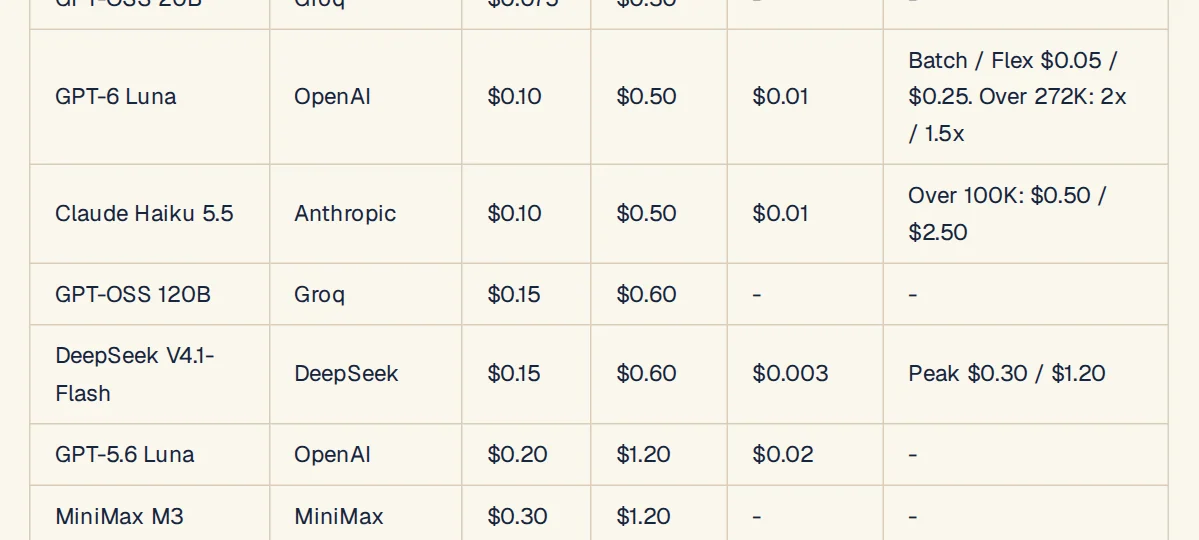
Once first-party Chinese endpoints and low-cost hosts enter the frame, that multiple disappears. Alibaba's Qwen Turbo lists at $0.05 input and $0.20 output in Nadir's catalog, half of Luna's sticker. Groq serves open-weight GPT-OSS 20B at $0.075 / $0.30. And DeepSeek's current lightweight workhorse, DeepSeek-V4.1-Flash, charges $0.15 input and $0.60 output off-peak -- close to parity with Luna -- while beating Luna's $0.01 cached input with a $0.003 cache hit. OpenAI's 80% price cut two weeks after Luna's debut, which lifted Luna's usage 10-fold and pushed OpenRouter volume up 115% over the past month, stopped Luna from being priced out of the budget tier. It did not create a five-fold floor advantage over Chinese APIs.
From Flat Floors to Conditional Surcharges
If raw token prices converged around $0.10 / $0.50 by autumn, providers responded by moving margin recovery into structural rules. Between May 31 and early August, blended market inference prices dropped from $2.04 per 1M tokens to $1.16-$1.18, with the open-weight median sitting near $0.53 versus $2.81-$3.00 for proprietary models, according to Nadir. Since August, however, major labs have replaced flat rate cards with clocks, context cliffs, and tool surcharges.
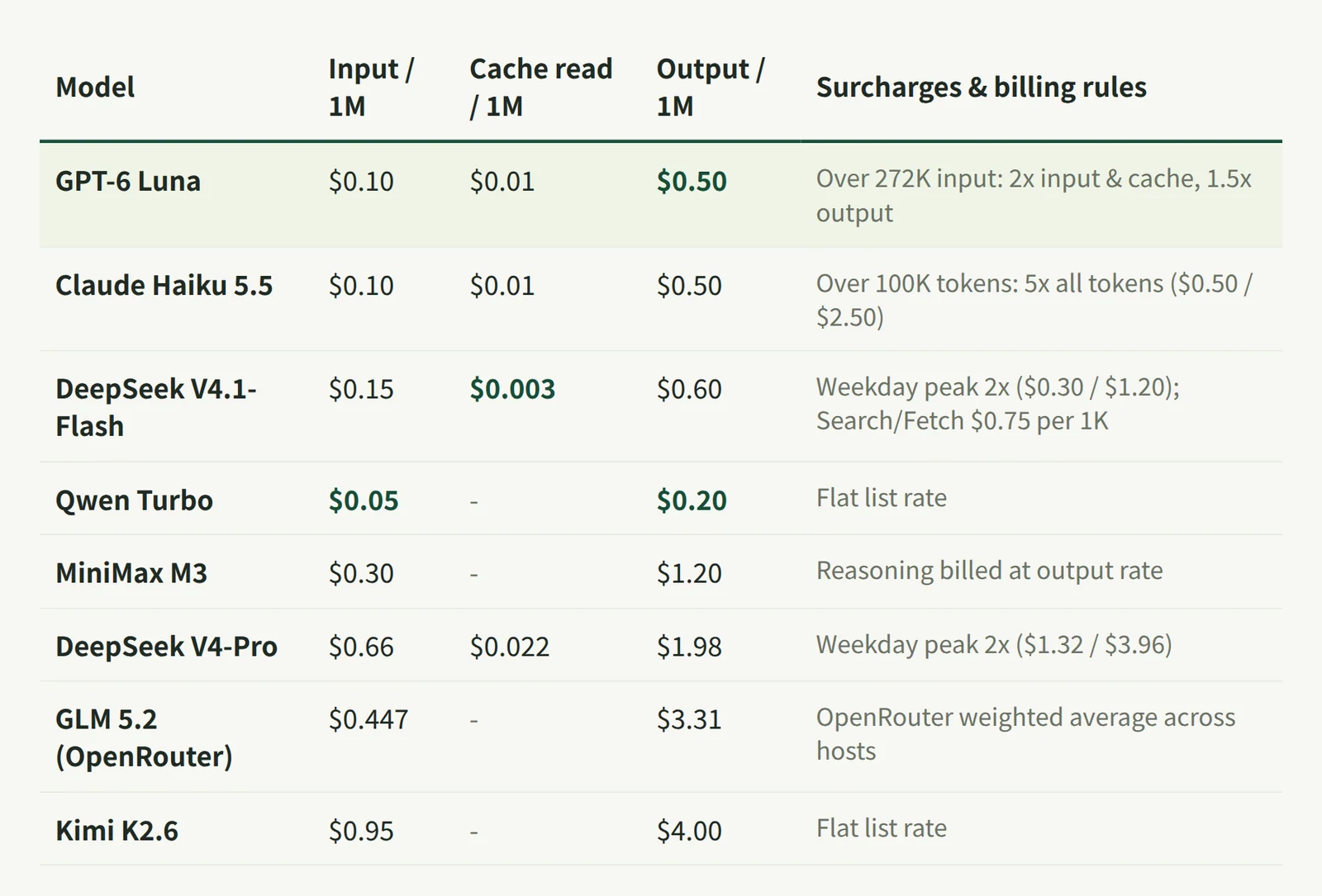
DeepSeek ended flat pricing on August 16 at 16:00 UTC. Compared with June's flat V4-Flash rate ($0.14 input, $0.28 output, $0.0028 cache hit), today's off-peak rate acts as a higher baseline, while seven weekday Peak hours (01:00-04:00 and 06:00-10:00 UTC) double every token fee to $0.30 / $1.20. On November 1, DeepSeek also began charging $0.75 per 1,000 successful Search and Fetch requests.
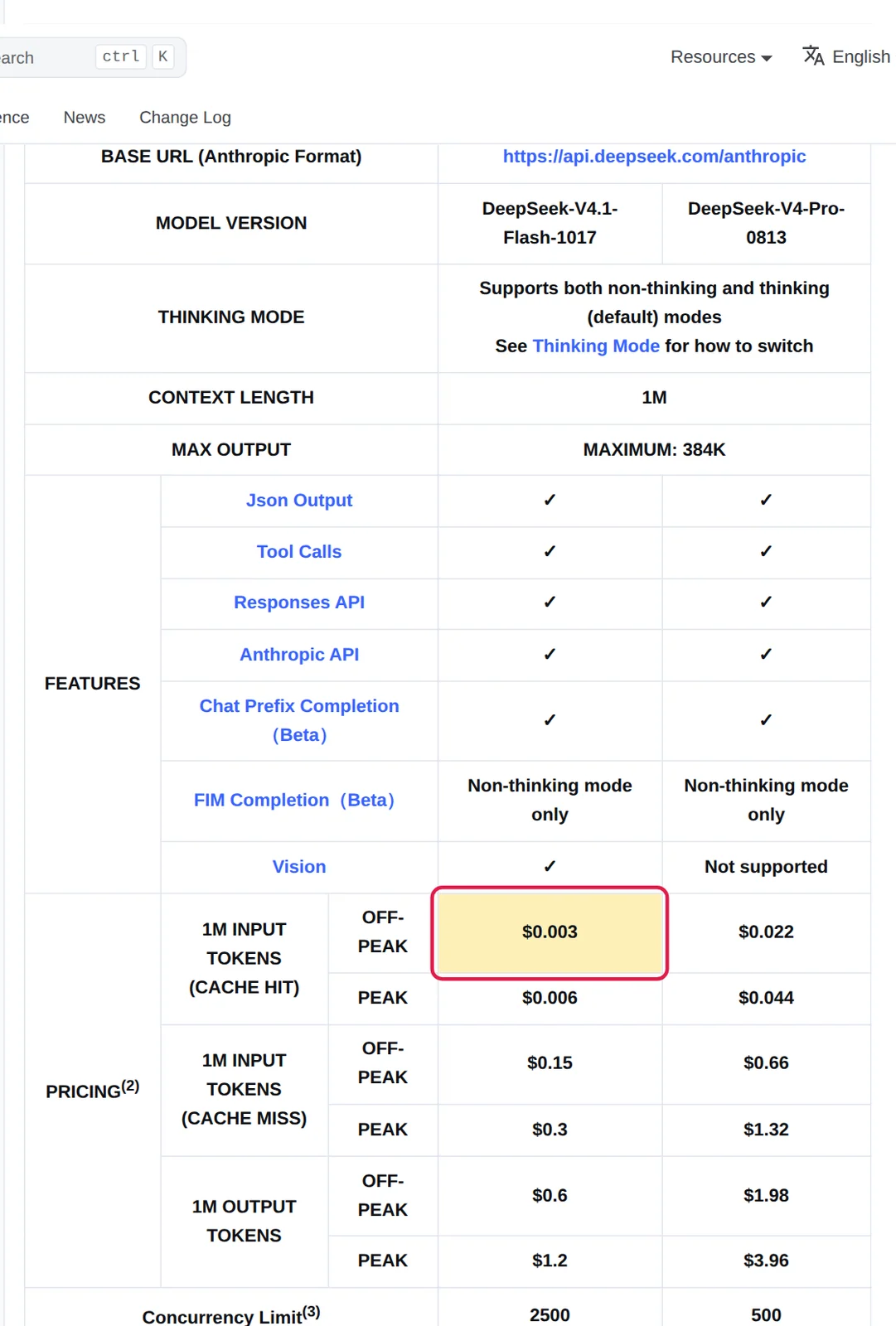
US frontier labs use context size and latency tiers instead of time-of-day pricing. OpenAI enforces a 272K input-token cutoff across every GPT-6 model -- including Luna -- repricing the full request at 2x input and cache rates and 1.5x output rates once crossed. Anthropic matches Luna's $0.10 / $0.50 floor with Claude Haiku 5.5, then imposes a 5x surcharge across the entire request past 100K tokens. Budget tiers now function like loss-leader entry ramps; revenue concentrates in long-context agent workflows, Fast modes, and tool calls.
Token Share vs. Enterprise Spend
That split explains why OpenAI's CFO is fighting an expectation battle as much as a price war. Santa Clara University professor Ram Bala estimated to Yahoo Finance that open-weight models could eventually capture 80% to 90% of overall token volume while most actual spending stays with closed models. High-volume experimental and consumer routing on OpenRouter naturally gravitates toward cheap, freely downloadable Chinese weights.
OpenAI is aiming Luna's economics at corporate buyers weighing whether self-hosting open weights saves money. As Friar noted in September, OpenAI's enterprise revenue grew 32% between June and July -- outpacing its 20% annualized company-wide growth rate -- alongside 25 million users on Codex and new pilots tying fees to business outcomes in chip design, life sciences, and financial services. Backing that aggressive floor is custom silicon: OpenAI and Broadcom taped out the Jalapeño inference chip in under nine months, with early samples showing roughly 50% cost savings over typical AI GPUs ahead of targeted deployment by late 2026.
Put alongside those chip savings and enterprise numbers, cutting Luna by 80% is a straightforward retention trade: OpenAI uses a low entry rate to keep corporate teams calling its API instead of migrating to hosted open weights, then earns its margin on long-context agents, complex reasoning, and outcome-priced workflows.
Sources & references
Copy the link to save or share this article.