On November 13, AI Weekly cited Wall Street Journal reporting—followed by Hong Kong's Mingpao on November 14—that Moonshot AI is deregistering its Cayman Islands holding company and transferring early dollar-denominated stakes to its mainland Chinese operating entity. The restructuring clears a regulatory hurdle for a targeted Q1 2027 Hong Kong IPO that could raise up to $5 billion at roughly a $50 billion valuation, yet market turbulence, regulatory probes, and mixed benchmark data leave the timing far from settled.
Why Hong Kong Became the Only Exit
Moonshot AI's fundraising pace accelerated sharply this year. According to Quartz, citing Bloomberg, the Beijing startup founded in early 2023 by former Tsinghua University faculty member Yang Zhilin, with backing from Alibaba, Tencent, and 5Y Capital, reported annual recurring revenue of $300 million in June before launching Kimi K3 in July. ARR climbed to $1 billion by October, with management telling investors it is on track to reach $2 billion by December. Over the same stretch, its private valuation jumped from $31.5 billion this summer to roughly $50 billion, supported by a confidential Hong Kong filing led by Bank of America as overall coordinator alongside CICC, Deutsche Bank, and Goldman Sachs as sponsors.
Unwinding the offshore Cayman vehicle is less a sudden delay than a compliance prerequisite. Tightened China Securities Regulatory Commission rules on offshore red-chip structures pushed Moonshot to repurchase shares from dollar-denominated shareholders and redirect funds and equity into its domestic operating entity, a full unwind of its variable-interest-entity structure. At the same time, AI Weekly noted that investment banks have shut China and Hong Kong investors out of Anthropic's IPO, leaving Hong Kong as the primary public venue able to absorb a multi-billion-dollar offering from a Chinese frontier lab. By mid-August, Hong Kong IPO proceeds had already reached $41.2 billion, more than double a year earlier, driven largely by Chinese technology listings.
Three Overhangs Before a Prospectus Appears
Cleaning up corporate incorporation does not guarantee an easy debut. Mingpao's summary of the Wall Street Journal report noted that recent market turbulence has left some investors uneasy that weak sentiment could depress valuation or force Moonshot to push back its listing schedule, with final offering size and timing still fluid.
Two unresolved overhangs sit directly in front of the Hong Kong Stock Exchange listing committee. First, regulators have opened a data-security probe into both Moonshot and rival DeepSeek, adding direct uncertainty over when confidential paperwork can advance into a public prospectus. Second, Moonshot executives are reportedly working to settle an investor dispute ahead of any listing, even as they negotiate the terms for cashing out or transitioning Cayman dollar shareholders onshore. Moonshot has also faced scrutiny from U.S. officials over allegations involving restricted Nvidia chips and distillation from Anthropic models, though Moonshot has pushed back specifically on the distillation claim.
Does Kimi K3.1 Pro Justify a $50B Tag?
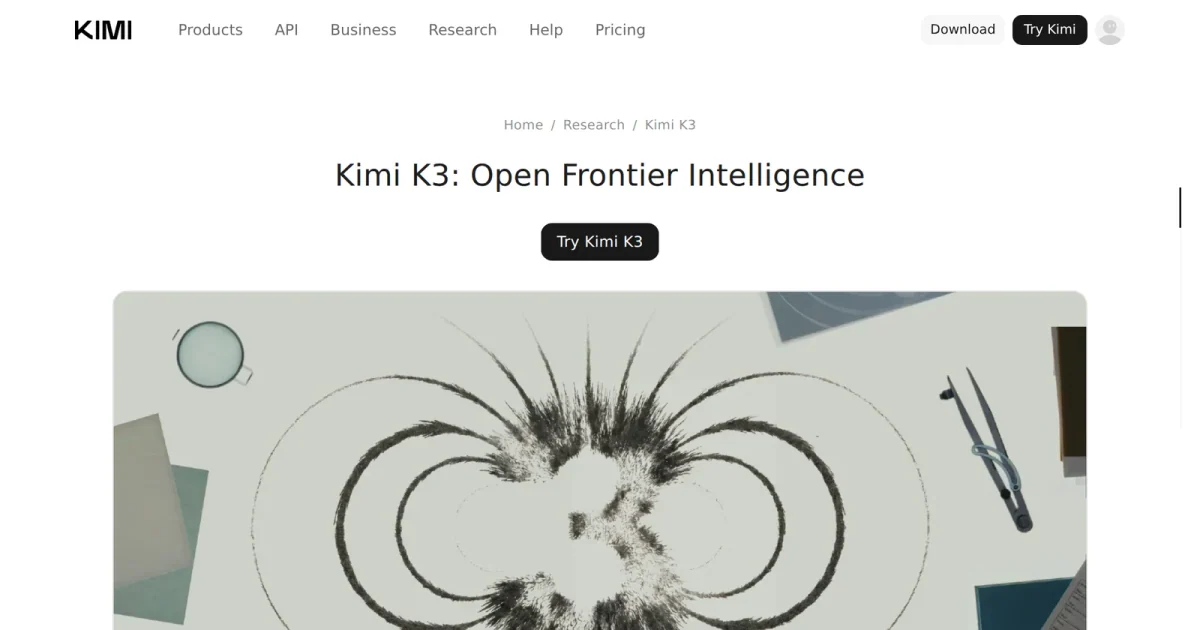
For a lab asking public markets for a $50 billion valuation, flagship model competitiveness remains the core underwriting test. With full weights slated for release by November 4, Kimi K3.1 Pro scales to 2.8T total parameters with 104B active per token, retains K3's 1,048,576-token context window while swapping Gated MLA layers for Gated DSA to improve long-context efficiency, pairs with a 401M-parameter MoonViT-V2 vision encoder, and uses quantization-aware MXFP4/MXFP8 training alongside a 2-3x faster Highspeed tier. Post-training reinforcement learning cut claim-level hallucinations on internal Kimi Hallu Bench Hard from 23.4% to 8.3%, while lifting internal financial modeling and financial research benchmarks by 7.2 and 11.6 points over K3 and hitting 92.7% with tools on BenchCAD (just behind Claude Opus 5.5's 96.2% and GPT-6 Astra's 95.9%).
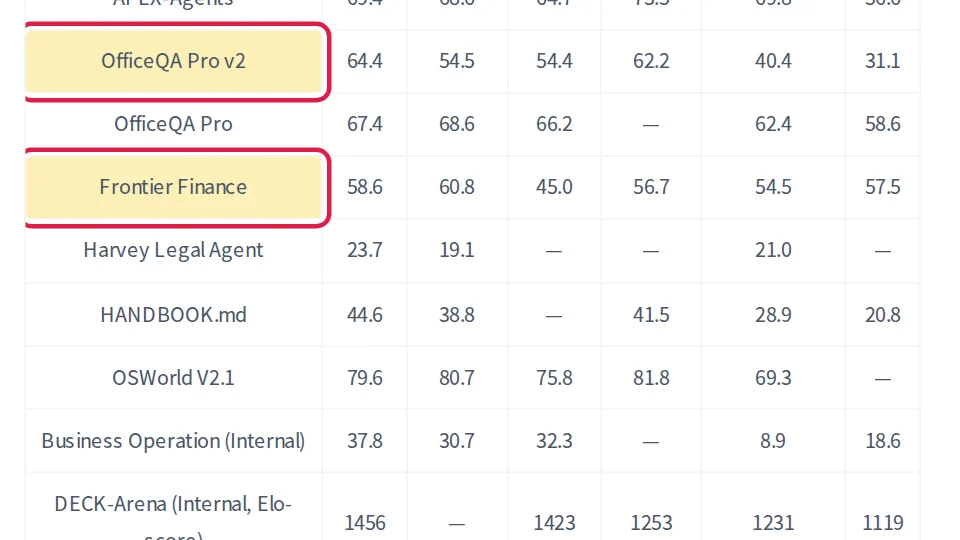
Yet the full comparison table on Hugging Face reveals a sharp split against Claude Fable 5.1. K3.1 Pro outperforms Fable 5.1 across agentic and office automation benchmarks such as Automation Bench-AA (73.3 vs. 59.4), OfficeQA Pro v2 (64.4 vs. 54.5), DeepSWE v1.1 (75.5 vs. 67.4), Terminal-Bench 4.0 (65.7 vs. 57.9), Business Operation (37.8 vs. 30.7), and GDPval-AA v2.1 (1846 vs. 1754 Elo), though it trails slightly on Frontier Finance (58.6 vs. 60.8) and OSWorld V2.1 (79.6 vs. 80.7).
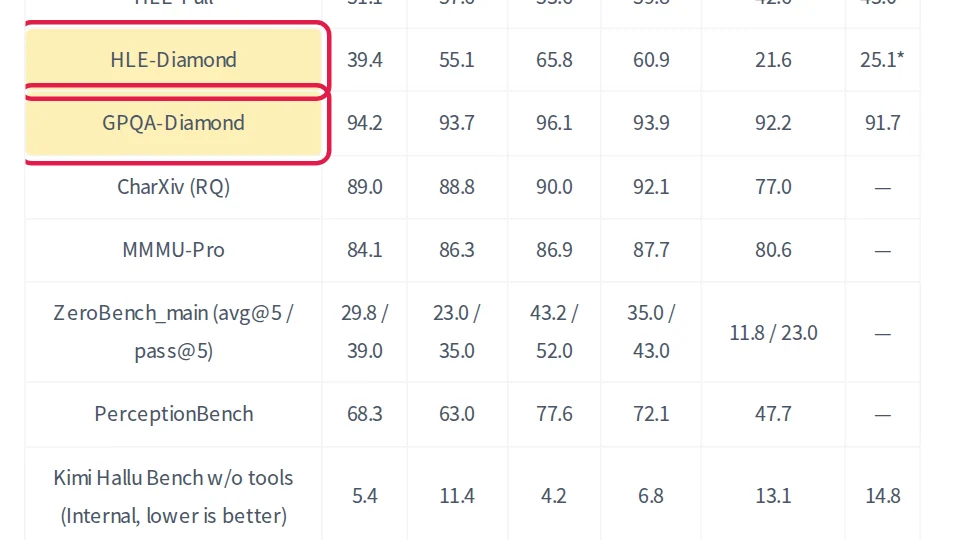
On strict single-pass coding, hard reasoning, and offensive security tasks, a wider deficit remains: K3.1 Pro scores 31.5 on Program Bench against Fable 5.1's 53.5, 39.4 on HLE-Diamond against 55.1, 51.1 on HLE-Full against 57.6, 36.5 on PostTrain Bench v1.2 against 44.6, 74.7 on ExploitBench against 83.0, and 20.7 on ExploitGym against 30.4. Moonshot acknowledged in its blog that stripping cyber-related data from mid-training and reinforcement learning reduced its internal xdev-bench-hard pass@3 rate from 90.5% to 81.0%, leaving its security capabilities behind proprietary models released at least three months earlier. That positions K3.1 Pro as a cost-competitive workhorse for agent loops and document pipelines rather than an across-the-board replacement for Fable-class reasoning.
Retiring K2 to Funnel Revenue Into K3
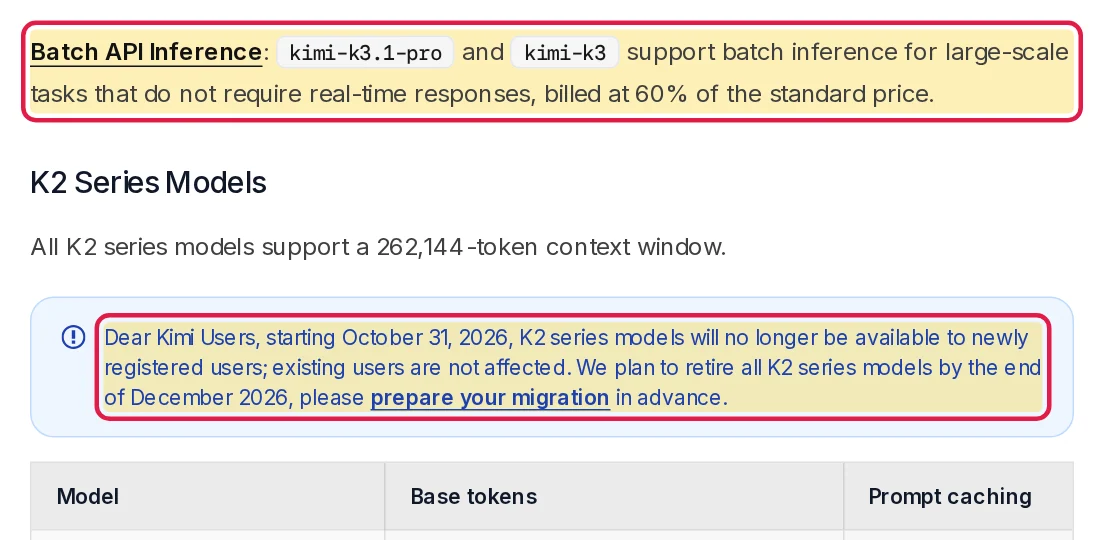
On the commercial side, Kimi API Platform documentation shows Moonshot consolidating developer spend onto its newest stack. Pay-as-you-go billing operates separately from Kimi memberships and Kimi Code, with automatic context caching (5-minute default TTL or 1-hour TTL) and temporarily free file upload and extraction APIs. K2 models closed to newly registered users on October 31, and all K2 series models are slated for retirement by the end of December, while kimi-k3.1-pro and kimi-k3 offer Batch API pricing at 60% of standard rates.
Sunsetting legacy tiers while discounting batch volume aligns directly with the push to hit $2 billion in ARR by December ahead of investor roadshows. Between revenue momentum and regulatory overhang, the hard constraint on Moonshot's $50 billion timeline is a clear resolution to the data-security probe: until oversight questions clear before the HKEX converts confidential paperwork into a public prospectus, even $2 billion in ARR will not lock in a Q1 listing.
Sources & references
Copy the link to save or share this article.