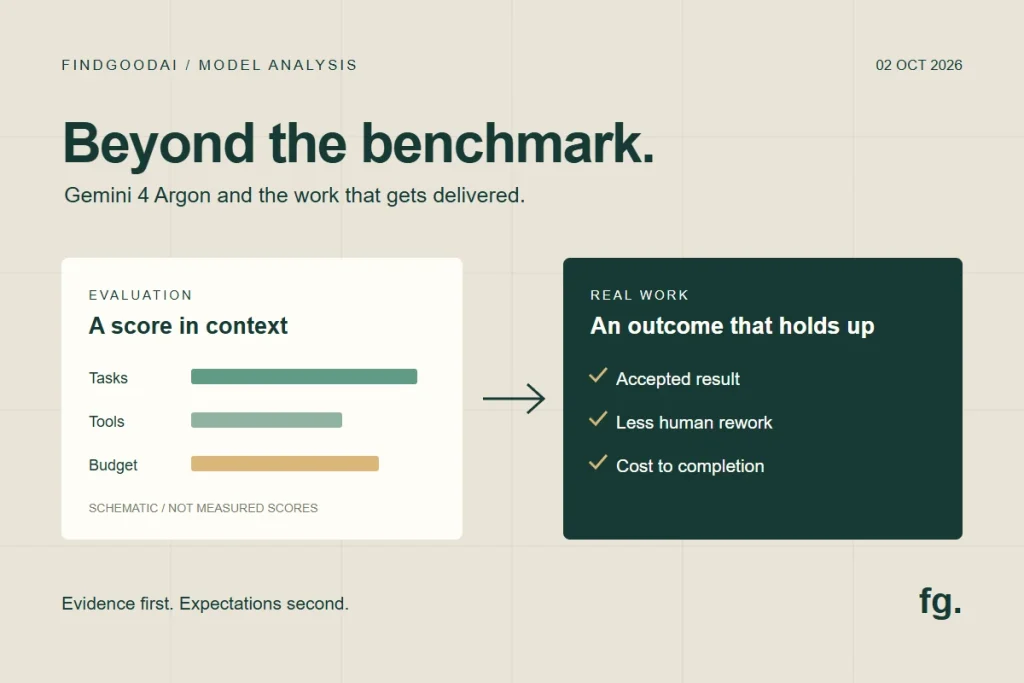
How much confidence should a launch benchmark chart buy the next generation of an AI model? On October 1, 2026, Ishu Agrawal resurfaced Google’s launch results for Gemini 3.1 Pro and questioned the enthusiasm surrounding Gemini 4 Argon. Logan Kilpatrick’s reply moved the discussion toward extensive testing by engineers inside Google.
The exchange matters because it exposes two tempting shortcuts: treating benchmark leadership as a guarantee of everyday usefulness, and letting disappointment with an earlier model settle the case against its successor. A useful assessment separates historical scores, evaluation conditions, and evidence about the new model.
The original post and the reply
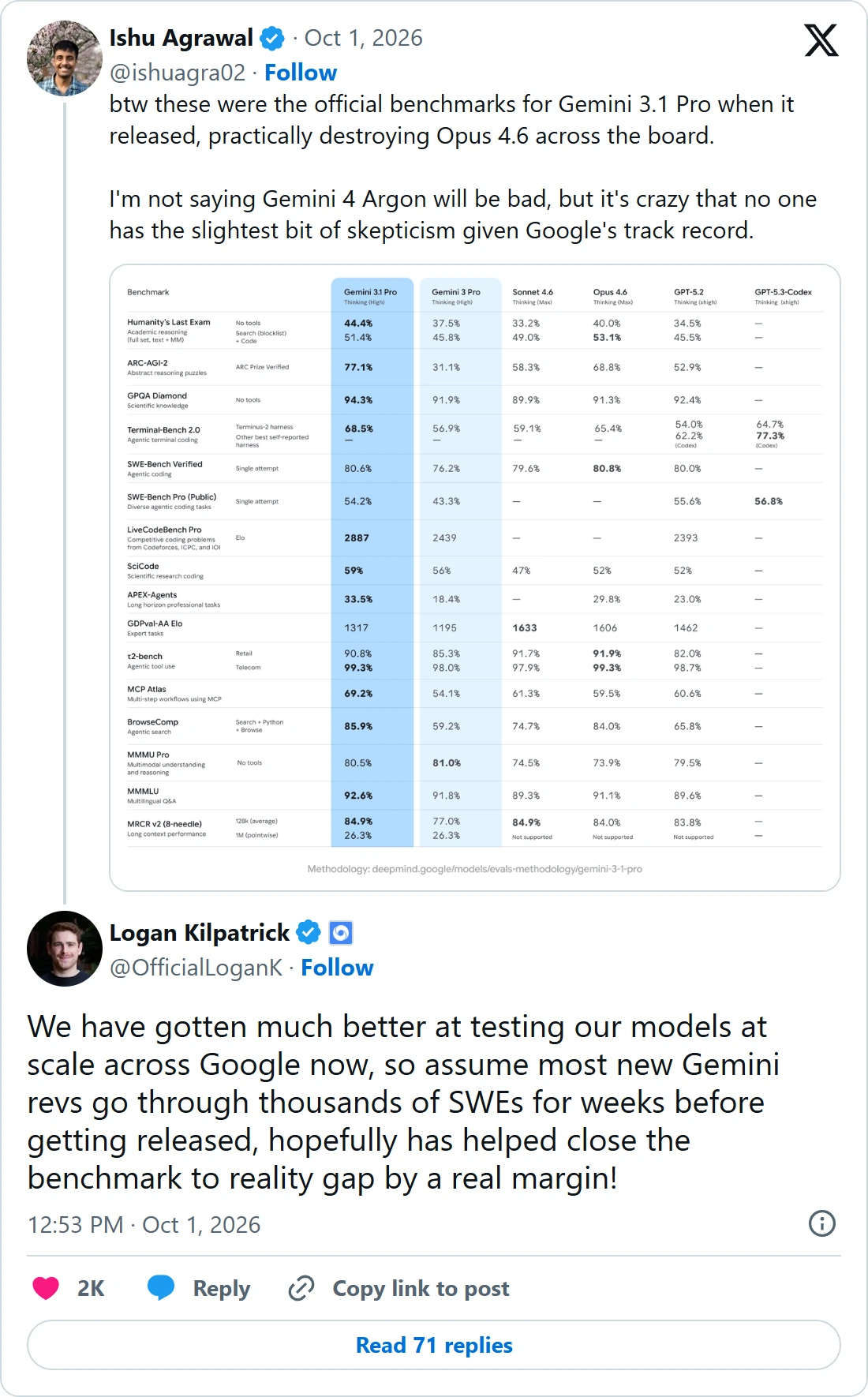
Ishu Agrawal (@ishuagra02) posted the following at 02:32 UTC on October 1, 2026:
btw these were the official benchmarks for Gemini 3.1 Pro when it released, practically destroying Opus 4.6 across the board.
I’m not saying Gemini 4 Argon will be bad, but it’s crazy that no one has the slightest bit of skepticism given Google’s track record.
Logan Kilpatrick replied directly at 04:53 UTC:
We have gotten much better at testing our models at scale across Google now, so assume most new Gemini revs go through thousands of SWEs for weeks before getting released, hopefully has helped close the benchmark to reality gap by a real margin!
These are two different claims. Agrawal characterizes a set of results and argues for skepticism; Kilpatrick describes an evaluation process. Neither statement, by itself, establishes the quality of the work a customer will receive. Kilpatrick’s “hopefully” also matters: the reply does not quantify how much the gap has narrowed.
A strong chart, with visible exceptions
The chronology is essential. Google’s Gemini 3.1 Pro announcement was published on February 19, 2026. The chart in the post is a historical launch comparison, not an October leaderboard and not an evaluation of Argon.
The selected results below match the screenshot and Google’s official model card. Percentages are scores on the named evaluations; GDPval-AA uses Elo.
| Evaluation and setting | Gemini 3.1 Pro Thinking: High |
Opus 4.6 Thinking: Max |
|---|---|---|
| ARC-AGI-2 | 77.1% | 68.8% |
| GPQA Diamond, no tools | 94.3% | 91.3% |
| Terminal-Bench 2.0, Terminus 2 | 68.5% | 65.4% |
| Humanity’s Last Exam, no tools | 44.4% | 40.0% |
| Humanity’s Last Exam, search (blocklist) and code | 51.4% | 53.1% |
| SWE-bench Verified, single attempt | 80.6% | 80.8% |
| GDPval-AA, Elo | 1317 | 1606 |
| τ2-bench, retail | 90.8% | 91.9% |
| τ2-bench, telecom | 99.3% | 99.3% |
The table supports a substantial claim: Gemini 3.1 Pro performed well across several evaluations. It does not support universal superiority. The 0.2 percentage point difference on SWE-bench Verified does not establish a statistically meaningful winner, but it certainly is not a numerical lead for Gemini. Elo differences should not be converted into percentage differences in ability.
Humanity’s Last Exam provides another useful clue. The relative ordering changes between the no-tool and tool-enabled rows. That illustrates why the evaluated system matters. These rows alone cannot isolate the contribution of a particular tool or design choice.
One table does not guarantee one testing environment
Google’s evaluation methodology says that other providers’ scores are generally self-reported unless otherwise specified. It also states that SWE-bench comparisons use different scaffolding and infrastructure. A shared table therefore does not mean every model was rerun with identical software and resource budgets.
Scaffolding is the working environment around a model: the tools it can call, how it reads files, how it retries, and how it checks its output. Answering a difficult isolated question and completing a task that requires setup, changes across files, and recovery from failure put different demands on that system.
A disappointing user experience consequently deserves investigation without automatically invalidating the benchmark. What task failed? Which model version and product were used? What context and time budget were available? Did the failure happen while interpreting the request, operating a tool, or checking the result? Recording those conditions turns a vague disagreement into something another person can reproduce.
What thousands of internal testers can establish
Sustained use in real repositories can reveal weaknesses that short tests miss: forgotten constraints, unnecessary interface changes, loops after a failed test, and code that appears complete but is difficult to maintain. That is a plausible reason to value extensive internal testing.
Yet the number of testers leaves important questions unanswered. What was the comparison baseline? How was success defined? Were failures and abandoned attempts counted? How much time did engineers spend correcting the result? Participation measures coverage; it does not, by itself, measure productivity.
The most useful reading of Kilpatrick’s reply is that Google says it is improving the process connecting evaluation with practical use. That deserves attention and follow-up. The reply alone does not demonstrate that the gap has disappeared. Internal feedback, external evaluations, and a customer’s acceptance tests each contribute a different kind of evidence.
Argon must be judged with the new evidence included
As of our October 2, 2026 check, Argon is an announced model. Google introduced Gemini 4 Argon on September 30, initially rolling it out to trusted cyber defenders through the Fairwind Program. Broad developer and consumer availability was still forthcoming.
There is also early independent testing. In its September 30 evaluation, Artificial Analysis reported 78% on AutomationBench-AA and 57% on Terminal Bench 4 with Argon’s high reasoning setting. That is relevant evidence about the new model, beyond expectations inferred from an old launch chart.
The scope still matters. These are results on particular tasks and configurations, not guarantees for every workflow. In particular, subtracting Terminal Bench 4’s 57% from the older Terminal-Bench 2.0 score of 68.5% would not demonstrate regression: the test versions differ. AutomationBench-AA should likewise not be conflated with a differently configured evaluation carrying a similar name.
Healthy skepticism must leave room for new evidence to change the conclusion. Earlier experience can justify asking for stronger validation; it should not decide the outcome in advance.
Measure the work you actually need to finish
For a team choosing an AI model, our recommendation is to start with recurring tasks, preserve the same inputs, and define acceptance criteria before comparing outputs. For a software fix, “produced code” is too weak a standard. The change should run, preserve existing behavior, satisfy the original constraints, and remain understandable to the next maintainer.
- Usable outcomes: count tasks that pass acceptance, not responses that merely look complete.
- Human rework: record time spent reviewing, correcting, adding context, and repeating instructions.
- Total cost per completed task: include failed attempts, tool use, and human intervention.
- Reliability and waiting time: check repeated runs, the visibility of failures, and whether recovery works.
The useful contribution of this debate is to move attention from bold numbers in a launch table to the work that gets delivered. Gemini 3.1 Pro deserves credit for its strengths, alongside an honest account of what its chart cannot establish. Argon deserves an assessment based on its own evidence and outcomes. The same standard should apply to every provider.
Editorial note: This is a source-based analysis, not an independent rerun of the benchmarks by FindGoodAI. We checked the X text and direct-reply relationship against official embed data. Historical scores retain their launch-time context. Sources were checked on October 2, 2026.
Sources & references
Logan Kilpatrick: direct reply ↗
Google: Gemini 3.1 Pro announcement (February 19, 2026) ↗
Google DeepMind: Gemini 3.1 Pro model card and historical results ↗
Google DeepMind: Gemini 3.1 Pro evaluation methodology ↗
Google: Gemini 4 Argon announcement (September 30, 2026) ↗
Artificial Analysis: independent Argon evaluation (September 30, 2026) ↗
Copy the link to save or share this article.