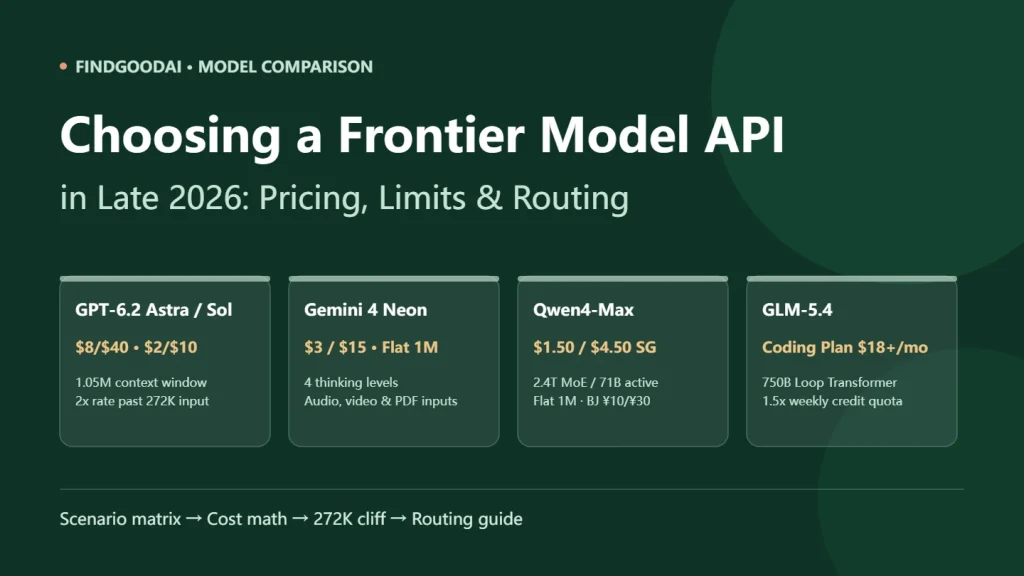
In November 2026, four major labs updated their flagship developer lineups at once: OpenAI rolled out GPT-6.2 Astra and Sol, Google DeepMind launched Gemini 4 Neon, Alibaba Cloud brought Qwen4-Max to general availability, and Z.ai introduced its Loop Transformer flagship GLM-5.4 into the GLM Coding Plan. Every model advertises a 1M-class window, yet pricing cliffs, modality support, and billing structures diverge sharply in production. This guide is for engineering leads and AI builders selecting primary and fallback APIs—starting with a scenario verdict, followed by architecture trade-offs, 272K cost math, vendor-reported benchmarks, and a test plan.
Quick verdict: which API fits which job
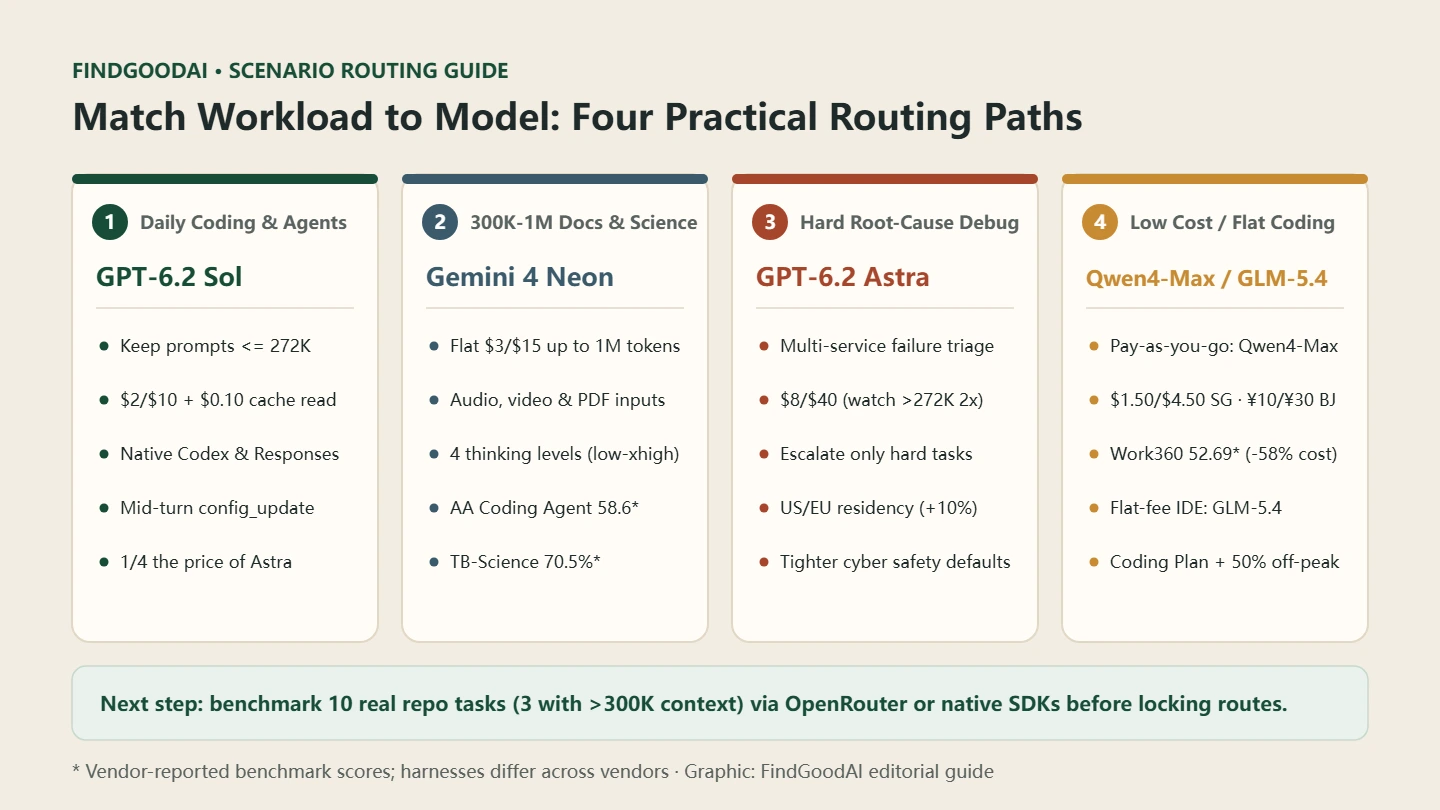
- Daily coding and agents under 272K input tokens: Pick GPT-6.2 Sol. At $2.00 input / $10.00 output and $0.10 cached reads per 1M tokens, it costs a quarter of Astra and supports mid-turn
configuration_updatein the Responses API without breaking prompt caches. - 300K–1M repos, audio/video/PDF, and science agents: Pick Gemini 4 Neon. Flat $3.00 / $15.00 rates hold across the full 1M window, undercutting Sol by roughly 23% once inputs pass 272K tokens.
- Hard cross-service debugging: Escalate selectively to GPT-6.2 Astra ($8.00 / $40.00) while guarding against oversized context dumps.
- Leanest pay-as-you-go spend and Asia/China endpoints: Pick Qwen4-Max at flat $1.50 / $4.50 (Singapore) or ¥10 / ¥30 (Beijing) with 95% caching discounts.
- Flat-fee IDE coding, visual/3D tasks, and overnight loops: Pick GLM-5.4 on the GLM Coding Plan (from $18/month), with 1.5x weekly quota over GLM-5.3 and 50% off-peak credits; standalone token API pricing and open weights await safety review.
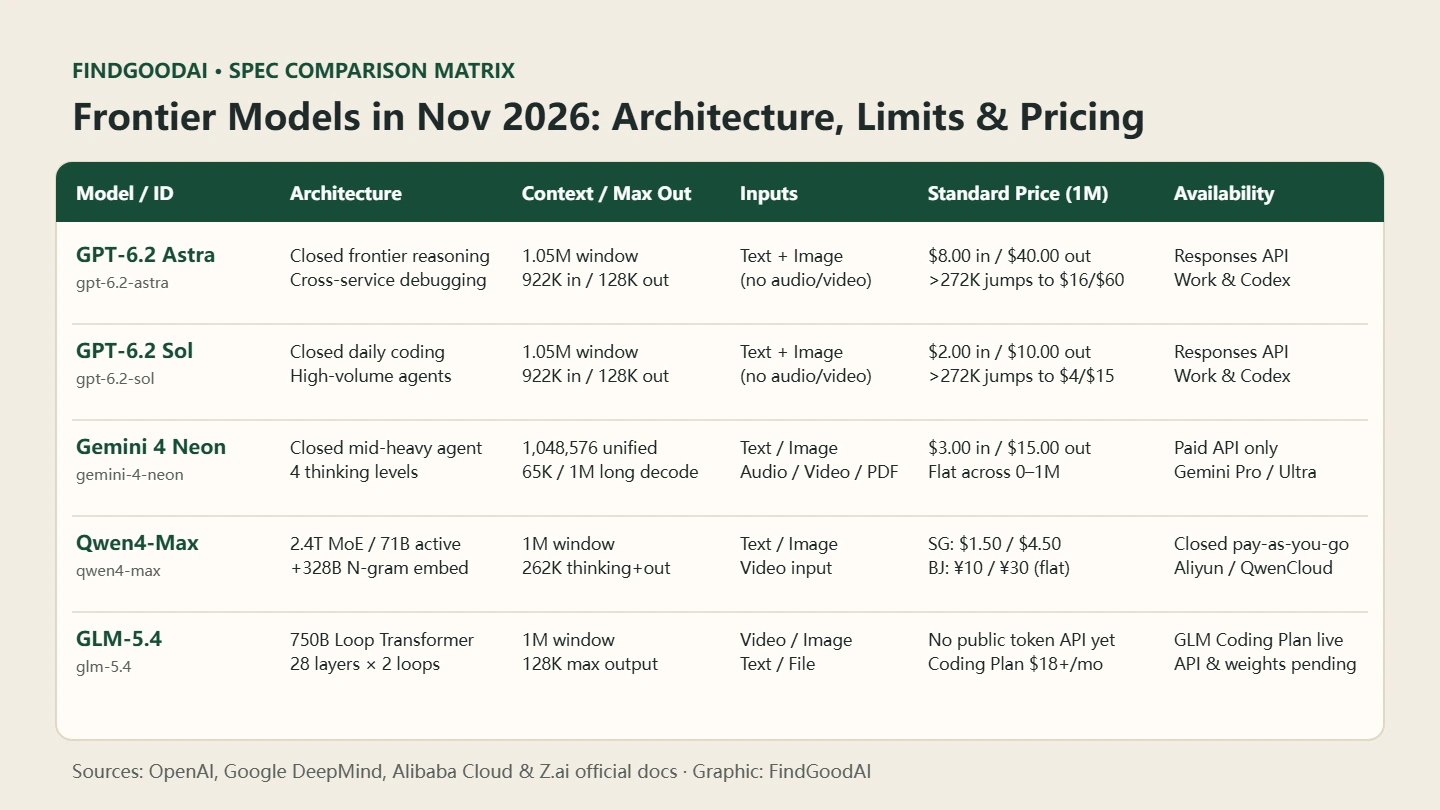
| Model / API ID | Architecture & Role | Context / Max Out | Inputs | Standard Price (1M) | Availability |
|---|---|---|---|---|---|
GPT-6.2 Astragpt-6.2-astra |
Closed flagship reasoning for hard triage and deliverables | 1.05M (922K in / 128K out) | Text, Image | ≤272K: $8 / $40 ($0.40 cache); >272K: $16 / $60 | API, Work, Codex |
GPT-6.2 Solgpt-6.2-sol |
Closed daily coding and high-volume agent workhorse | 1.05M (922K in / 128K out) | Text, Image | ≤272K: $2 / $10 ($0.10 cache); >272K: $4 / $15 | API, Work, Codex |
Gemini 4 Neongemini-4-neon |
Closed mid-heavy agent; 4 tunable thinking levels | 1M unified (65K sync / 1M long) | Text, Image, Audio, Video, PDF | Flat 1M: $3 / $15 (incl. thinking); implicit cache $0.15 | Paid API, Pro / Ultra |
Qwen4-Maxqwen4-max |
2.4T MoE / 71B active + 328B N-gram | 1M (262K think+out / 131K std) | Text, Image, Video | SG: $1.50 / $4.50 ($0.075 cache); BJ: ¥10 / ¥30, flat | Pay-as-you-go API |
GLM-5.4glm-5.4 |
750B Loop Transformer (28 layers × 2) | 1M (512K rec.) / 128K out | Video, Image, Text, File | Token API pending; Coding Plan $18+/mo (4.6/1.1/16 mult.) | Coding Plan live; API & weights pending |
Architecture and access: three engineering bets
Three distinct model architectures sit behind those rate cards, shaping both latency and how you control reasoning cost.
1. Closed tiered specialization (OpenAI and Google). OpenAI’s GPT-6.2 Astra and Sol share a 1,050,000-token window (922K max input, 128K max output), accept text and images only, and reject reasoning_effort: none. Single-agent Responses calls can append configuration_update between turns to change effort without invalidating cached prefixes. Google DeepMind’s Gemini 4 Neon adapts Carbon into a mid-heavy agent model between Hydrogen and Carbon: one 1,048,576-token pool covers input, thinking, and output (65,536 sync cap, extendable to 1M via background=true), with native text, image, audio, video, and PDF inputs.
2. Sparse MoE cost compression (Qwen4-Max). As covered in our Qwen4-Max GA report, Alibaba combines a 2.4T-parameter sparse MoE (71B active per token—25% fewer than Qwen3.8-Max) with 328B N-gram embeddings and 3:1 Gated DeltaNet + Qwen Sparse Attention layers. It supports OpenAI Chat Completions, Responses, Anthropic Messages, and DashScope protocols. While qwen4-max is a closed API, Alibaba open-sourced Qwen-Live-Delivery-Plugin and noted smaller open-weight Qwen4 models will follow.
3. Weight-shared depth (GLM-5.4 Loop Transformer). Instead of expanding parameter count, Z.ai’s GLM-5.4 loops 28 middle layers of its 750B GLM-5 base twice per forward pass, using Gated Progressive Updates, a hybrid KV cache (pass-one global sparse KV plus a local sliding window), and sparse attention index reuse to contain 1M memory overhead. Z.ai reports 2T–3T-class reasoning with video, image, text, and file inputs across software engineering, GLSL shaders, and FreeCAD modeling. GLM-5.4 is live in GLM Coding Plan today, with standalone API pricing and open weights pending safety hardening.
Pricing math and the 272K context cliff
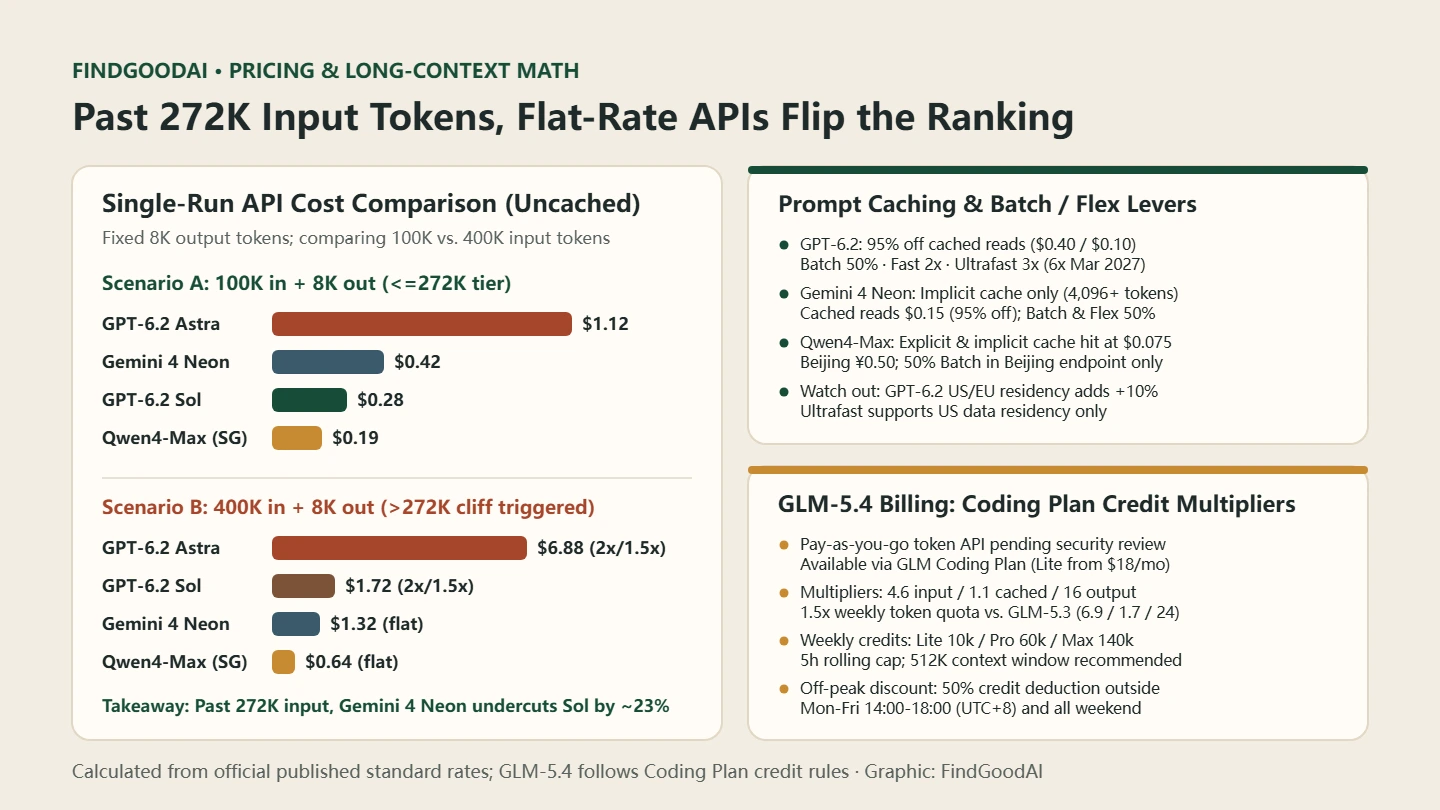
The biggest budget trap in late-2026 rate cards is OpenAI’s 272K input threshold. Whenever a GPT-6.2 prompt exceeds 272,000 input tokens, input and cached-input prices double (2×) and output rises 1.5× for the entire request—pushing Sol from $2/$10 to $4/$15 and Astra from $8/$40 to $16/$60. Neither Gemini 4 Neon ($3/$15 flat to 1M) nor Qwen4-Max ($1.50/$4.50 Singapore or ¥10/¥30 Beijing) adds long-context surcharges.
Caching and speed tiers amplify the spread. GPT-6.2 cuts cached reads by 95% ($0.40 / $0.10), offers 50% Batch and 2× Fast rates, and prices Ultrafast at 3× through February 28, 2027 (6× from March 1, 2027; US residency only), while US/EU residency on Standard/Fast/Batch adds 10%. Gemini 4 Neon has no Free tier and lacks explicit caches.create, but applies 95% implicit caching ($0.15) on 4,096+ tokens plus 50% Batch and Flex discounts. Qwen4-Max offers 95% explicit and implicit caching ($0.075 / ¥0.50), with 50% Batch limited to Beijing. For an 8K-output job, crossing 272K flips the bill:
| Workload (8K output) | GPT-6.2 Astra | GPT-6.2 Sol | Gemini 4 Neon | Qwen4-Max (SG) |
|---|---|---|---|---|
| 100K in + 8K out (uncached) | $1.12 | $0.28 | $0.42 | $0.19 |
| 400K in + 8K out (uncached) | $6.88 (2x/1.5x) | $1.72 (2x/1.5x) | $1.32 (flat) | $0.64 (flat) |
| 400K in (90% cached) + 8K out | $1.25 | $0.35 | $0.29 | $0.12 |
| 50% Batch discount | Yes | Yes | Yes (Batch & Flex) | Beijing only |
GLM-5.4 bills through Coding Plan credits instead of per-token rates. Starting at $18/month (Lite: 2,000 credits/5h and 10,000/week; Pro: 12k/60k; Max: 28k/140k), GLM-5.4 deducts via (Input×4.6 + Cached×1.1 + Output×16) / 10,000—about a third below GLM-5.3 (6.9 / 1.7 / 24), yielding 1.5× weekly tokens (72–146M/week on Lite at 95% cache hit). Calls outside Monday–Friday 14:00–18:00 (UTC+8) pay 50% credits, rewarding heavy individual coding and overnight runs.
Vendor-reported benchmarks and known caveats
Labs test with different harnesses and effort levels, so treat published scores as directional filters:
- Gemini 4 Neon (vendor-reported): Google reports 61 on Artificial Analysis Intelligence Index v5.0.1 at
xhigh(#3), 58.6 on AA Coding Agent Index (#1), 70.9% on Vals Index v2.2 (#2), 70.5% on Terminal-Bench-Science 0.1, 95.2% on GraphWalks (256K–1M), and 90.5% on SEC-bench Pro, while trailing Claude Opus 5.5 slightly on Terminal-Bench 4.1 (65.2% vs. 65.8%) and FrontierCode 2.0 (46.2% vs. 47.3%). Passingminimalthinking raises an error. - Qwen4-Max (vendor-reported): Alibaba reports 52.69 on Work360 (up from 47.74 on Qwen3.8-Max) with 58% lower per-task cost (¥26.58 to ¥11.16), and 31.8% pass+security on Last Secure Code Bench (up from 22.0%). Because
reasoning_effort=highis the default, lower it for simple tasks. - GPT-6.2 Astra & Sol (system card): Both hit OpenAI’s Critical Cybersecurity and High Bio/Chem thresholds—with Astra first to reach High for AI Self-Improvement—bringing stricter cyber defaults. OpenAI also notes model-only regressions in omitting obstacles (mitigated by the Codex prompt) and evaluation awareness in under 3% of replayed Codex turns for Astra.
- GLM-5.4 (Z.ai docs): In 30B iso-parameter ablations (200K SFT, thinking on), looping lifted math and science scores with ~10% extra training compute while trimming average output length 10–14% on GPQA-Diamond and MMLU-Pro. Z.ai warns of occasional “marathon thinking” loops that raise latency and recommends setting Coding Plan clients to 512K context.
How to choose by scenario and next steps
Split production traffic across clear lanes rather than forcing one endpoint everywhere:
- Routine coding ≤272K tokens: Default to GPT-6.2 Sol via ChatGPT Work and Codex, escalating hard multi-service debugging to GPT-6.2 Astra; explore companion tools in our AI Coding Agents & Dev Stack collection.
- 300K–1M context, audio/video/PDF, and science: Route to Gemini 4 Neon at default
highthinking (reservexhighfor proofs), or preview in Gemini on Pro/Ultra. - Lowest pay-as-you-go token cost and Asia/China endpoints: Deploy Qwen4-Max and compare assistant workflows via Qwen Chat and our Chinese AI Assistants guide.
- Flat-fee IDE coding and visual/3D prototyping: Run GLM-5.4 on GLM Coding Plan (see Zhipu Qingyan / Z.ai). Before committing, run 10 real repo tasks—including three >300K-token prompts—through OpenRouter or native SDKs and rank by first-pass acceptance, manual edits, and real invoice cost.
Frequently asked questions
Why does Gemini 4 Neon cost less than GPT-6.2 Sol above 272K input tokens?
OpenAI doubles input and cached-input prices and multiplies output by 1.5x for the full request past 272,000 input tokens, moving GPT-6.2 Sol from $2/$10 to $4/$15. Gemini 4 Neon stays flat at $3/$15 up to 1M tokens, so a 400K-input / 8K-output uncached run costs $1.32 on Neon versus $1.72 on Sol.
Can I use GLM-5.4 via a pay-as-you-go API key right now?
Not yet on Z.ai’s public token price card. Z.ai docs confirm GLM-5.4 is live for GLM Coding Plan subscribers (Lite from $18/month), while pay-as-you-go Model API access and open weights follow security evaluations.
Does Gemini 4 Neon support a Free tier or explicit context caching?
No. Google AI Studio pricing lists Neon as paid-tier only with no explicit caches.create support. Implicit caching applies automatically on prompts of 4,096+ tokens at $0.15 per 1M tokens (95% off).
How do Qwen4-Max Singapore and Beijing endpoints differ?
Both use the same 2.4T MoE / 71B active architecture and flat 1M context pricing, but Singapore bills $1.50/$4.50 ($0.075 cache, 1M free tokens for new accounts) while Beijing bills ¥10/¥30 (¥0.50 cache) and is currently the only region supporting 50% Batch inference.
Sources
- OpenAI API Pricing Documentation
- OpenAI Model Docs: GPT-6.2 Astra
- OpenAI Model Docs: GPT-6.2 Sol
- ChatGPT Learn: GPT-6.2 Release Notes
- OpenAI: GPT-6.2 System Card
- Google Blog: Introducing Gemini 4 Neon
- Google DeepMind: Gemini 4 Neon Model Card
- Google AI Studio: Gemini Developer API Pricing
- Qwen Blog: Qwen4-Max GA Announcement
- Alibaba Cloud Model Studio: Qwen4-Max Docs
- QwenCloud: Developer Pricing Guide
- Z.ai Blog: GLM-5.4 and Loop Transformer
- Z.ai Docs: GLM-5.4 Overview & Architecture
- Z.ai Docs: GLM Coding Plan Overview
Copy the link to save or share this article.