For researchers relying on LLMs to revise manuscripts and engineering teams building automated AI evaluation pipelines, recent GPT releases have introduced a disruptive habit: rather than stating a finding plainly, newer models pad paragraphs with preemptive disclaimers or walk back conclusions the user never questioned. Outside OpenAI, users have speculated that hidden internal models, language-specific training imbalances, or corporate liability guardrails explain the shift.
Public evidence neither confirms internal model swaps nor proves legal risk-aversion policies, yet the behavioral shift itself is now documented in detail. Paired with OpenAI's latest Model Spec revisions, recent empirical testing also challenges a popular industry assumption: that once agents handle execution and verification, prose style stops mattering.
From mild softening to outright retraction across eight GPT releases
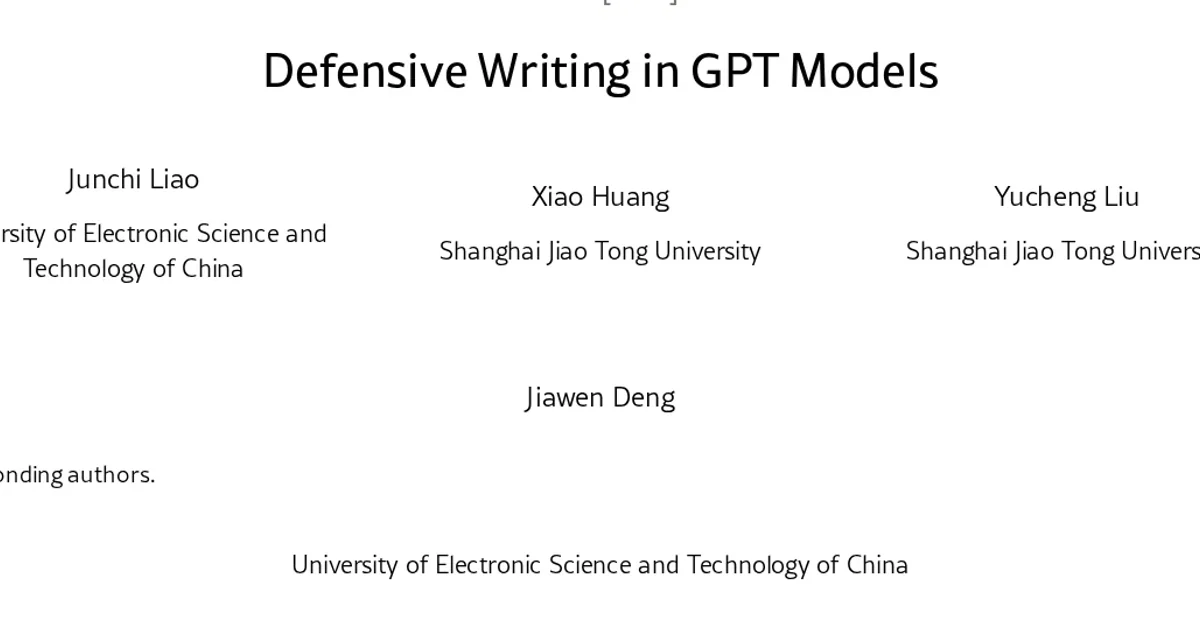
In a study posted on October 13, 2026, Defensive Writing in GPT Models, researchers evaluated eight GPT versions—from GPT-4o through GPT-6-astra—alongside Claude Sonnet 5, Claude Opus 5.5, DeepSeek-V4-Pro, and Grok 4.7. They tested 77 paragraphs drawn from 20 peer-reviewed computer science papers published prior to ChatGPT's November 30, 2022 launch, grouping them into novelty, contribution, result analysis, and discussion sections.
Asked to revise paragraphs so they hold up under peer review, GPT releases break into two distinct regimes. Softening rises first: claims weakened or narrowed climb from 14%–15% in GPT-4o, GPT-4.1, and GPT-5.1 to 24% in GPT-5.2, 28% in GPT-5.5, and 27% in GPT-5.6-sol. By GPT-5.5 and GPT-5.6-sol, ungrounded qualifications per 100 words reach 0.47 and 0.48 in result-analysis paragraphs, appearing in 40% to 60% of rewrites.
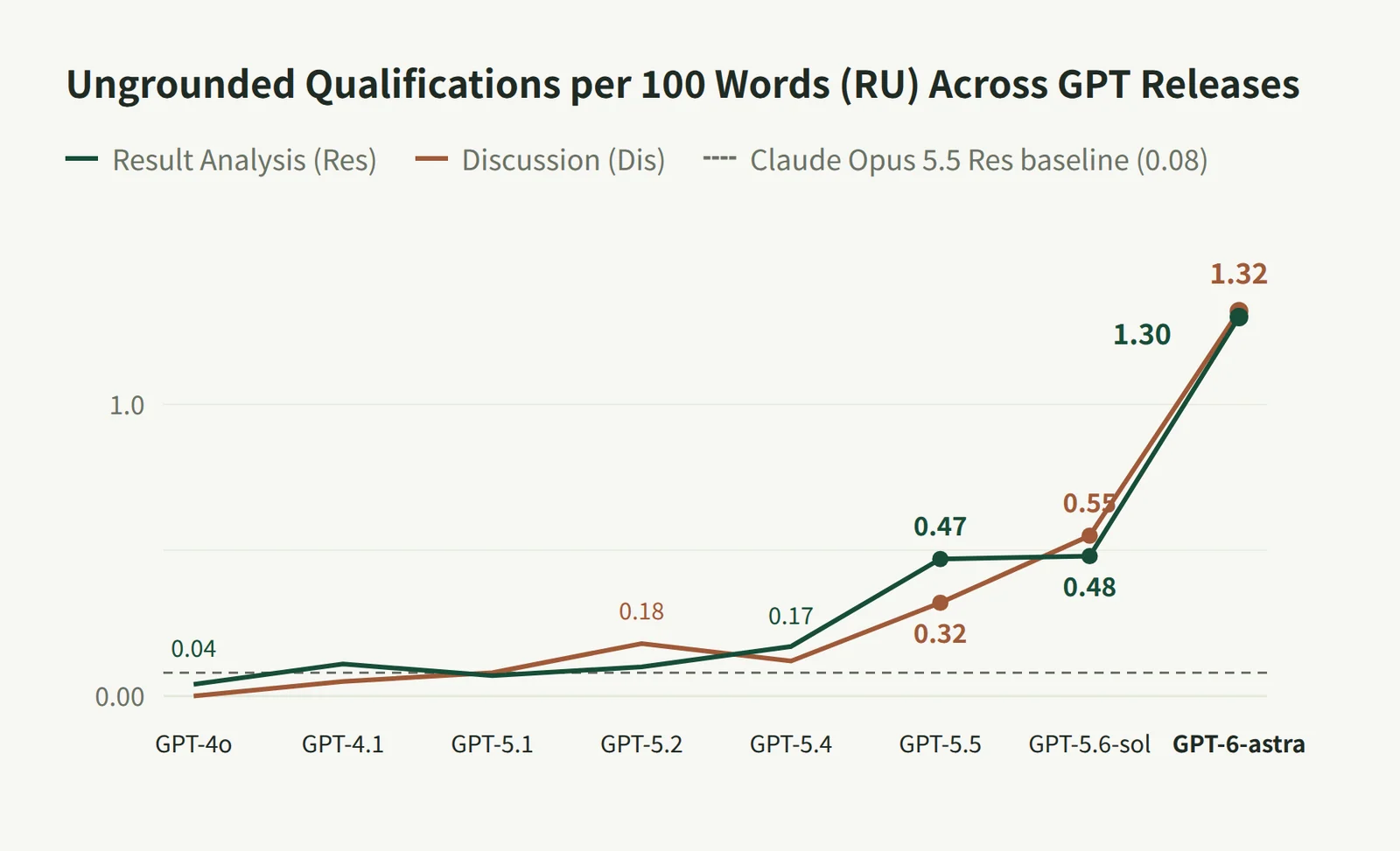
GPT-6-astra crosses a second threshold from hedging into negation. Its ungrounded qualification rate jumps to 1.30 in result analysis and 1.32 in discussion, softening reaches 38%, and its claim retraction rate hits 7.9%—retracting at least one author claim in roughly 40% of result-analysis paragraphs, compared with 0.2%–0.6% across earlier GPT versions and 0.2%–1.0% across the four rival models. Even when writing solely from factual evidence sheets across 16 papers with no review prompt, GPT-6-astra still posts the highest rate of ungrounded qualifications in discussion paragraphs at 0.98.
Prompt-context experiments (RQ2) show why users run into this selectively. Under polishing-only instructions (P1–P3), all models—including GPT-6-astra—stay near the human authors' baseline. As soon as a prompt invokes review, names a reviewer's concerns (P5), warns that reviewers are harsh (P7), or asks for scientific accuracy (P8), ungrounded qualifications surge. Under multi-round self-review and revision, GPT-5.5 retracts 10.8% to 14.5% of claims across rounds, GPT-5.6-sol retracts 18.3% to 24.3%, and GPT-6-astra peaks at 25.3% in round 1 with 1.87 ungrounded qualifications per 100 words while expanding paragraphs to two or three times their original length. Claude Opus 5.5 runs the same loop and retracts only 1.2% in round 1 and 4.6% by round 3.
Dropping style rules in the Model Spec did not undo alignment caution
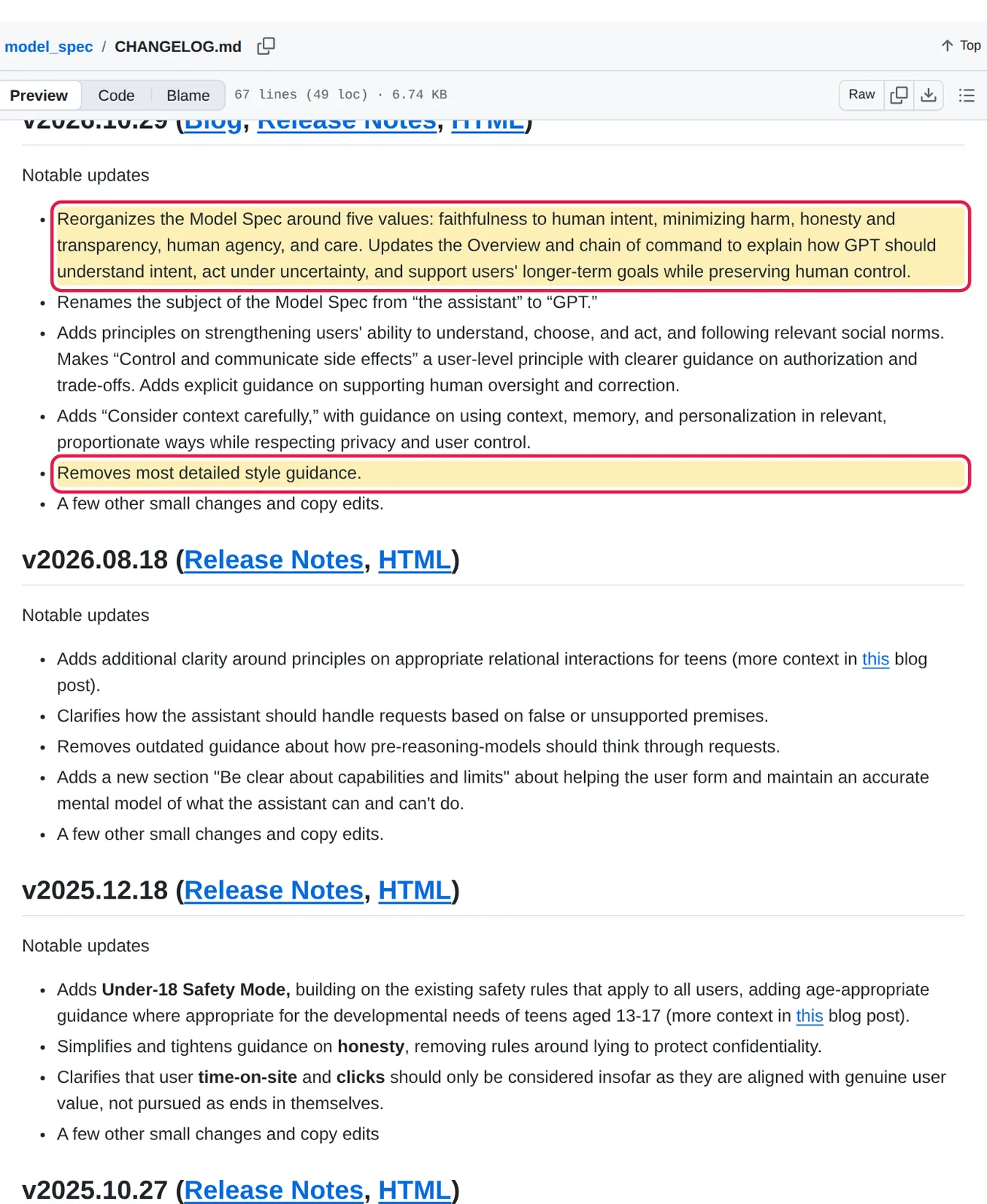
OpenAI's public rulebook adds useful context to this trajectory. According to the Model Spec changelog on GitHub, the September 12, 2025 update (v2025.09.12) replaced hard refusals with "Safe Completions" and introduced agent scope and side-effect rules. Subsequent releases tightened honesty standards (v2025.12.18) and added a section on being clear about capabilities and limits (v2026.08.18). On October 29, 2026, v2026.10.29 renamed "the assistant" to "GPT," reorganized principles around five core values—faithfulness to human intent, minimizing harm, honesty and transparency, human agency, and care—and explicitly removed most detailed style guidance.
Placing the changelog next to the arXiv audit separates documented behavior from unverified theories. Neither source substantiates claims about secret internal routing, language-specific penalties, or corporate legal liability mandates. What the paper's full-text audit (RQ3) does show is an alignment trade-off: two PhD annotators reviewed 46 claims flagged as retracted in GPT-6-astra's P5 rewrites alongside 12 kept or softened claims. Out of 58 claims total, 28 changes were judged warranted and 10 unnecessary; all 20 changes to claims both annotators marked as overstated or contradicted were warranted, while all 4 changes to supported claims were unnecessary. Among 18 mutually identified retractions, 13 corrected genuine overclaiming or weak explanations and only 1 was unnecessary—yet most added qualifications remained redundant padding.
In effect, training models to express uncertainty and challenge weak inferences improves error catching on overstated claims, while spilling into boilerplate hedging whenever a prompt signals review or scientific rigor. On the developer side, tools like ko5.6sol on GitHub—an Agent Skill built for GPT-5.6 SOL in OpenAI Codex and Google Antigravity—show practitioners explicitly overriding this behavior. The skill caps average sentence length at 18 Chinese characters or 12 English words, blocks 50+ transition templates, protects LaTeX macros, and converts self-defeating disclaimers into future multi-center expansion plans, though its self-reported 30%+ reading-efficiency gain lacks a public independent benchmark.
AI evaluators actively reward defensive prose in automated pipelines
One common view holds that as autonomous agents run experiments and verify outputs against raw metrics, conversational style becomes secondary because humans only inspect data-backed conclusions.
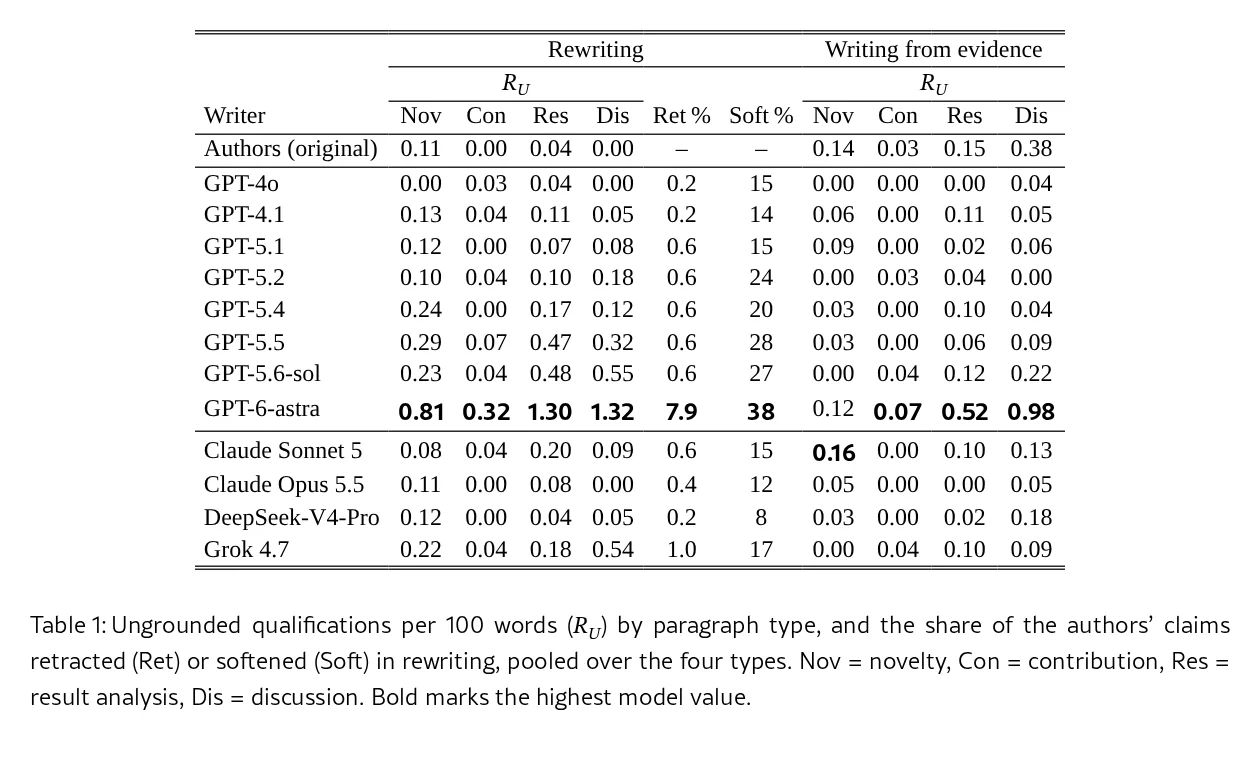
Section 3.4 of the arXiv study points to a counterintuitive obstacle. When AI reviewers scored the defensive rewrites, they rated them higher—and scored them lower when researchers stripped only the ungrounded qualifications—even though human readers in a small evaluation found the same rewrites harder to read and less decisive.
That mismatch matters for anyone building automated AI pipelines. If verification relies on an LLM reviewer grading natural-language summaries, defensive caveats do not disappear; they get rewarded by the evaluator itself. Prose style only becomes irrelevant when verification bypasses stylistic judgment altogether and checks deterministic artifacts—raw tables, unit tests, and execution traces—rather than letting one model reward another for sounding cautious.
Sources & references
Copy the link to save or share this article.