
Humata
ProductivitySearch, summarize and compare uploaded documents with source-linked answers. Humata adds team-oriented document access and page-based plans for ongoing knowledge work.
Questions across filesCited passages
A free self-hosted RAG platform that parses documents, makes retrieval inspectable and connects source-backed information to AI chat and applications.
RAGFlow is designed for workflows where finding the right material inside documents matters as much as generating an answer. It parses files into searchable pieces, lets you inspect those pieces and connects relevant results to a language model. This makes it useful for manuals, reports, slides and other collections whose structure can be lost in a simple copy-and-paste chat.
Its role is retrieval-augmented generation, often shortened to RAG. The model receives selected document context when responding; it is not permanently retrained on every uploaded file. Source references improve traceability but do not guarantee correctness. An answer can still omit a condition or misread a table, so the underlying passage remains important.
Technical documentation search
Report comparison
Internal procedure lookup
Document ingestion diagnosis
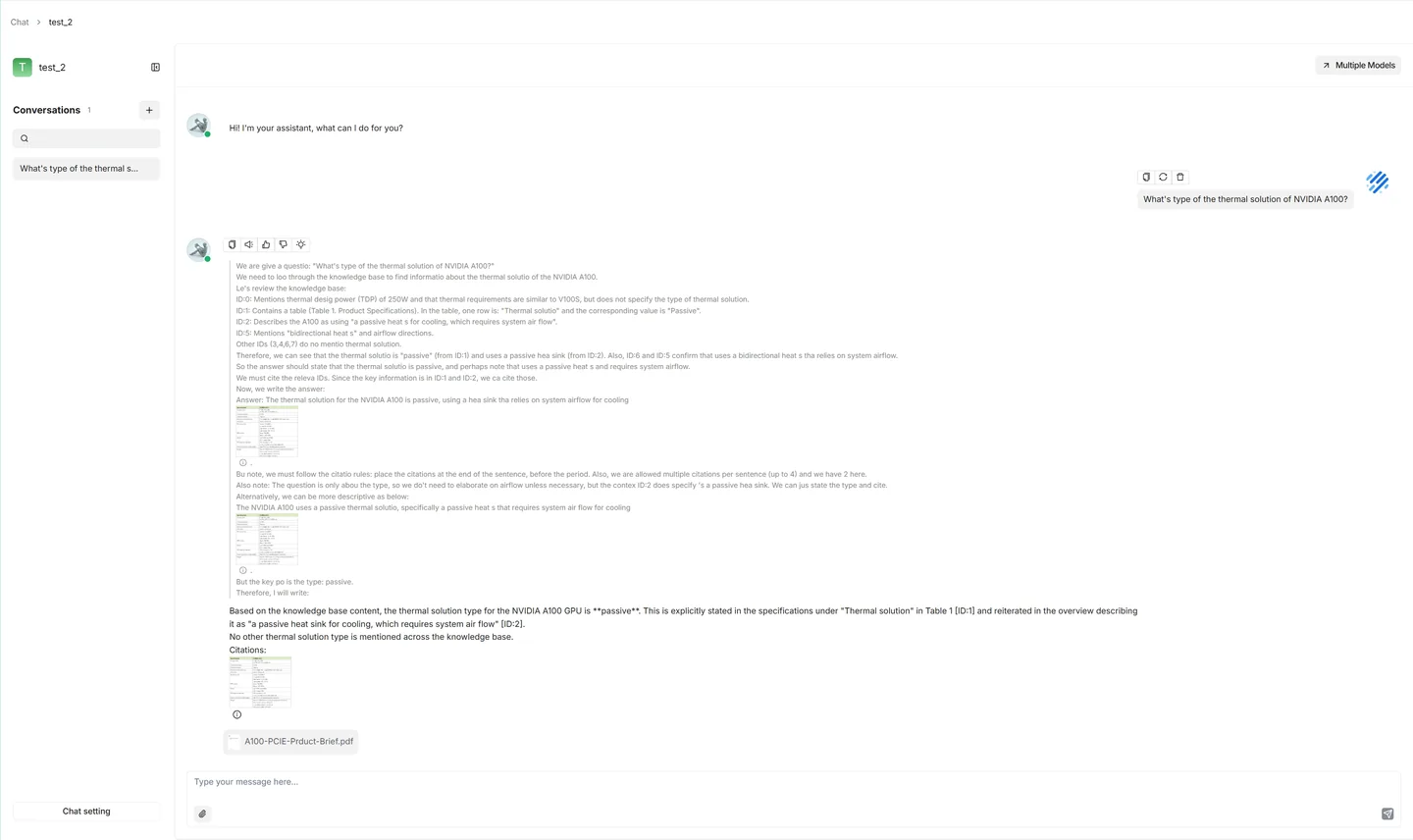
Official product image. Click to inspect the details.
Deploy a compatible release
Select model roles and create a dataset
Parse and inspect one representative file
Create a bounded chat assistant
Example prompt or task: Using the selected manual, state the supported operating conditions and the exceptions. Cite the corresponding passage for each point. If the retrieved material does not answer the question, say the answer was not found in this dataset.
This editorial task checks retrieval boundaries. A missing-answer setting and careful source review are more useful than assuming the presence of citations makes hallucinations impossible.
The platform is free to deploy under its license. Parsing, storage and model inference still use resources.
RAGFlow’s repository uses Apache-2.0, providing a free self-hosted route. The server, database or document engine, stored files, parsing jobs and model requests still need resources. A local inference service can avoid external API billing, but requires additional capacity.
The current quick-start guide recommends a starting point of four x86-64 CPU cores, 16 GB RAM and 50 GB free storage. Treat that as an application starting point, not a guarantee for every workload. Local models, large document collections and concurrency can require substantially more.
The Apache-2.0 project can be self-hosted without a software subscription. Infrastructure and model services are separate costs.
No. The normal workflow retrieves relevant chunks and places them in the model’s context. That is different from permanently changing its weights.
Inspect parsing, chunking, selected datasets and retrieval results. A citation label only identifies a source; it does not prove that source supports the claim.
The guide restricts changing the embedding model after parsing in a dataset. Different embedding spaces are not interchangeable; plan migration or re-indexing carefully.
It supports local model-serving routes as well as external providers. Local operation still needs compatible models and adequate hardware.
Configure an explicit missing-answer response. Leaving the assistant free to improvise can produce claims beyond the dataset.
Yes, the project documents an HTTP API. Configure access for the intended application and validate how it handles source references and errors.
Explore platforms, inputs and outputs, licensing, and access requirements.
The current repository quick-start describes a Go deployment and a supported Linux x86-64 native Docker target. Release instructions can change, so use matching documentation and images instead of mixing a recent development guide with an older production database.
Documents, tabular files, images and slides are supported inputs; parsing quality varies with their structure. The guide warns that an embedding model cannot simply be switched after a dataset has been parsed, because its vectors must remain comparable. Plan a rebuild or a separate dataset when changing that foundation.
Self-hosting controls where the application and documents are stored, but external embedding or chat providers can receive material required for their work. Inspect the full pipeline, including parsing services and optional tools, before treating a deployment as fully local.
Retain original documents and back up both configuration and stored knowledge. The software license does not grant permission to redistribute a confidential document collection, and an API integration should not accidentally make a private dataset public.
Reviewed October 3, 2026. Product facts come from the official sources below. Suggested projects, prompts and review methods are FindGoodAI editorial guidance, not measured performance results.
Loading experiences…
Saved tools are private. Approved comments are public; edits return to moderation. Comment counts include approved comments and replies. Each person has one rating. New ratings are automatically approved; withdrawn, unapproved or invalid ratings do not count. Share real experiences and avoid spam, private information or personal attacks.
For moderation appeals or data requests: support@findgoodai.com
Bring a real task and see how it fits the way you work.
User experiences