Weaviate
CodingWeaviate is an open-source AI vector database featuring hybrid search, built-in vectorization, multi-tenancy and Query Agent, with an always-free $0/month cloud tier (10 GB disk).
Qdrant is an open-source Rust vector database for RAG, hybrid dense-sparse search and AI agent memory, with a forever-free 1 GB cloud cluster tier.
Qdrant is an open-source vector search engine and database written in Rust under the Apache-2.0 license, engineered for high-throughput retrieval in RAG pipelines, semantic search, recommendation systems and AI agent memory. Unlike thin wrappers around approximate nearest neighbor libraries, Qdrant pairs a custom Gridstore storage engine and SIMD-accelerated HNSW indexing with one-stage payload filtering—evaluating JSON metadata constraints directly during graph traversal so recall stays high without pre- or post-filtering penalties.
Editorial suggestion: Qdrant is an ideal default when your retrieval requires complex metadata filters, hybrid dense-plus-sparse scoring (such as BM25, SPLADE++ or miniCOIL) or multi-vector late interaction models like ColBERT. You can prototype for free on Docker, Qdrant Edge in-process, or Qdrant Cloud’s Free Tier, then scale to Standard clusters or Hybrid Cloud on your own Kubernetes.
Production RAG pipelines
Long-term AI agent memory
E-commerce & multimodal search
Offline & edge AI search
Official product image. Click to inspect the details.


Official examples and public-page captures; these are not results from a paid-feature trial.
Attach arbitrary JSON payloads to points and filter by nested fields, full-text terms or geo coordinates directly during HNSW graph traversal.
Combine dense semantic embeddings with sparse vectors (BM25, SPLADE++, miniCOIL) and multi-vector late interaction like ColBERT or MMR in a single query.
Apply binary, scalar or asymmetric quantization to cut RAM consumption by up to 64x while keeping vectors searchable in real time.
Deploy self-hosted OSS, Managed Cloud on AWS/GCP/Azure, Kubernetes Hybrid Cloud, air-gapped Private Cloud, or embedded Qdrant Edge with official MCP and FastEmbed support.
Pick local Docker or Cloud Free Tier
Install client SDK
Create collection & payload indexes
Upsert vectors & run hybrid queries
Run docker run -p 6333:6333 qdrant/qdrant locally, or create a forever-free cluster on cloud.qdrant.io.
Install qdrant-client in Python or @qdrant/js-client-rest in TypeScript/JavaScript (Go, Rust, Java and .NET also supported).
Define vector size and distance metric, then create payload indexes upfront for any fields used in filters.
Upsert points with JSON payloads, test queries in the built-in Web UI, and enable quantization before scaling.
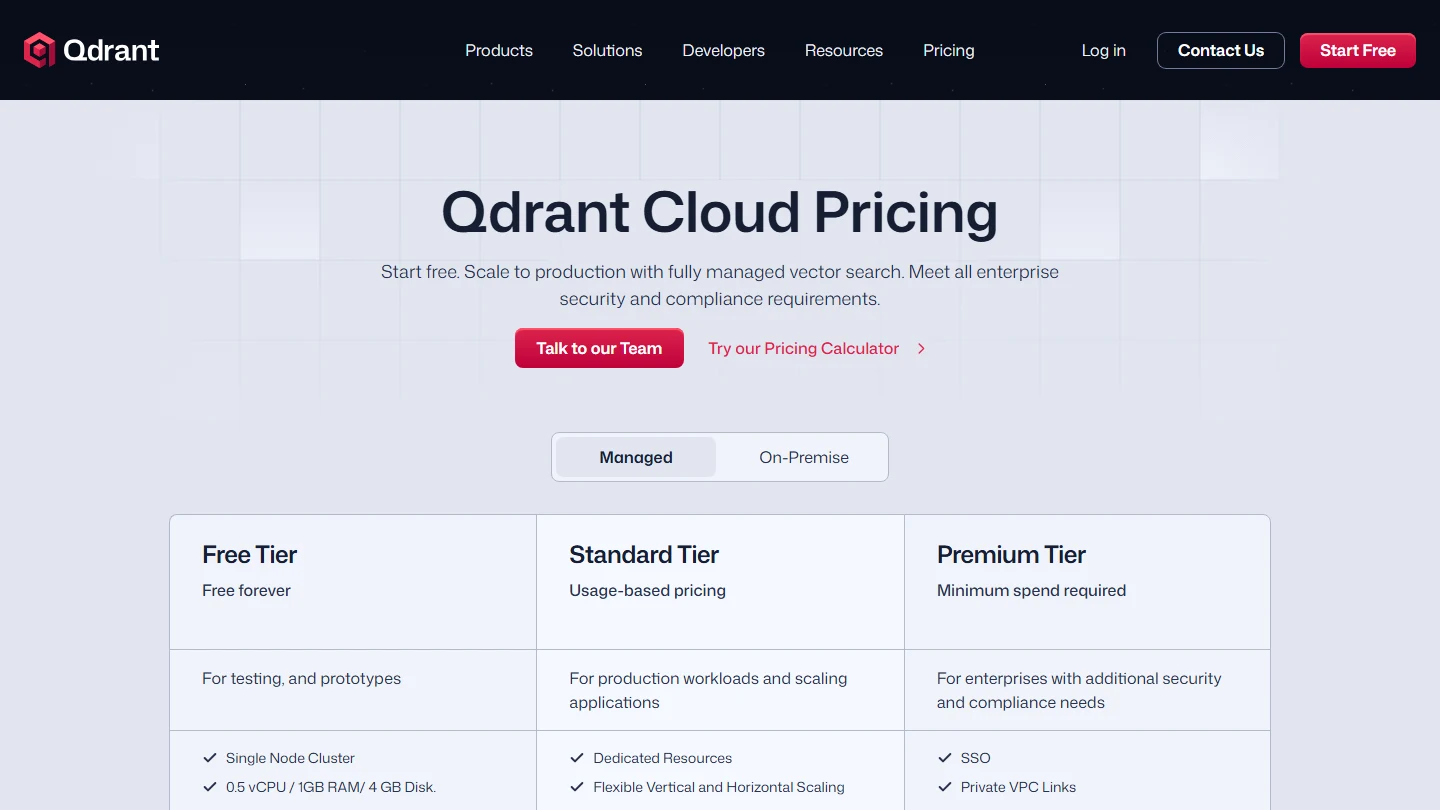
Qdrant’s open-source engine is Apache-2.0 licensed and free to self-host without node limits. Qdrant Managed Cloud offers a forever-free Free Tier (no credit card required for initial setup) providing a single-node cluster with 0.5 vCPU, 1 GB RAM and 4 GB disk storage, plus free Cloud Inference on selected embedding models.
Production workloads move to Standard Tier on AWS, GCP or Azure with hourly usage-based billing for vCPU, RAM, cluster disk, backup storage and paid inference tokens, backed by a 99.5% uptime SLA and 10×5 business-hours support. Using Qdrant’s official Cloud Pricing Calculator as a reference, a 3-node AWS us-east-1 cluster sized for 1 million 1536-dimensional vectors (1.5 vCPU, 12 GiB RAM, 48 GiB disk total, no quantization) estimates at $0.04668/hour per node ($0.14004/hour total, or ~$102.51/month excl. VAT). Premium Tier adds minimum spend commitments, Enterprise SSO, Private VPC Links, 99.9% Single-AZ / 99.95% Multi-AZ SLAs and 24×7 1-hour support; Hybrid Cloud and air-gapped Private Cloud are quoted on request.
Yes. The Apache-2.0 open-source server can be self-hosted in production at no software cost, while Qdrant Cloud offers a forever-free 1 GB RAM / 4 GB disk cluster for testing and small prototypes.
Free Tier has no high availability and caps at 1 GB RAM and 4 GB disk; when data grows beyond that, you can upgrade seamlessly to a Standard Tier dedicated cluster or enable quantization.
No. Qdrant recommends using a single shared collection with a user_id or tenant_id payload field and enabling tenant indexing to keep memory and shard overhead low.
Yes. Qdrant provides collection snapshots and official migration tooling to move data smoothly between self-hosted OSS, Hybrid Cloud and Qdrant Managed Cloud.
Each point can store multiple named vectors—such as dense semantic embeddings alongside sparse BM25, SPLADE++ or miniCOIL vectors—and fuse results using RRF or reranking in one query.
Yes. Because cloud providers do not shrink disks in place, Qdrant Cloud performs rolling node replacement one node at a time so vertical and horizontal scaling stay zero-downtime.
Explore platforms, inputs and outputs, licensing, and access requirements.
These tools and curated collections overlap with parts of the workflow; compare the specific task, export requirements and current plan rather than treating them as identical products.
Qdrant Cloud clusters ship with encryption at rest and in transit, default API key security, SOC 2 and HIPAA compliance options, and GDPR-aligned deployments. Self-hosted open-source instances start open without authentication enabled, so operators must configure API keys, TLS and read-only or JWT collection-scoped keys before exposing endpoints.
Loading experiences…
Bring a real task and see how it fits the way you work.
User experiences