JetBrains Junie
CodingJunie combines a coding agent with planning, model choice and JetBrains development workflows. Use the CLI, supported IDE integration or repository automation to work on scoped code changes.
Build knowledge assistants and repeatable AI workflows visually, then publish them as web apps or APIs. The community edition can run on your own infrastructure.
Dify is useful when a chat prompt has become a recurring business process. Instead of repeatedly pasting instructions, you can connect inputs, document retrieval, model calls and decision logic in a visual application. A published app gives colleagues a simpler interface while its builder retains control over the underlying flow. Dify does not supply unlimited free inference merely because the community software is free.
Start with a narrow application such as answering questions about one product manual or extracting a fixed set of fields from a short document. A small, explicit workflow is easier to inspect than an autonomous agent with many tools. Once the data path is reliable, extend it to more sources and tasks. The platform is most valuable when you need repeatability, access to source material and a way to inspect failed runs.
Product manual assistant
Structured intake
Editorial preparation
Internal process guide
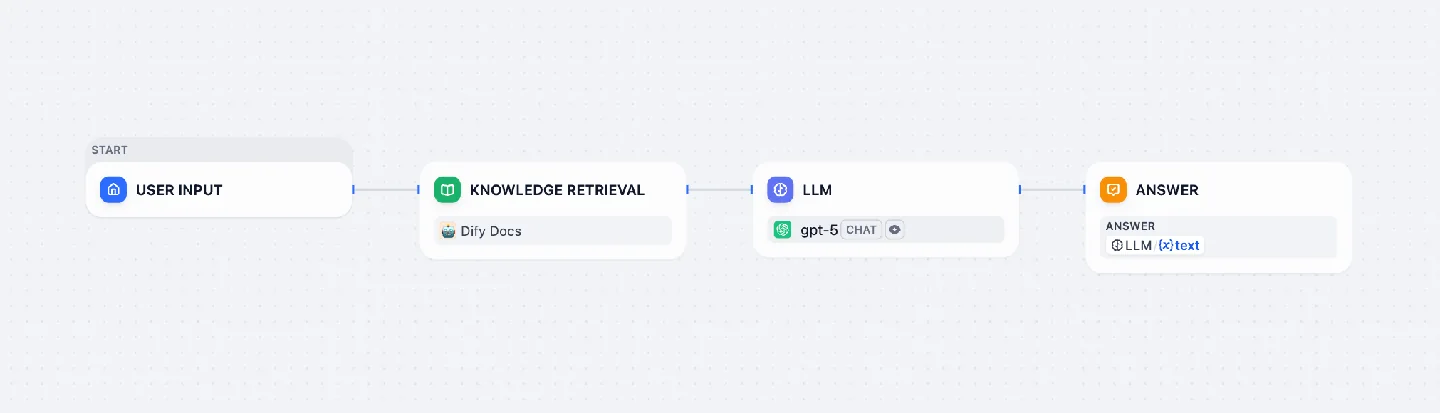
Official product image. Click to inspect the details.

Deploy the community edition
Connect a model and one source
Build the simplest working flow
Publish and inspect real use
Example prompt or task: Answer using only the retrieved product documentation. Return the relevant procedure, its prerequisites and the source section. If the retrieved text does not establish an answer, state what is missing and ask one clarifying question.
Use one answerable question, one ambiguous question and one outside the documents. This editorial check separates retrieval failure from a model inventing an answer after receiving insufficient evidence.
The free route here is the community deployment. Cloud plans and external model quotas have their own conditions.
The community self-hosted route is available without a recurring software subscription under the project license. Your server, storage, backups, embedding requests and model inference can still cost money. Running a local model moves inference onto your own hardware; it does not remove resource requirements.
Dify also offers hosted cloud plans. Do not treat a cloud trial credit allowance as a permanent free production budget. This listing qualifies Dify through the community deployment, so its free status does not depend on an unverified number of hosted messages or credits.
The community self-hosted software provides a free route. Infrastructure and model providers remain separate expenses; hosted cloud services have separate plans.
No. The Dify license is based on Apache-2.0 with additional conditions, including multi-tenant service and frontend branding provisions. Read the current license before redistribution or resale.
Use Workflow for a task that produces a result from defined inputs. Use Chatflow when users need a continuing conversation and answers across turns.
Check text extraction, chunking, selected knowledge bases, retrieval settings and whether retrieved results reach the model prompt. A different model cannot fix every missing-input problem.
Not automatically. The test interface uses temporary settings; configure the actual knowledge retrieval behavior used by the application.
The documented production logs concern actual use of published applications. Workflow and Chatflow editor previews are not equivalent to published end-user requests.
Not as a blanket free entitlement. Multi-tenant service and branding changes are subject to additional license conditions and may require authorization.
Explore platforms, inputs and outputs, licensing, and access requirements.
The Docker Compose guide lists a baseline of at least two CPU cores and 4 GiB of RAM for the application; platform-specific instructions can require more. This is not a claim that the same machine can run a large language model. Model serving, document indexing and concurrent users need their own capacity planning.
The builder runs in a browser after deployment. Applications accept the inputs defined by their flows and deliver chat answers, structured outputs or API responses. Original files, application configuration and database state are separate assets: retain the source documents and a deployment backup so a rebuilt container does not become a lost knowledge project.
Self-hosting gives you control over the application deployment, but a configured cloud model can still receive prompts and retrieved passages. Map the data path for embedding, chat and any external tool separately. Limit who can read stored documents and execution logs.
The current license permits uses subject to its conditions, including restrictions concerning multi-tenant operation and modifying frontend branding. Keep software licensing, model terms and rights to knowledge-base documents separate; owning the server does not automatically settle all three.
Reviewed October 3, 2026. Product facts come from the official sources below. Suggested projects, prompts and review methods are FindGoodAI editorial guidance, not measured performance results.
Loading experiences…
Saved tools are private. Approved comments are public; edits return to moderation. Comment counts include approved comments and replies. Each person has one rating. New ratings are automatically approved; withdrawn, unapproved or invalid ratings do not count. Share real experiences and avoid spam, private information or personal attacks.
For moderation appeals or data requests: support@findgoodai.com
Bring a real task and see how it fits the way you work.
User experiences