
Humata
ProductivitySearch, summarize and compare uploaded documents with source-linked answers. Humata adds team-oriented document access and page-based plans for ongoing knowledge work.
Questions across filesCited passages
A free developer toolkit for reading text from images and PDFs, parsing document layouts and producing structured data for search, knowledge bases and automation.
PaddleOCR helps developers move from scanned pages and image-based text to machine-readable information. It offers text recognition and broader document parsing, so a project can start with a small OCR task or build a pipeline that preserves layout and tables. It is a software toolkit to integrate, not simply a website where every user receives an identical upload allowance.
The useful choice is the level of structure your application needs. A searchable text archive may need recognized lines and locations; a knowledge base may need reading order and paragraphs; a table workflow needs cells associated with the right row and column. Decide on that output before selecting a model, because readable words alone do not guarantee a usable document conversion.
Build a searchable scan collection
Prepare knowledge-base documents
Collect table data
Read multilingual image text
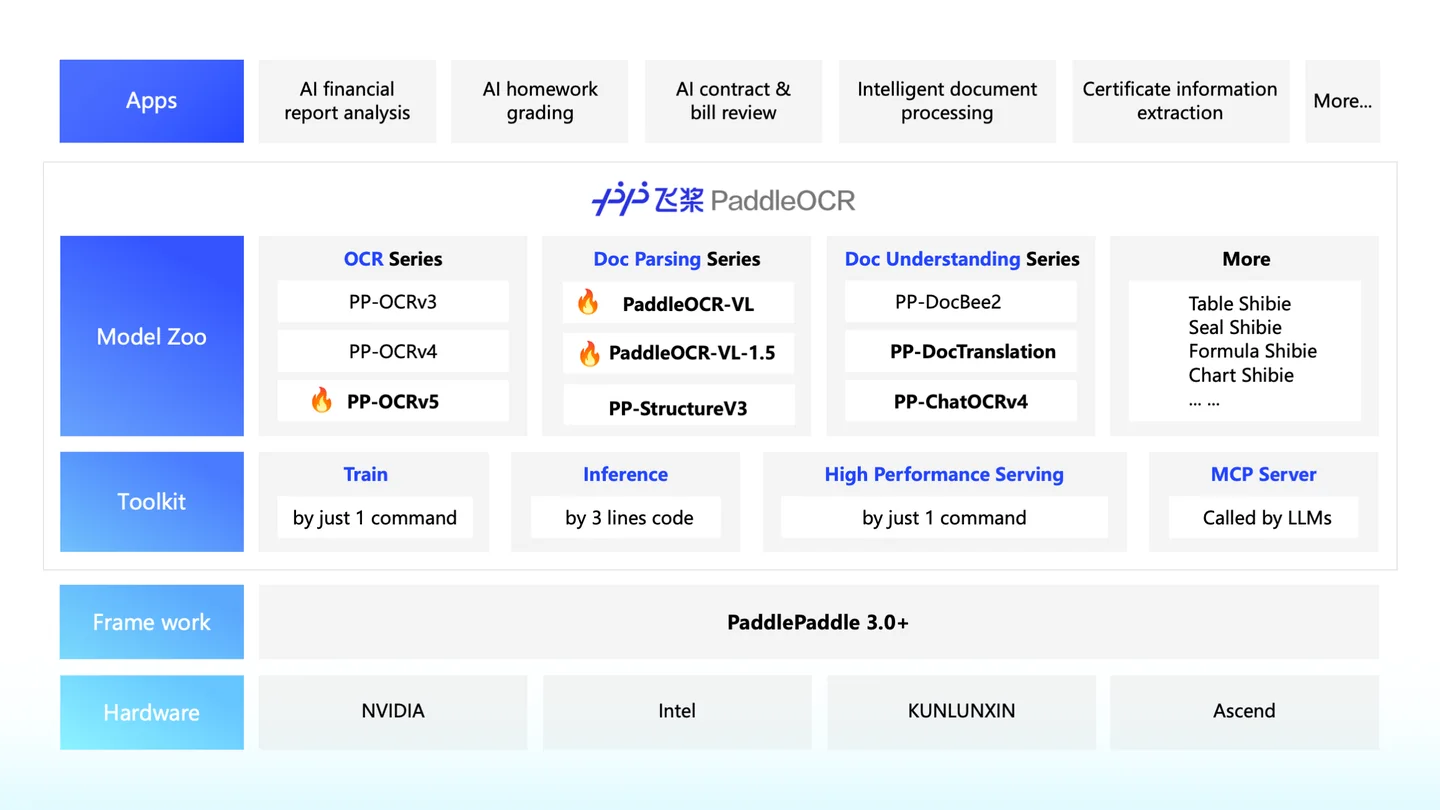
Official product image. Click to inspect the details.
Define the expected output
Install a matching environment
Run a small local sample
Review before scaling
Example prompt or task: Take a two-column PDF page containing a table. Extract structured data, compare the reading order with the original, and verify every table heading and unit before adding it to a searchable knowledge base.
This is a suggested processing task, not a claim of a built-in conversational prompt interface. The right command and parameters depend on the installed pipeline and release.
The free route is local software. Hosted API quotas and optional language-model costs follow their own service terms.
The Apache-2.0 toolkit provides a free local route: you supply the machine and run the supported software and models. There is no required per-page cloud purchase for that route. Processing time, model storage, deployment maintenance and any hardware rental still belong in a real project budget.
Hosted APIs and optional language-model integrations are separate services. An OCR extraction pipeline also does not automatically include unlimited paid model calls for summarization or semantic information extraction.
Its Apache-2.0 local toolkit is free under the license. Compute, storage, optional hosted APIs and external model services are separate.
It is primarily a developer toolkit with Python and command-line workflows. A team can build an application around it, but the toolkit itself is not a complete hosted document-chat product.
No. Language coverage belongs to a particular model or pipeline. Check the selected model and test mixed-language examples before processing a whole collection.
Document parsing pipelines support table structure, but complex borders, merged cells and poor scans can produce errors. Review the output against the page.
No. Confidence is a model signal, not independent verification. Important names, identifiers, dates and numeric values should be checked in the source.
Only after checking version compatibility. The project warns of interface changes between major versions, so current documentation and old snippets should not be assumed interchangeable.
Basic local OCR does not inherently require a paid cloud model. Additional semantic extraction or chat workflows may introduce other components and their costs.
Explore platforms, inputs and outputs, licensing, and access requirements.
Installation involves both the inference engine and the appropriate PaddleOCR package options. The quick start describes supported engine choices, but not every model or feature has identical behavior across them. Match the selected pipeline, backend, package version and hardware instead of copying an old installation command into a new environment.
Input support includes document images and PDFs through the documented pipelines. Very large pages, skewed scans, compressed text and complex tables deserve their own sample checks. For unattended processing, give each input a stable identifier and record failures, so a partial run does not silently appear to be a complete archive.
A local setup can keep document processing under your control, while model downloads and any chosen remote endpoints remain separate network activities. Review where files and results are stored, particularly when adding a hosted service to the pipeline.
The code license does not grant rights to process or redistribute every document. Use appropriate source material, retain the original for verification, and manage extracted text with the same care as the scanned file because it can contain the same sensitive information.
Reviewed October 3, 2026. Product facts come from the official sources below. Suggested projects, prompts and review methods are FindGoodAI editorial guidance, not measured performance results.
Loading experiences…
Saved tools are private. Approved comments are public; edits return to moderation. Comment counts include approved comments and replies. Each person has one rating. New ratings are automatically approved; withdrawn, unapproved or invalid ratings do not count. Share real experiences and avoid spam, private information or personal attacks.
For moderation appeals or data requests: support@findgoodai.com
Bring a real task and see how it fits the way you work.
User experiences