Tibo (@thsottiaux) announced on X that all paid ChatGPT accounts would receive a global reset. He also said GPT-6.1 Sol had returned to expected speeds after a large load spike during its first two days. This illustrated report explains the announcement and converts its time for readers in the United States and China.
What was announced?
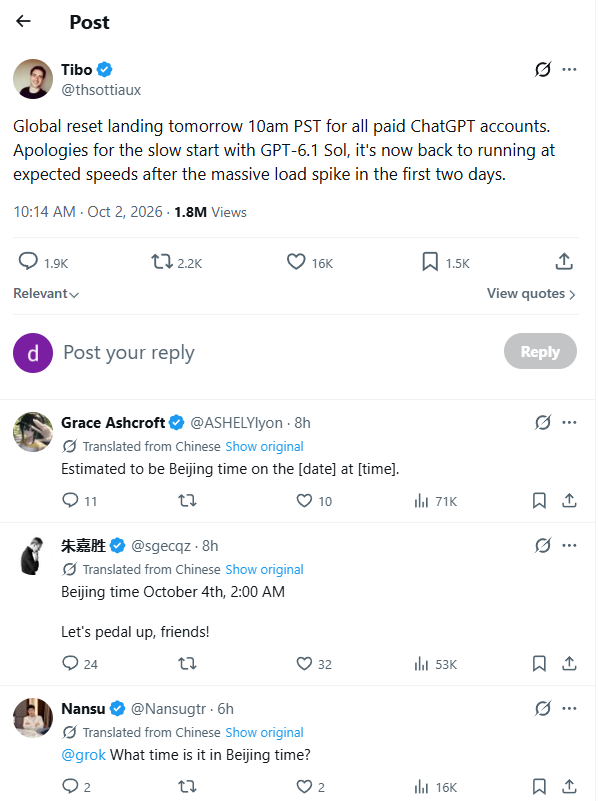
Global reset landing tomorrow 10am PST for all paid ChatGPT accounts.
This is an announcement of an upcoming reset, rather than confirmation that it has already happened. The wording does not establish that every model and every usage window will reset in the same way. It does not specify API credits, an extra banked reset, or a permanent increase in allowances.
Which date does tomorrow mean?
The supplied screenshot displays October 2, 2026 at 10:14 AM. Decoding the timestamp embedded in the linked X post ID gives October 2 at 02:14 UTC: October 1 at 7:14 PM in Los Angeles, October 1 at 10:14 PM in New York, and October 2 at 10:14 AM in Beijing. This calculation agrees with the screenshot and a third-party record. We could not directly load the full X post during this check; the supplied screenshot is the basis for the reported wording.
If tomorrow refers to the author’s US Pacific calendar date, the intended US date is October 2. A screenshot showing October 2 in China does not make the US date October 3. The reply suggesting October 4 at 2am Beijing is not an author confirmation.
US time zones and Beijing time
The US has several time zones. All dates below are in 2026. Major US locations that observe daylight saving time are still on daylight time on October 2.
| Location | If intended as 10am local Pacific (PDT) | If literal 10am PST (UTC−8) |
|---|---|---|
| Los Angeles / San Francisco (PDT, UTC−7) | October 2, 10:00 AM | October 2, 11:00 AM |
| Denver (MDT, UTC−6) | October 2, 11:00 AM | October 2, 12:00 PM |
| Chicago (CDT, UTC−5) | October 2, 12:00 PM | October 2, 1:00 PM |
| New York (EDT, UTC−4) | October 2, 1:00 PM | October 2, 2:00 PM |
| UTC | October 2, 17:00 | October 2, 18:00 |
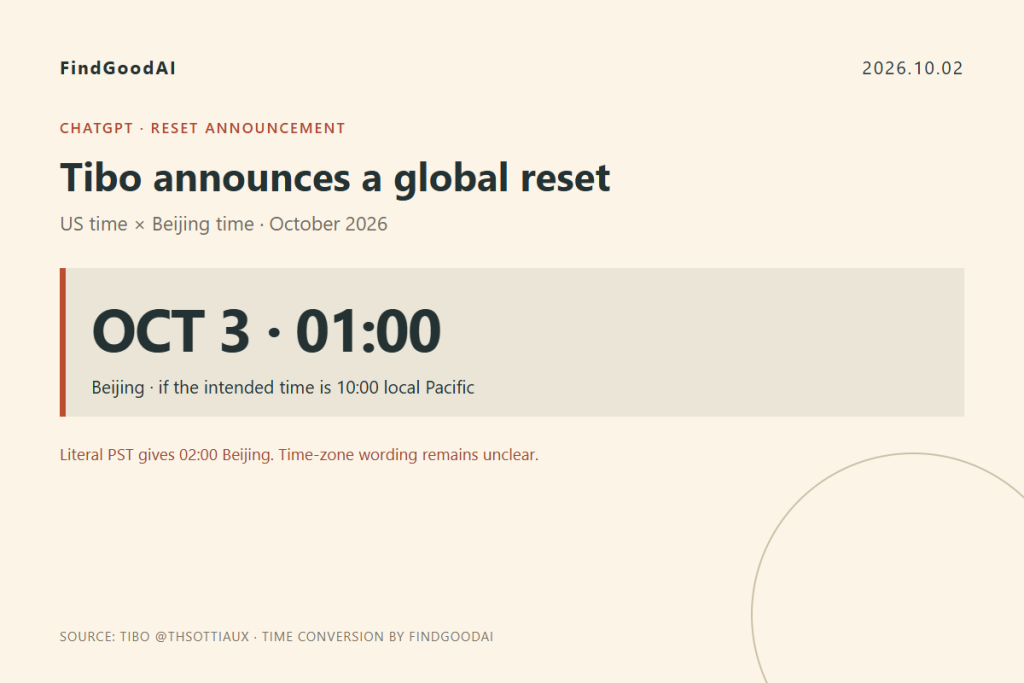
| Beijing / Shanghai (UTC+8) | October 3, 01:00 | October 3, 02:00 |
Why PST and PDT differ by an hour
Pacific Standard Time is UTC−8; Pacific Daylight Time is UTC−7. NIST lists US daylight saving time in 2026 as running from March 8 to November 1. Los Angeles therefore uses PDT on October 2. The post explicitly says PST: the author might mean Pacific time colloquially, or might intend the fixed UTC−8 offset. Without clarification, neither interpretation should be presented as a confirmed event time.
Adding 15 hours to 10am PDT gives 1am the following day in Beijing. Adding 16 hours to 10am PST gives 2am the following day. Readers in China can check account status around October 3, 1–2am. This is a checking window covering two interpretations, not an officially promised delivery window.
What to check when the time arrives
Look at the usage panel in the ChatGPT, Codex, or related client you use, and compare remaining allowance and the next recovery time before and after the event. Coverage of particular models, weekly limits, and rollout timing should be established from account state or subsequent clarification. A speed recovery and an allowance reset are separate claims: the former is a reported performance update, while the latter remains an announcement at publication.
Images and sources
- Tibo’s X post: reported wording is taken from the user-supplied screenshot included here.
- NIST: daylight saving time rules for 2026.
- Third-party timestamp record, used for cross-checking rather than official confirmation.
Prepared October 2, 2026. Actual reset completion has not been verified. The time card was created by FindGoodAI; the X screenshot was supplied by the user.
Sources & references
Copy the link to save or share this article.