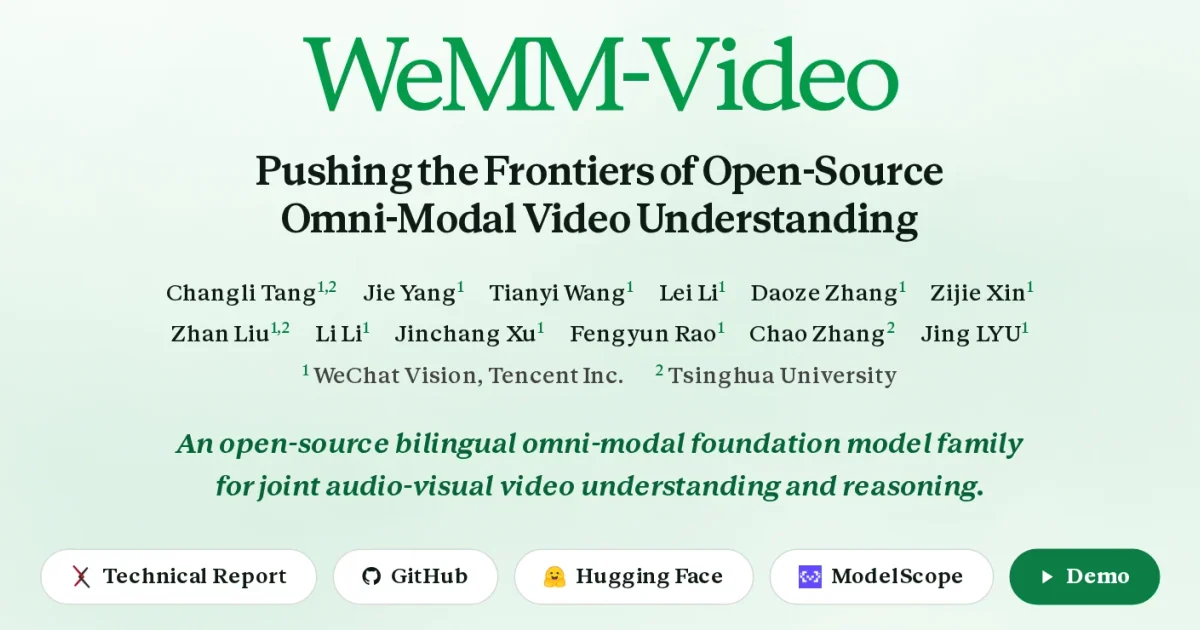
Tencent's WeChat AI account has open-sourced WeMM-Video, following the November 19 submission of its technical report arXiv:2611.26409 and public weights. While most open omni-modal releases over the past year aimed to build full-duplex voice assistants, WeChat Vision made a narrower bet: drop speech generation entirely and concentrate on understanding real-world videos with their original soundtracks. Before today's public announcement, the model family was already running in production across WeChat live-stream highlights, video e-commerce, short-drama analysis, and WeChat Channels' Ask Xiaowei search assistant.
Why Frame-Plus-Transcript Pipelines Fail Before Reasoning Starts
Critics often blame video-model blind spots on frame sampling, yet WeMM-Video also samples video into frames—by default at 2.0 frames per second. What breaks conventional pipelines is how they treat the soundtrack. Many systems discard audio completely or run an automatic speech recognition pass and paste plain text transcripts next to sampled images. As WeChat AI points out, that split collapses in short dramas when the camera holds on Character A smirking while Character B delivers a twist off-screen and a door slams, or in livestream shopping when a host lifts a kettle, picks up a cup, and announces a two-for-30-yuan discount. Plain transcripts strip out tone, music cues, speaker identity, and frame-level timing.
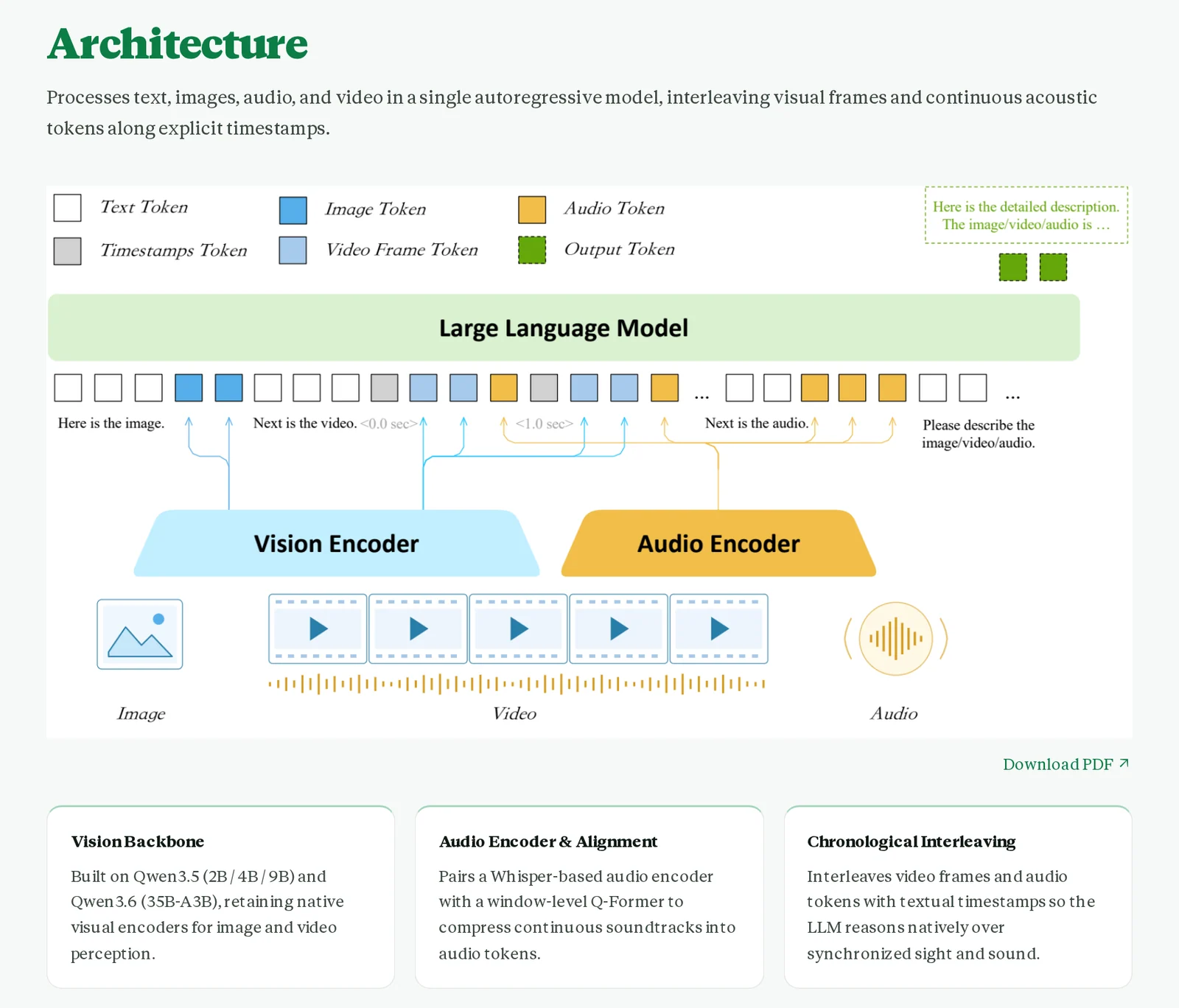
Instead of training a new vision backbone from scratch, WeMM-Video grafts continuous acoustic perception onto existing Qwen models. The 2B, 4B, and 9B dense checkpoints build on Qwen3.5, while the 35B-A3B flagship builds on Qwen3.6-35B-A3B, preserving their native visual encoders and projectors. On the audio side, WeMM-Video initializes from Qwen2.5-Omni, pairing a Whisper-based encoder (sampling at 16,000 Hz in 30-second chunks) with a 0.1-second window-level Q-Former that emits 10 audio tokens per second. Frame tokens and audio tokens are interleaved chronologically with explicit text timestamps before entering the language model, letting sight and sound share one timeline.
Dropping Speech Output to Fund a 45.4% Audio-Visual Corpus
Comparing WeMM-Video with Alibaba's Qwen3-Omni-30B-A3B-Instruct clarifies why Tencent trimmed the output side. Qwen3-Omni uses a Thinker-Talker design to stream natural speech alongside text; teams that only need text analysis have to invoke model.disable_talker() to free roughly 10GB of GPU memory. WeChat's production workloads—short-drama indexing, live-commerce compliance, and Channels Q&A—do not need synthesized voice. They need speaker attribution, temporal grounding, and low hallucination rates.
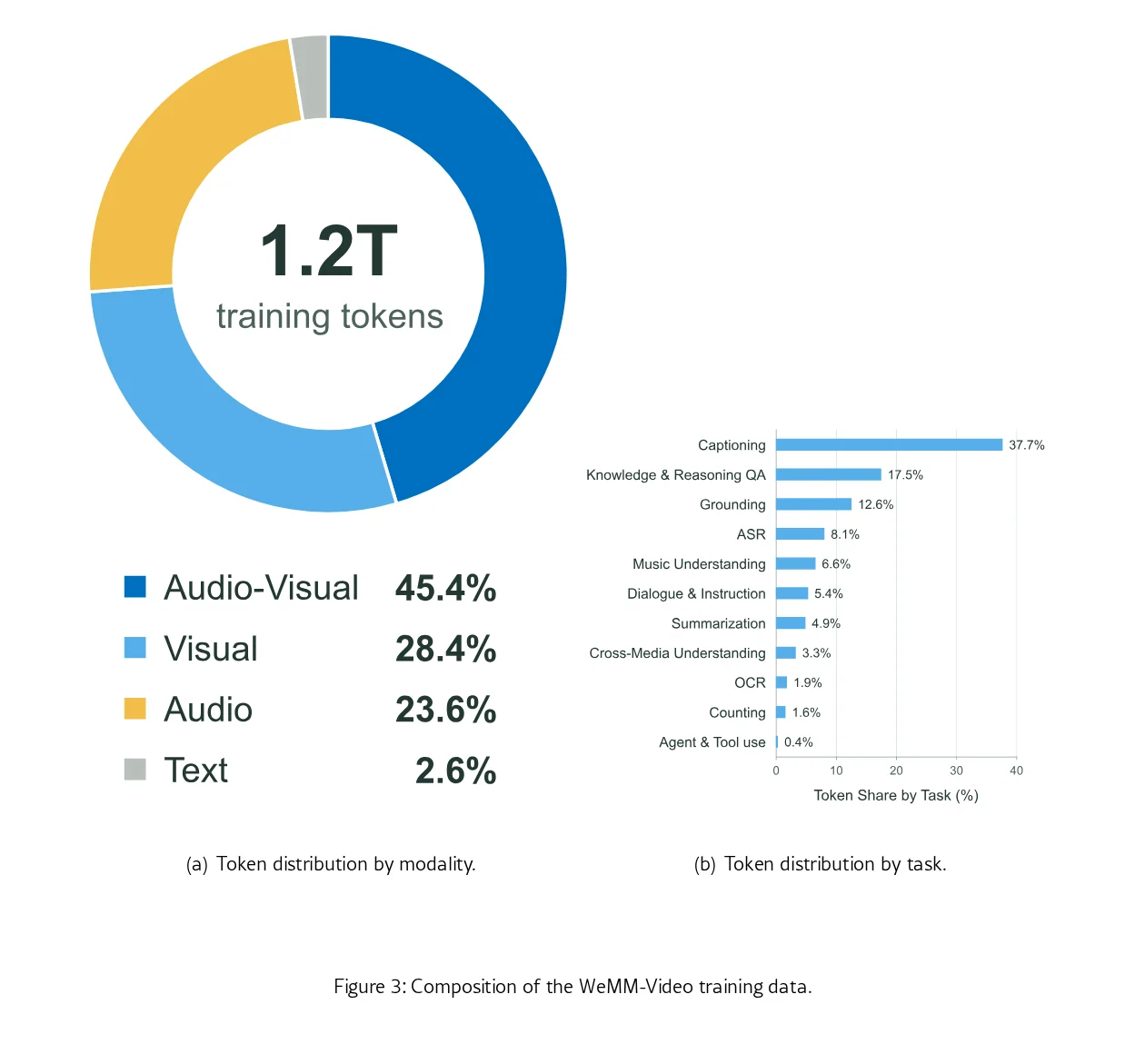
The data mix reported on the project page and in the paper reflects those production priorities. Across roughly 1.2 trillion training tokens, joint audio-visual data makes up the largest single share at 45.4%, ahead of visual-only (28.4%), audio-only (23.6%), and text (2.6%). Captioning accounts for 37.7% of all tokens and is split into two distinct tracks: action-dense silent clips (sports, gaming, dance) and native audio-visual media (films, short dramas, interviews, livestream commerce), backed by automated quality scoring, semantic deduplication, and toxicity filtering. The team also built cross-media splits for pairwise video comparison, soundtrack matching, and product-to-ad consistency checks. Training runs through three progressive pre-training stages—acoustic alignment, omni-modal injection with the visual encoder kept frozen, and long-context scaling—followed by multi-teacher distillation, offline anti-repetition MrDPO over LoRA adapters to curb endless decoding loops, and specialist reinforcement learning unifying Instruct and Thinking modes inside one checkpoint.
Closing In on Gemini-3.0-Flash—at a Measurable Cost on Silent Video
Across more than 120 benchmarks in the technical report, WeMM-Video-35B-A3B sets a clear new ceiling for open-source audio-visual models. On 17 general audio-visual benchmarks, Thinking mode beats proprietary Seed2.0-Mini-0428 and Qwen3.5-Omni-Flash on 16 tests—reaching 86.4 on Video-MME with audio (versus 83.6 and 79.3), 83.4 on Daily-Omni (slightly ahead of Gemini-3.0-Flash at 82.4), and 69.4 on SciVideoBench (ahead of Seed2.0-Mini-0428 at 60.1). Switching from Instruct to Thinking mode delivers roughly a 7% average relative gain across 33 public audio-visual benchmarks, pushing SciVideoBench from 57.8 to 69.4 and Video-MME-v2 with audio from 47.5 to 54.9. In the open-source tier, even the 9B and 4B Thinking models beat the larger Qwen3-Omni-30B-A3B-Instruct and MiniCPM-o-4.5-9B across most general audio-visual benchmarks.
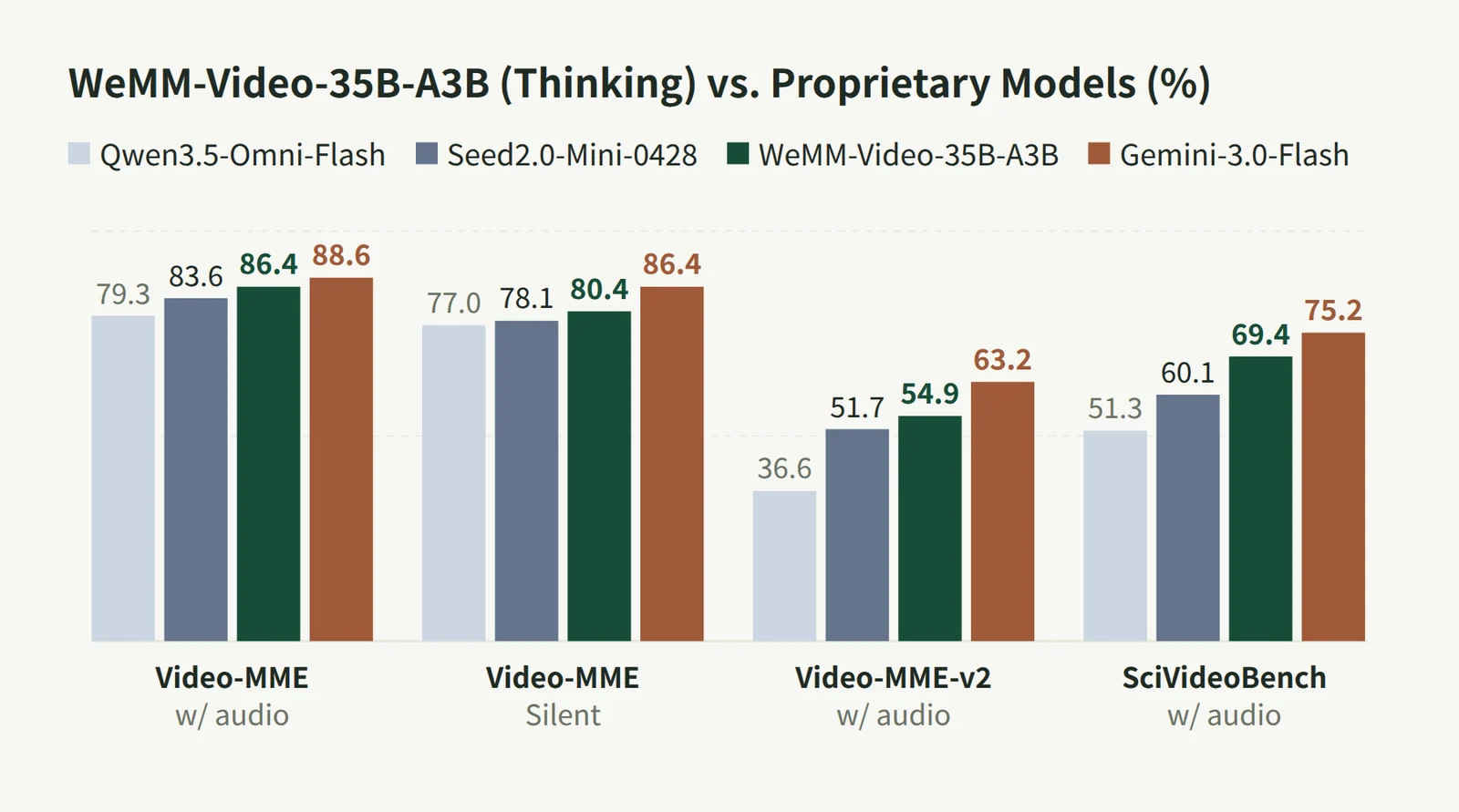
Reading across the silent-video and multi-step reasoning tables reveals the trade-off behind that specialization. On silent Video-MME, WeMM-Video-35B-A3B scores 80.4 in Thinking mode and 78.0 in Instruct mode—trailing Gemini-3.0-Flash (86.4) and sitting slightly below its own Qwen3.6-35B-A3B base model (82.5). A noticeable gap to Gemini-3.0-Flash also remains on multi-step detective reasoning in Video-Holmes (63.4 vs. 71.2) and on the harder Video-MME-v2 audio suite (54.9 vs. 63.2). Heavy audio-visual alignment lifts multimodal synergy when sound carries real clues, while slightly taxing pure visual precision unless Thinking mode steps in on long-form benchmarks such as LVBench (71.6) and LongVideoBench (76.6).
What Remains Unverified Outside WeChat
By releasing Apache 2.0 weights from 2B to 35B-A3B alongside evaluation scripts, Tencent has handed open-source video teams a practical baseline for timeline-aligned audio-visual reasoning. Still, the paper withholds task-level breakdowns for WeChat's 11 internal video benchmarks, and outside teams targeting multi-minute streams will need to test how the patched serving stack behaves once pushed past the default 128-frame cap.
Sources & references
Copy the link to save or share this article.