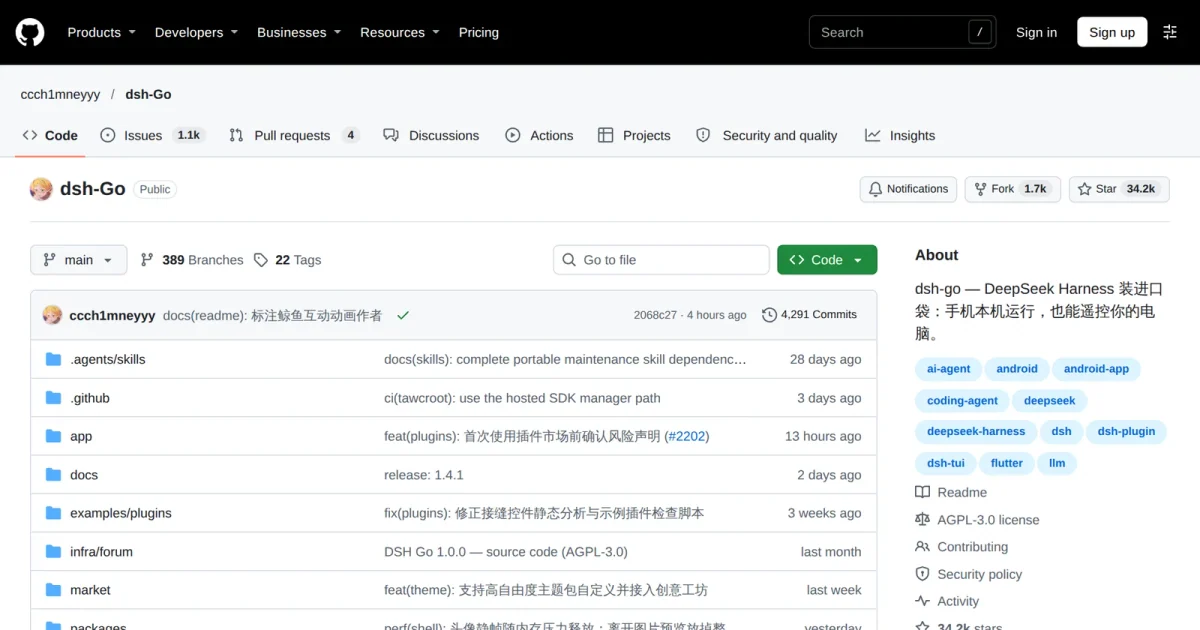
On GitHub, DeepSeek Harness (dsh) has accumulated 288.5k stars, 36.1k forks, and 30,122 commits, yet the upstream repository remains a developer preview centered on terminal sessions and a local Web UI at http://127.0.0.1:3080. Filling that mobile vacuum, the unofficial community client DSH Go—maintained by ccch1mneyyy—has climbed to 34.2k stars, 1.7k forks, and 4,291 commits, reaching number one on Trendshift's all-language daily ranking on October 30, 2026 and shipping v1.4.1 on November 27.
The star gap between the official framework and a community mobile client points to a structural divide in how agent software matures: upstream maintainers guard core runtime stability, while third-party wrappers race to capture everyday mobile workflows.
Upstream Protects the Kernel While Downstream Captures Mobile Habits
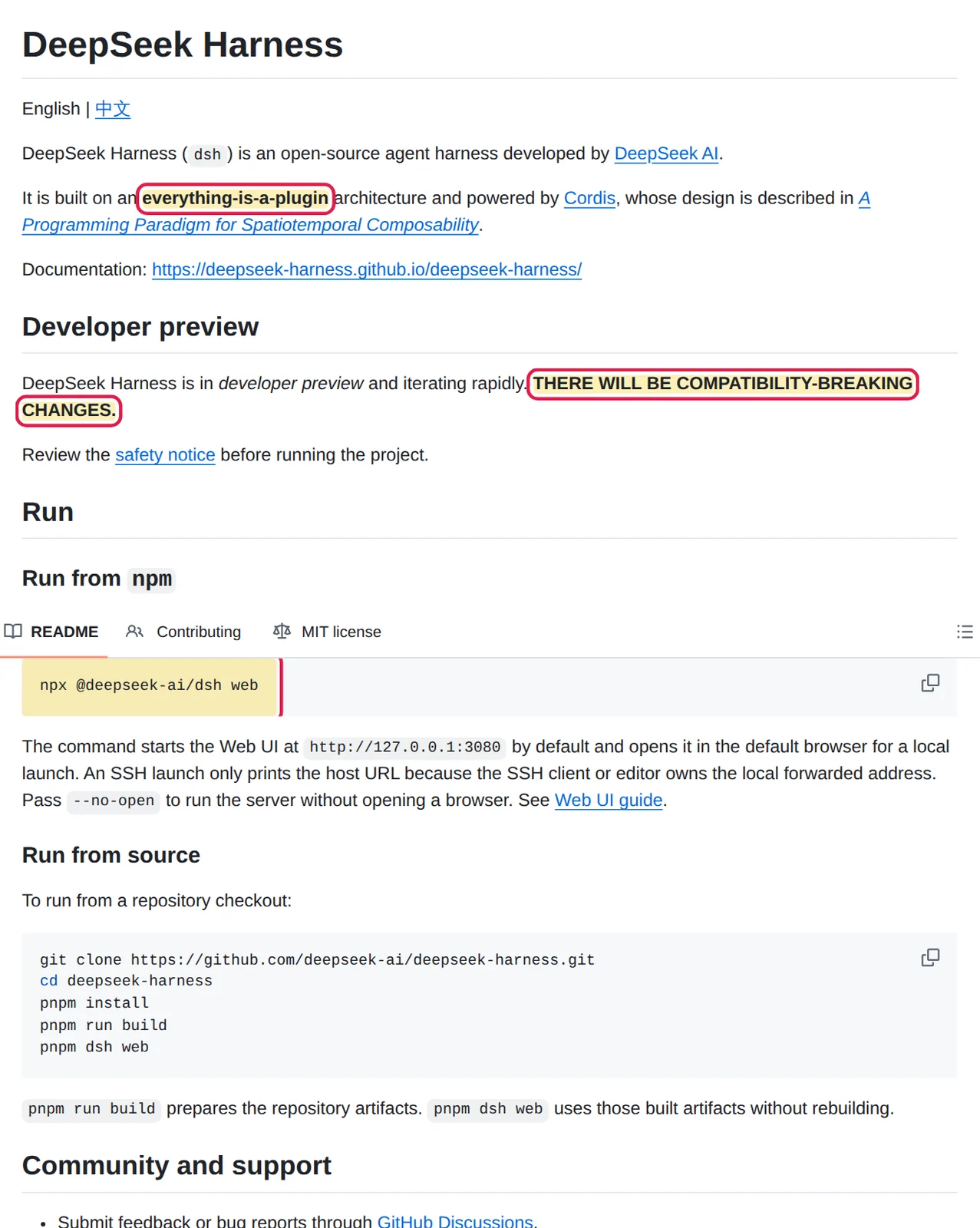
DeepSeek Harness organizes every capability around a Cordis-powered plugin model and carries an explicit all-caps warning in its README that compatibility-breaking changes will occur. Its launch instructions reflect a workstation mindset: running npx @deepseek-ai/dsh web opens a local browser at port 3080, whereas an SSH launch prints only the host URL and leaves port forwarding to the developer's editor or SSH client. Holding off on first-party mobile apps makes engineering sense at that stage, since fragmented Android battery savers, iOS background rules, and Accessibility compliance would pull core maintainers away from the agent loop.
Users running multi-step coding or automation tasks, however, step away from their desks long before upstream APIs freeze. DSH Go gained traction because it combined two distinct jobs inside one package rather than shipping a thin terminal viewer. Through SSH and DSHarness Remote, developed by Li Guobao, it acts as a pocket console for desktop hosts; through an embedded Ubuntu and Node.js layer, it runs the DSH engine directly on Android without Root or Termux, while bundling sdk/plugin-kit/ so plugin authors can render native mobile cards and forms. On top of work sessions, the maintainer added voice calls, animated desktop pets, screen automation, and a Tavern mode compatible with SillyTavern 1.19 cards—blending developer tooling with consumer app polish.
Even so, bridging protocols reveals uneven parity. As documented in the English README, DSHarness Remote currently accepts image attachments only, cannot open the web interface inside the app, limits plugin management to enabling or disabling plugins, and omits both DS Bot and conversation exports.
Six Releases in Two Weeks Push QA Burden Downstream
Looking through the DSH Go release log shows an unusually fast shipping cadence: v1.0.16 landed on November 13 with Tavern and experimental tawcroot startup, v1.1.0 on November 15 added voice calls and overlay controls, v1.2.0 on November 18 folded in unsigned iOS IPA builds and HarmonyOS code, v1.3.0 on November 20 added encrypted host-to-phone chat backups that can be restored to another host and chunked context trimming to preserve model cache hits, v1.4.0 on November 25 added ChatGPT subscription sign-in and phone skills, and v1.4.1 arrived on November 27 to fix relay DS Bot access (requiring ds-harness-remote#605 on the host) alongside background keep-alive.
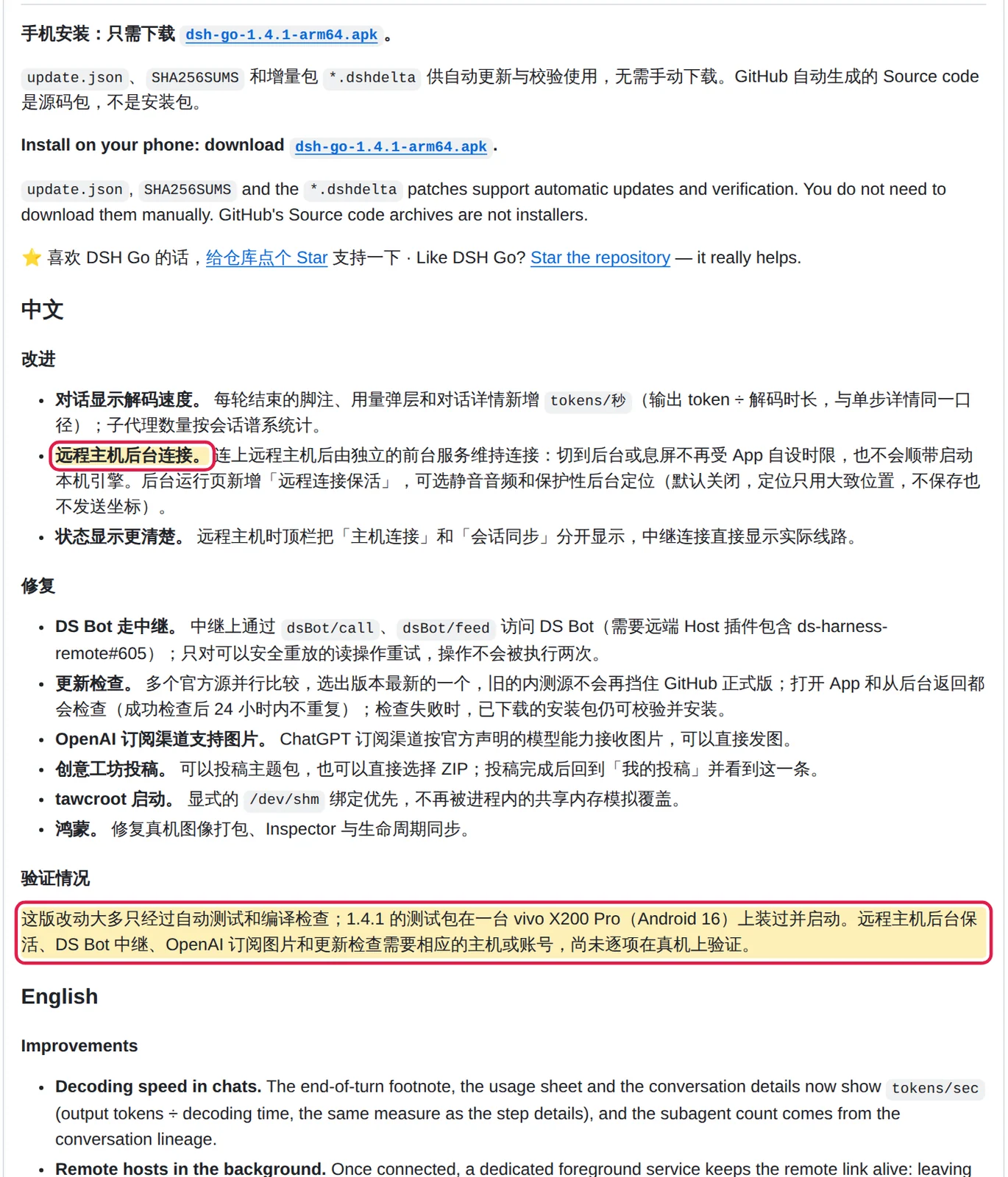
That delivery speed comes with visible verification debt, which the maintainer documents openly at the bottom of each changelog. Across v1.1.0, v1.2.0, v1.3.0, and v1.4.1, the notes state that most changes passed only automated tests and build checks. For v1.4.1 specifically, the test package was installed and started on a single vivo X200 Pro on Android 16, leaving remote background protection, DS Bot over relay, OpenAI subscription image inputs, and update checks unverified on physical hardware. Earlier bug fixes—such as HyperOS 60 Hz frame caps, Android 10 Shizuku identity errors, and vivo phone-control readback failures—show how edge-case hardware bugs surface after release when automated CI outpaces device labs, echoed by 1.1k open issues on the repository.
Moving Agents From Sandboxes to Personal Phones Redraws Risk and Licensing Lines
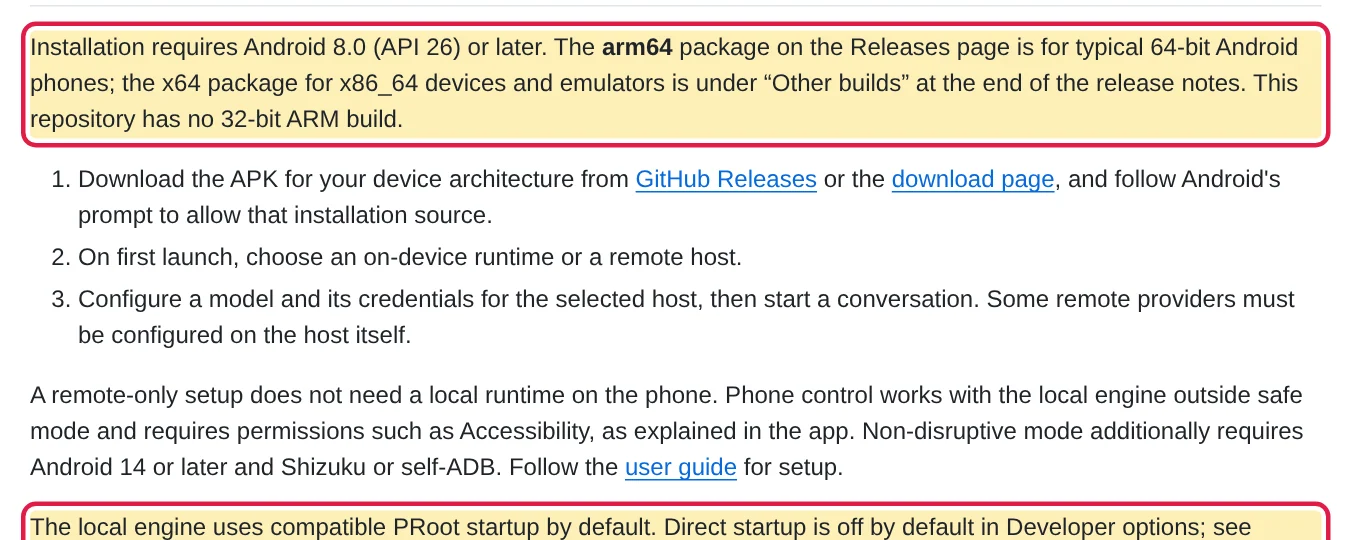
Running an agent inside a desktop project folder carries different assumptions than installing it on a primary phone holding banking apps and private messages. As detailed on the project site and in the repository guide, DSH Go targets APK sideloading rather than Google Play, requires Android 14 or later plus Shizuku or self-ADB for non-disruptive phone control, and builds dedicated battery-saver shortcuts for vivo, Xiaomi, Huawei, Honor, and OPPO phones. Anonymous usage statistics are enabled by default with an opt-out toggle, and the disclaimer emphasizes that running locally does not keep data offline—screen text and screenshots during phone-control tasks may still travel to external model providers.
Licensing follows an equally deliberate split. Core application code uses copyleft AGPL-3.0, while sdk/ and examples/ stay under MIT to encourage plugin authors. Meanwhile, the DSH Go brand and mascots Deepy and Whale girl sit outside the open-source license under ASSETS.md, paired with a collaboration request asking forks to contact the author beforehand, credit upstream in READMEs and About screens, and avoid unauthorized commercial reskins. For upstream agent teams, DSH Go's 34.2k-star reception signals that mobile steering and background continuity are fast becoming baseline expectations; until official remote protocols stabilize and third-party clients expand real-device QA, keeping execution on a controlled workstation while limiting phones to remote approvals remains the prudent boundary.
Sources & references
Copy the link to save or share this article.