After Jensen Huang's exit, Stephen Witt, who wrote a biography of him, offered his own explanation on the New York Times opinion page. The problem, he argues, is not only one man's temperament but the structure built around him: power concentrated in one person, nobody willing to say no, and nobody ready to take over.
Where possible, Witt is quoted here from his own Substack. Other paraphrases come from the Chinese full text this piece draws on, a compiled translation on Sohu whose editor's note says some background was rewritten, so they may not match his English word for word.
The charge is about structure, not just temperament
In that translation, Witt describes a near-mafia culture of silence inside Nvidia that outsiders could hardly penetrate and that let Huang show his worst side without restraint. Read only that far and it sounds like a character sketch.
But the essay then turns to the company. Witt writes that Huang never groomed a successor and that no number two exists inside Nvidia who could replace him. On interim CEO Colette Kress, he argues that because her background is finance rather than electrical engineering, he does not see her as the answer to Nvidia's long-term leadership problem.
Put together, those lines describe three governance problems: decisions concentrated in the founder, dissent that never travels upward, and a thin bench. Temperament is his explanation for why they persisted.
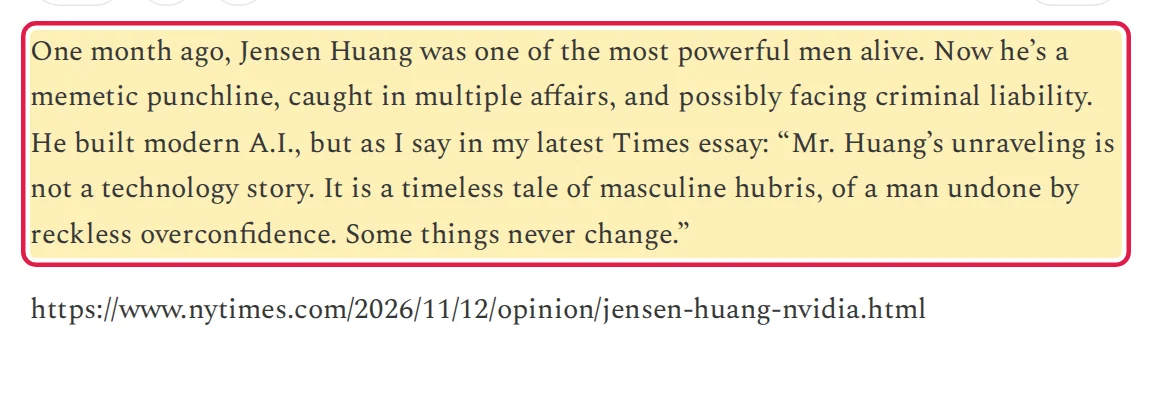
On his Substack, Witt makes the framing explicit: "Mr. Huang's unraveling is not a technology story. It is a timeless tale of masculine hubris, of a man undone by reckless overconfidence."
A new seat, filled by a veteran
Alongside the resignation, Nvidia's press release, also filed with the SEC as Exhibit 99.1, announced several arrangements at once: "The Board of Directors appointed Harvey C. Jones as its first-ever Chair of the Board." Kress takes the interim CEO role while remaining CFO, and the board "is initiating a search for a permanent Chief Executive Officer and will consider internal and external candidates."
"First-ever" tells us Nvidia never had a board chair. It does not tell us the board lacked any other leadership or oversight mechanism, such as a lead independent director; answering that would require the company's earlier governance documents. What is certain is narrower: there is now a board leadership post held by someone other than the CEO.
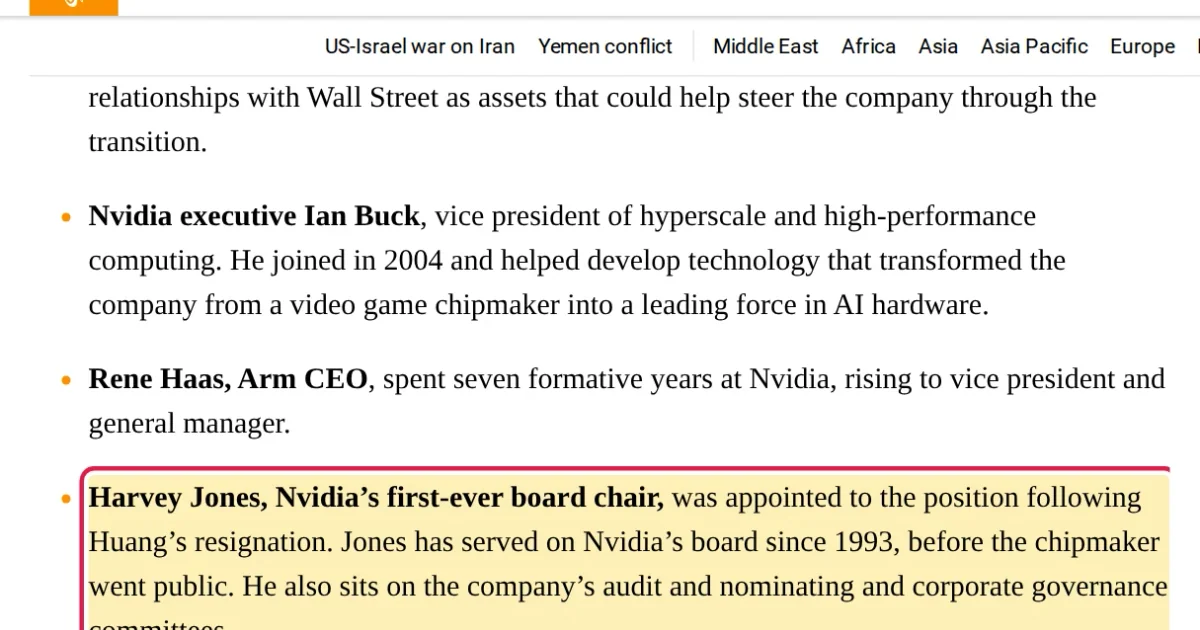
The choice of person matters more than the title. According to Al Jazeera, Jones has served on Nvidia's board since 1993, before the company went public, and sits on its audit and nominating and corporate governance committees.
Here is our read. If the culture Witt describes is real, it took shape under a board Jones has belonged to for decades. Elevating a pre-IPO director to the first chair signals continuity more than an outside perspective. Whether the appointment changes how dissent reaches the top depends on what powers the chair is actually given and whether the board reworks internal reporting lines. Neither is visible yet.
The search scope says little about the bench
Witt says there is no number two. The board says it will look inside and outside, which is standard language. It neither proves the internal bench is empty nor refutes Witt. The names Al Jazeera lists from industry watchers include Nvidia's own Ian Buck and Arm CEO Rene Haas, who spent seven years at Nvidia. The eventual pick will be only one signal; judging how deep Nvidia's bench really is will require evidence of its internal candidate pool, how executive responsibilities are divided, and what formal succession mechanism the board puts in place.
Kress's role needs the same care. Al Jazeera notes: "Before joining Nvidia, Kress held senior finance roles at Texas Instruments, Microsoft and Cisco." Jones, for his part, stressed in the release that she is backed by an experienced team that has been advancing the technology roadmap. The essay questions Kress's suitability for the long term; the release describes an interim appointment. The board has not named a permanent successor or said whether it shares Witt's assessment.
Where the evidence stops
Witt's strength is proximity. China Times reports that he first met Huang in 2023 and that his view of Huang's private conduct formed as his reporting deepened, including accounts of executives being berated at length for pushing back. Still, the material at hand is not enough to independently verify his portrait of Nvidia's culture as a whole. Techmeme collects a Wall Street Journal summary of Huang belittling Kress at a finance meeting and a comment from author Tae Kim describing berating presenters as standard practice for Huang. That corroborates the management style. It does not prove a company-wide code of silence.
The private-life material needs to be separated. Witt says he heard rumors of affairs earlier this year but could not confirm them at the time. Since then, per Al Jazeera, Huang has admitted to being unfaithful, and the Times separately reported on his relationship with a direct report. The claim that the relationship was an open secret inside the company comes, in Witt's essay, from one former employee.
The fair reading: the essay offers a plausible framework, that Nvidia's governance leaned too heavily on one man. Its core claim, the culture of silence itself, still lacks evidence that would verify it independently.
The release does not touch the culture question
In the announcement we checked, statements about people come in two places: Jones's praise of Kress and the leadership team, and Kress's line that "NVIDIA's strength has always come from its people." Both are meant to steady confidence. Neither responds to the culture-of-silence charge.
Several things will test Witt's thesis. How management discusses the transition on the Nov. 17 earnings call. Whether later governance filings spell out what the new chair actually controls. And whether, once a permanent CEO is in place, Nvidia changes how dissent and internal reporting reach the top. The first two will show up in public records. The third will be hardest to see, and it would tell us the most.
Sources & references
Copy the link to save or share this article.