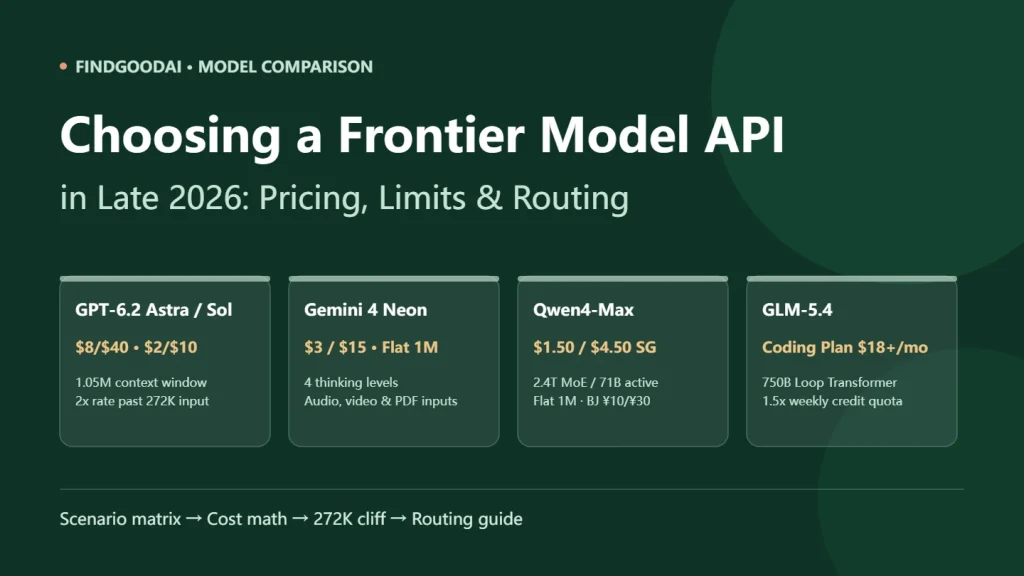
Between November 10 and 12, 2026, Google rolled out two pieces of the same strategy: opening Gemini 4 Carbon to paying developers and immediately following with Gemini 4 Hydrogen against OpenAI's GPT-6 Astra.
In research comparisons, the choice is often framed as natural writing on Carbon versus hard reasoning on Astra. Reading the November benchmark updates beside the API rate sheet turns up two sharper disconnects: current writing leaderboards do not test academic papers at all, and Google's real push is getting a two-tier routing workflow in place before Carbon's introductory discount expires.
The Unproven Leap Between Prose Style and Data Honesty
On ToneBench (updated November 10), Gemini 4 Carbon at high thinking sits outside the top tier—#27 of 87 models, with an 80.1 Writing Score and 1849 Writing Elo. Anthropic's Claude Opus 5.5 leads at 2704 Elo (85.8), open-weight GLM-5.3 ranks #10 (82.4, $0.240 per script), and $0.014-per-script DeepSeek V4.1 Flash 1017 hits #15 (81.6). On Slop Score, OpenAI's GPT-6 Sol (medium) holds the board-best 89.0 (#5 overall, against a 79.4 model median), compared with Carbon's 83.6 against an 81.3 configuration median.
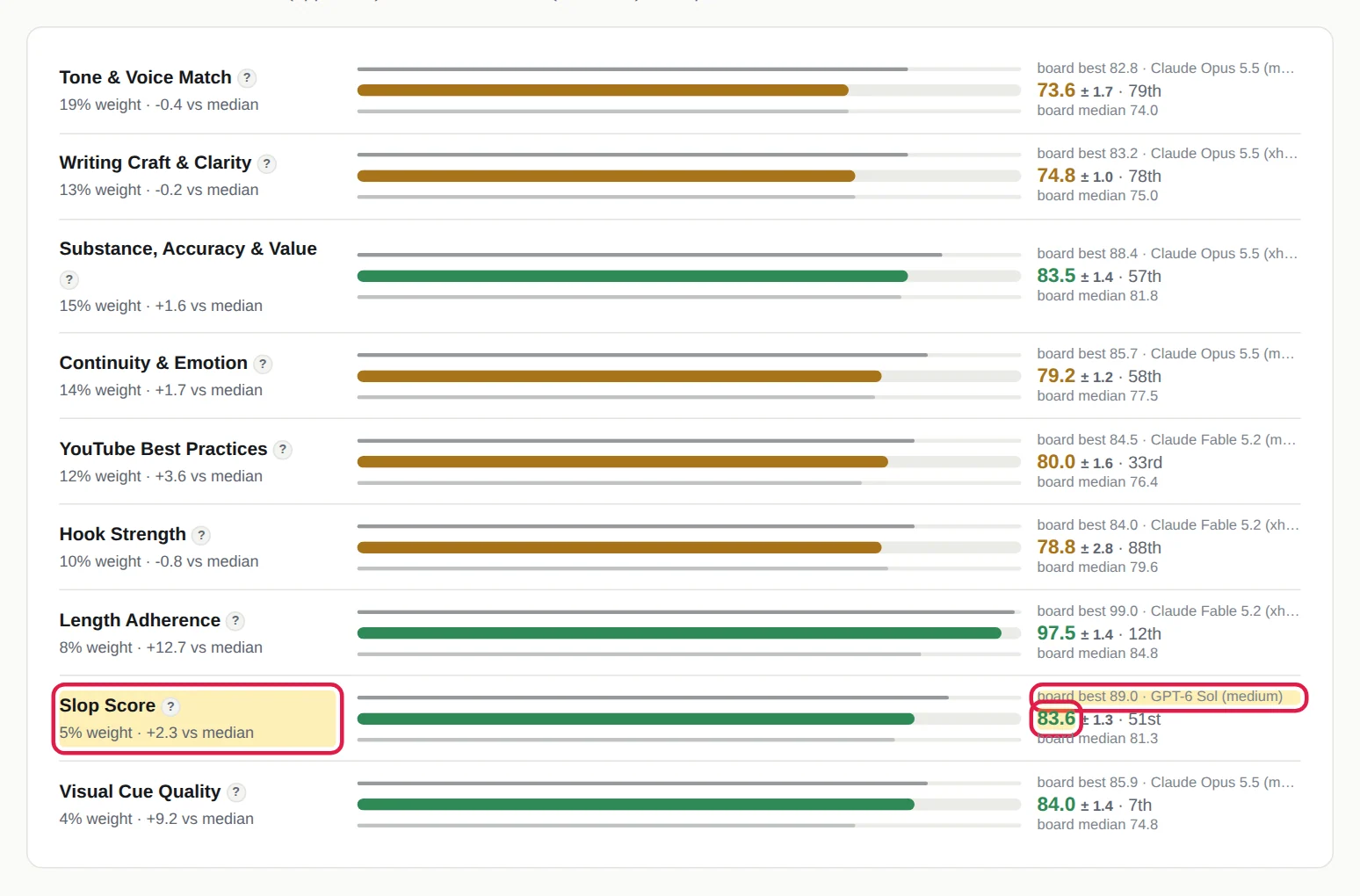
What ToneBench actually tests matters just as much as the ranks. Carbon's scorecard notes that a blind panel of four judges (Claude Opus 5.5, GPT-6.1 Sol, GLM 5.3 Flash, and TypeSafe's Jev) alongside code checks for length and EQ-Bench slop penalties scores five closed-book drafts across 10 YouTube scripts written in creator Louis-François Bouchard's voice, and explicitly warns that results do not carry over to every kind of text. Treating a YouTube script rank as proof of academic prose quality stretches the data past its design.
Google's November 10 disclosures emphasize something different: evidence discipline. In lab deployments, Carbon supported AlphaProof Code generating millions of lines of Lean proofs for Signal's cryptographic protocol, boosted remote homolog retrieval 40-fold across seven low-homolog protein families in CASP17, and caught wet-lab artifacts like incomplete deep-well mixing in enzyme assays. On Google's internal 375-task agentic honesty benchmark, Carbon passed 92% of tasks (up from Argon's 70%), refused to invent missing experimental data 98% of the time, and flagged methodological flaws 68% of the time.
Still, refusing to pad missing numbers is not the same thing as writing human-sounding prose. Carbon does score 83.5 on ToneBench's Substance, Accuracy & Value metric (above the 81.8 median), yet neither ToneBench nor Google's honesty test measures blind reader preferences on research manuscripts or establishes a causal link between data restraint and perceived naturalness. Connecting the two remains an untested hypothesis rather than an established explanation.
Where BenchLM Draws the Line Between Carbon and Astra
On BenchLM (updated November 13), neither flagship clears the board. Carbon holds the higher public score estimate at 89.19 (#2) vs. 85.68 (#4) for September 3-released GPT-6 Astra, yet their 90% intervals overlap (83.8–94.5 vs. 80.3–91.0). BenchLM lists evidence coverage separately: 16 results are shared, alongside 4 Carbon-only entries and 42 Astra-only entries.
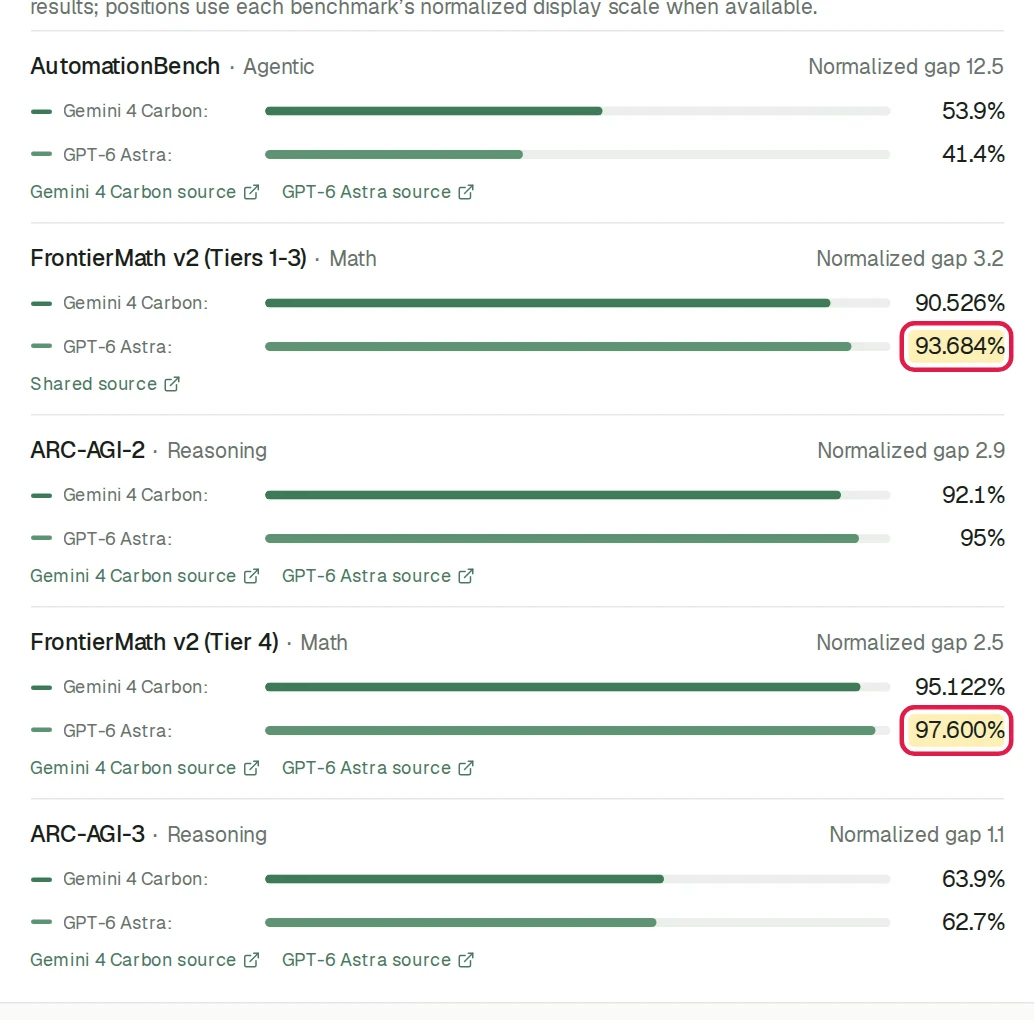
Individual rows trace clear task boundaries. GPT-6 Astra leads FrontierMath v2 Tiers 1-3 (93.684% vs. 90.526%) and Tier 4 (97.600% vs. 95.122%), ARC-AGI-2 (95% vs. 92.1%), and FrontierCode 2.0 (42.8% vs. 40.0%), while carrying BenchLM-tracked rows on GPQA (96%), BioBasicsBench (67.0%), and PhysicianBench (48.0%) where Carbon has no matched public scores. Carbon ranks #1 on the v5.0 Artificial Analysis Intelligence Index (59), beats Astra on AutomationBench (53.9% vs. 41.4%), ARC-AGI-3 (63.9% vs. 62.7%), and Gray Swan IPI defense (0.0% breach vs. 8.5%), and documents native text, image, video, audio, and PDF inputs.
Why Hydrogen Shipped Two Weeks Before Carbon's Price Doubles
Put the November 10–12 releases together, and the timing tracks Google's pricing clock. Carbon's introductory $2 input and $10 output rates expire on November 30, 2026, doubling to $4 and $20. Even with Carbon expanded into the six-month free Antigravity tier for 10,000 scientists, commercial API users face an immediate step-up. Assuming Limited Availability GPT-6 Astra holds at $10 input and $50 output, Carbon's standard rate gap will narrow automatically from 5x to 2.5x once November ends—even without an OpenAI price cut.
Speed and token burn sharpen that pressure. In ToneBench's closed-book script runs, Carbon (high thinking) averaged 8.7 minutes per accepted script including retries and billed 104.8k total input-plus-output tokens (57.7k input and 47.0k output, including thinking tokens). Running routine synthesis through a heavy reasoning tier wastes both time and budget.
Launching Gemini 4 Hydrogen at $1.50 input and $7.50 output gives Google a fast execution layer—scoring 51 on the Intelligence Index at default high (54 at xhigh), 53.4% on MKA, 58.8% on HLE-Diamond, and 52.3% on Vals Tax Agent Bench. Behind Antigravity's Orchestrator on Terminal-Bench 4.0, Carbon and Hydrogen together matched near-Carbon completion using 24% less quota in 19% less time.
That evidence shows Google betting on tiered orchestration, not an industry-wide shift already completed by OpenAI or research buyers. Once the introductory discount expires on November 30, the real test outside Google's benchmarks is whether multi-model routing still beats a single-model call once retries and messy real-world data are factored into the bill.
Sources & references
Copy the link to save or share this article.