DeepSWE-Preview is an open-weight model for working on software repositories. It is intended for tasks that involve finding relevant files, editing code and using feedback from a development environment. If you are looking for a downloadable coding model, its release is worth understanding—but the model weights are only one part of a working coding assistant.
Which DeepSWE is this?
The model discussed here is Agentica’s DeepSWE-Preview, developed with Together AI and based on Qwen3-32B. The release describes reinforcement-learning post-training and uses an MIT license. The name also appears in other software-engineering evaluation projects, so use the full repository identifier, agentica-org/DeepSWE-Preview, when searching or downloading.
Read the score before the headline
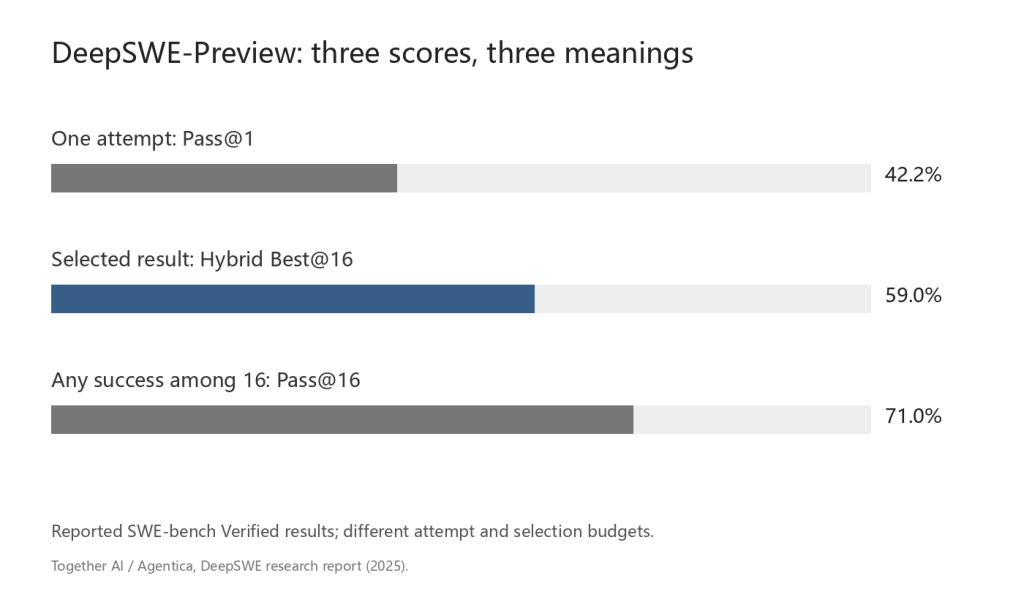
The original research report gives three different SWE-bench Verified results: 42.2% Pass@1, 59.0% with hybrid selection across 16 attempts, and 71.0% Pass@16. These describe different procedures. The 59% figure includes extra attempts and a selection stage. Pass@16 asks whether at least one attempt succeeded; it does not show that a system can always identify that successful answer.
A useful buying question is therefore: how many attempts can your workflow afford? Generating several patches, running environments and selecting a result consumes time and resources. Compare systems under the same budget. These are historical results from the model’s release, not a claim about its position on today’s leaderboard.
What happens when it works on a project?
A chat model receives messages and produces output. A coding agent adds an execution loop around it: give the model a task, translate its proposed action into an allowed operation, return the result, and continue until a patch is ready for review. Searching files and running tests happen in that execution environment.
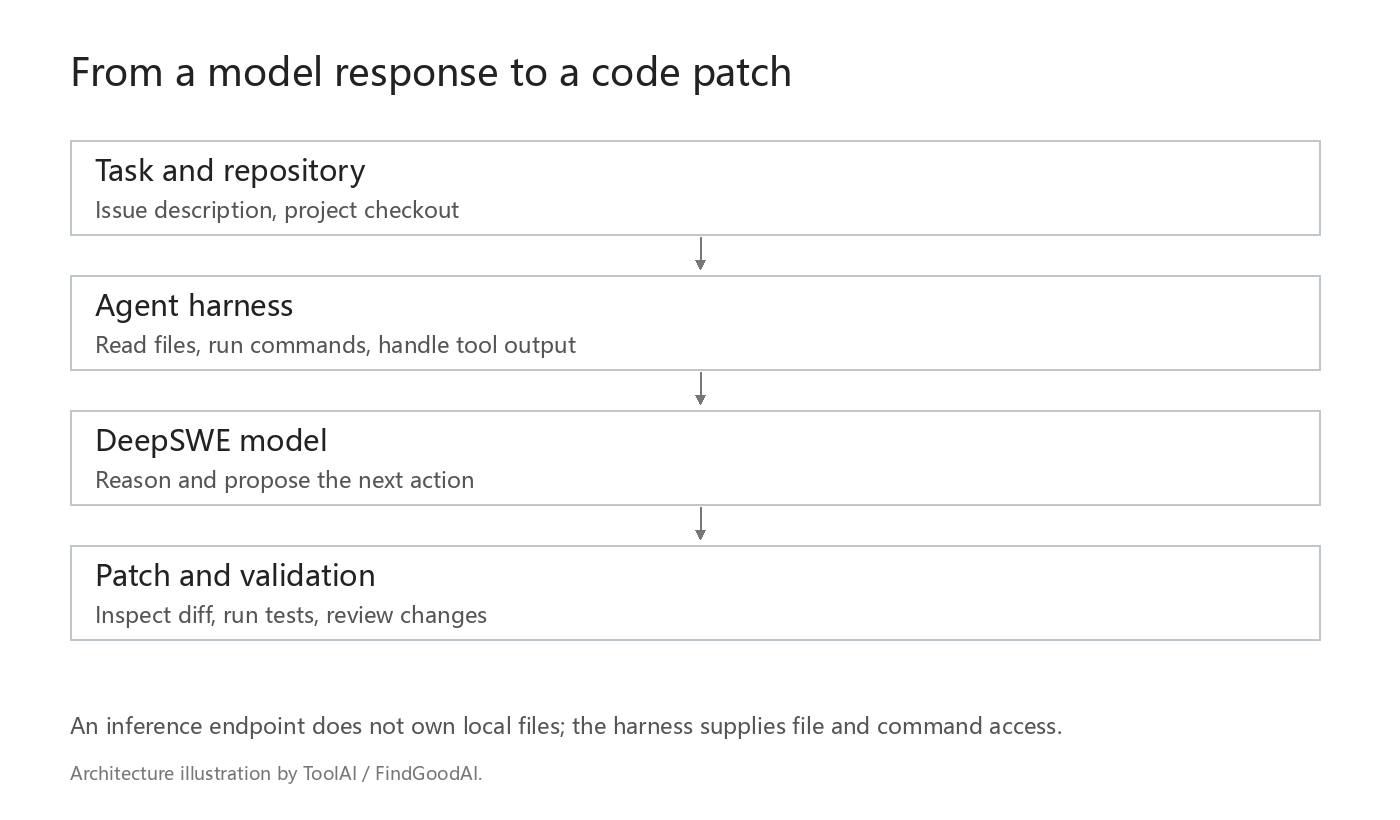
This distinction explains a common disappointment with local models. A model answering a coding question in a chat window does not automatically have access to your repository. You need a compatible agent harness, a checkout of the project and a way to execute the model’s actions. Matching the original evaluation also requires its environment and tool conventions.
Who should try it?
Developers evaluating self-hosted coding assistants can use a small, reproducible repository task as a starting point. Researchers can examine the released training and evaluation materials. Teams that only need occasional code explanations may find a simpler chat workflow easier to operate.
For a first trial, choose a bug with a clear reproduction, prepare an isolated branch, and record the model revision, runtime and context settings. Ask the assistant to identify the relevant code before editing. Then inspect its diff, run the original failing case and check neighboring behavior. Keep the patch even when it fails: an incorrect change can reveal whether the problem was missing context, a tool failure or flawed reasoning.
What should count as a good result?
Judge the completed change: does it solve the problem, preserve existing behavior and remain understandable to a reviewer? Record elapsed time and intervention as well as pass or fail. A model that produces a plausible explanation but never edits the right file has not completed a repository task.
For a fair comparison, use the same project snapshot, instructions, tools and attempt limit. Include tasks from the languages and frameworks you actually maintain. Public benchmark scores help choose candidates; your own repair tasks determine whether the assistant belongs in your workflow.
Copy the link to save or share this article.