DeepSeek updated V4.1 Flash on October 17 with DeepSeek-V4.1-Flash-1017. The website, app and API now serve the new version. Existing API clients should continue to request deepseek-flash; the release suffix is not a replacement API model ID.
The update puts the focus on repository work and agent tasks, alongside the time and output needed to complete them. DeepSeek also opened separate web search and page-fetching APIs. Those changes affect different parts of a workflow and are worth examining separately.
Where did coding performance improve?
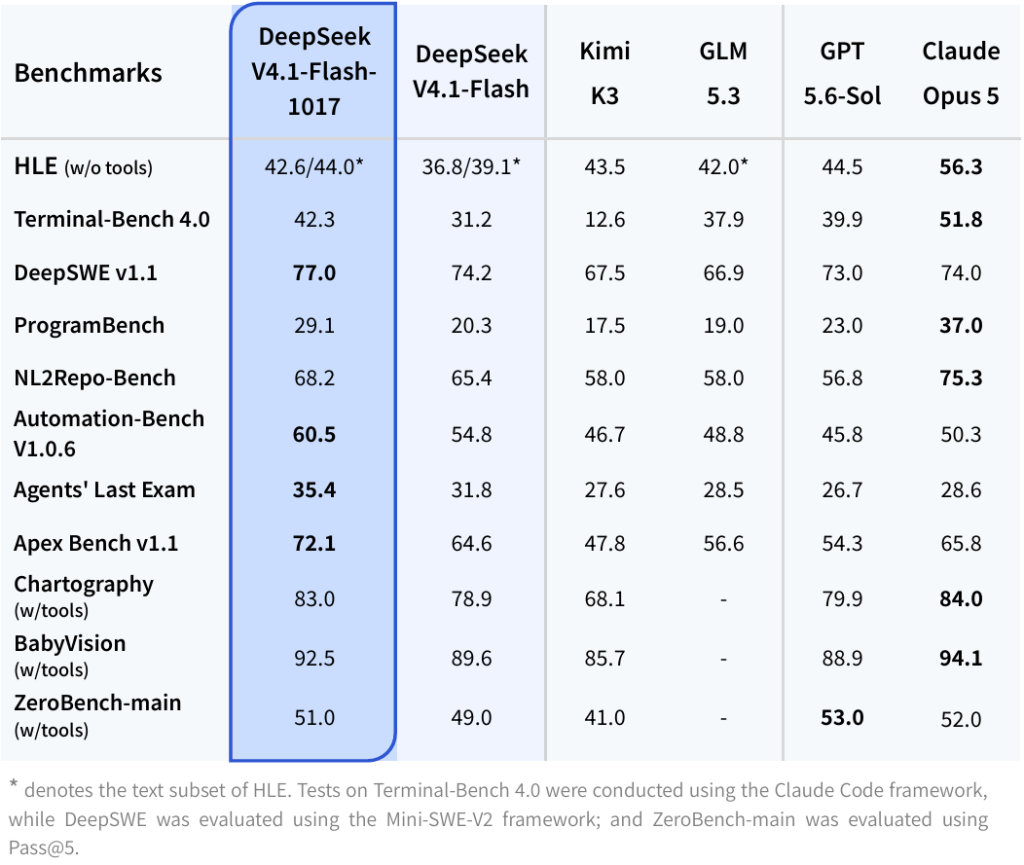
The official model card compares the release with the previous V4.1 Flash. Terminal-Bench 4.0 rises from 31.2 to 42.3, DeepSWE v1.1 from 74.2 to 77.0, ProgramBench from 20.3 to 29.1, and Automation-Bench v1.0.6 from 54.8 to 60.5.
The tests do not all use the same execution environment. DeepSeek identifies Claude Code as the harness for Terminal-Bench 4.0 and Mini-SWE-V2 for DeepSWE v1.1. A lead on one row should not be read as a guarantee across every repository or coding client.
DeepSWE v1.1 here is an evaluation benchmark. It is distinct from Agentica’s DeepSWE-Preview coding model. Keeping the tested model and the test name separate makes these announcements easier to interpret.
What do the project demonstrations show?
The release announcement includes a Forbidden City 3D model, a browser racing game, a Portal 2 recreation in Godot and a 3D scene showing the progression of historical eras. This is the original Forbidden City animation:

The demonstrations were produced inside DeepSeek Harness. For a trial on your own work, choose a concrete deliverable, such as an order page with working filters. Supply the data format, interactions and acceptance conditions, then check the running functionality rather than judging only the screenshot.
Why do runtime and output length matter?
Generating more text and repeatedly using tools can increase both waiting time and cost. DeepSeek reports shorter outputs and faster task completion alongside the higher scores. Read its cost-performance comparison with attention to the axes, effort settings and harness.
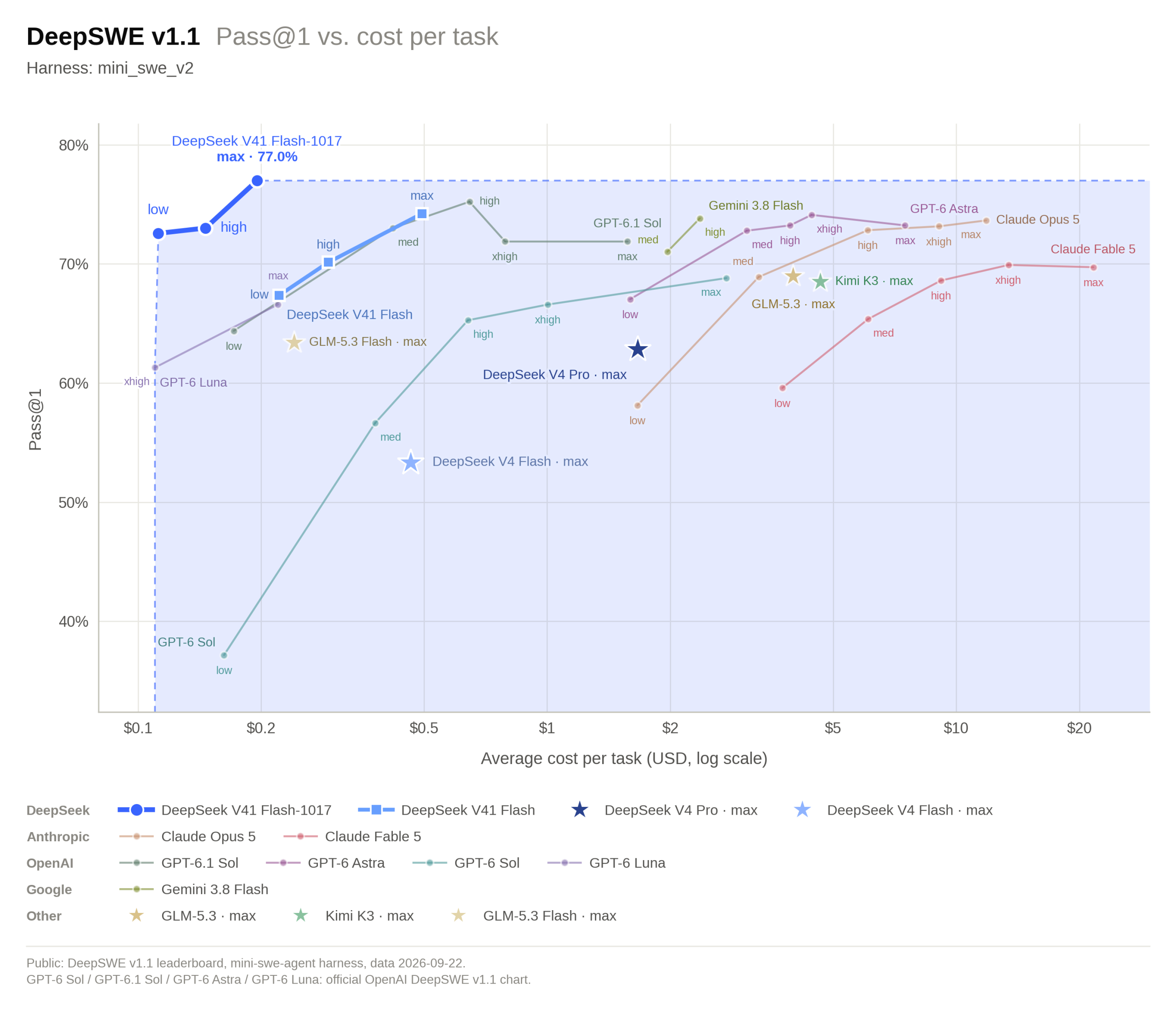
For a useful comparison, give each model the same task, materials, tools and attempt limit. Record completion, elapsed time, manual rework and the bill. A completed task is a more useful unit of comparison than output speed alone.
How can you try the update?
Start with the DeepSeek website or official app. Developers can keep the deepseek-flash model setting. DeepSeek recommends Harness 0.2.1-rc.1 or later for the updated model; clients such as CodeBuddy and WorkBuddy also have their own versions and configuration to check.
The weights are available through Hugging Face and ModelScope. Self-hosting is an option for teams equipped to run the inference stack. A hosted interface is a more direct first step when the immediate goal is to assess usefulness.
Search and fetching introduce a separate bill
Search finds web pages; Fetch retrieves a chosen page. Both are standalone endpoints with request-based charges. The official pricing page lists each at $0.75 per 1,000 successful requests.
There is a specific transition for Search and Fetch calls made by server-side tools in DeepSeek Harness, Claude Code and Codex. Those calls are currently unbilled and become billable at 00:00 Beijing time on November 1, 2026, equivalent to October 31 at 16:00 UTC. This does not make every direct use of the standalone APIs free.
Before adding search to an automated research workflow, try a small set of tasks. Check relevance, page extraction and whether later steps use the retrieved material correctly, then increase volume.
Copy the link to save or share this article.