Why can the same Codex Pro subscription feel both more restricted and harder to use up? In an October 1, 2026 post, lifcc (@mylifcc) connected weekly allowance estimates with slower model output. The useful question is whether slower consumption also means slower work.
The post and its English translation
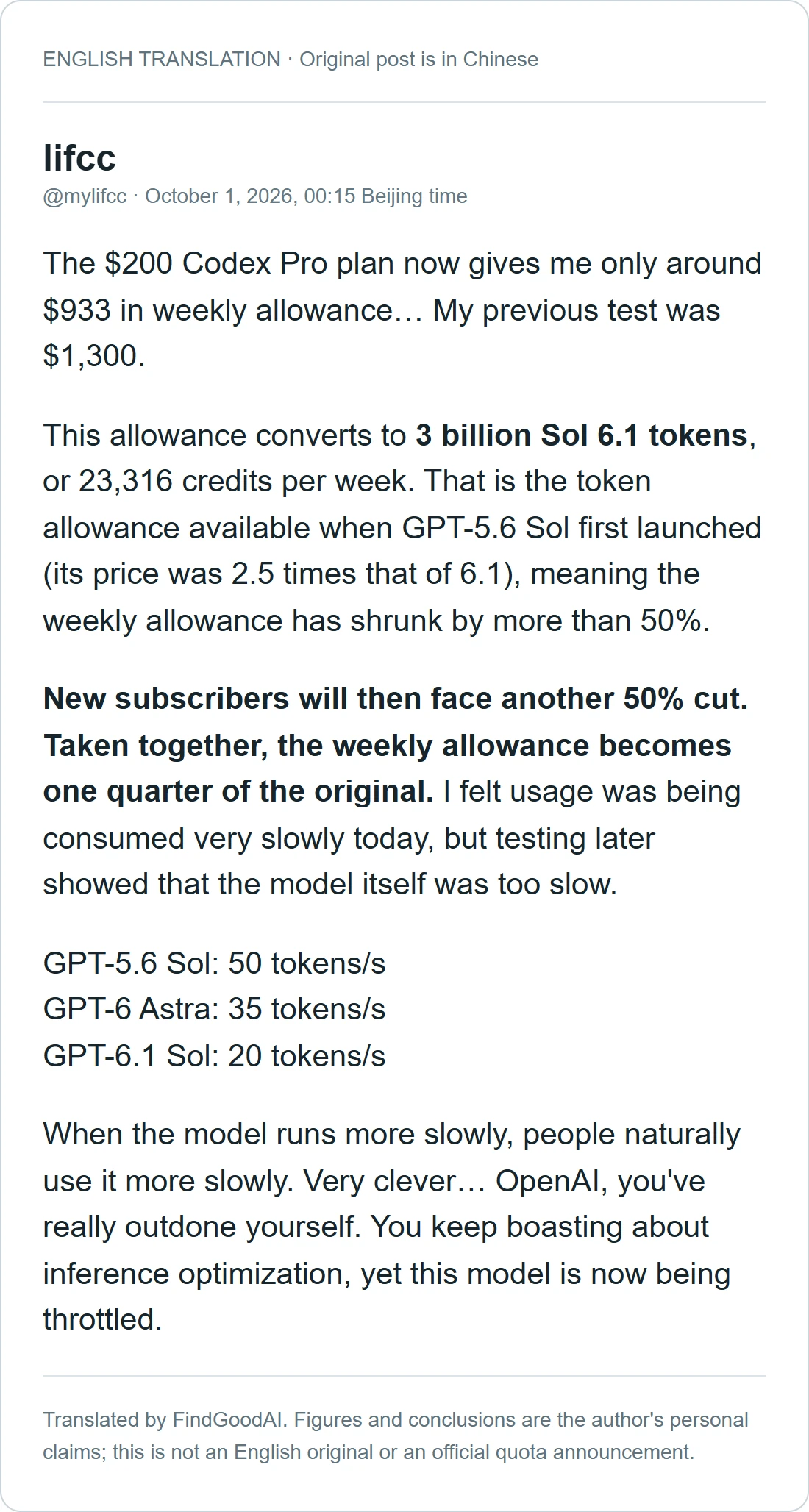
The original is in Chinese. The author estimates a weekly allowance equivalent to roughly $933 on the $200 plan, compared with $1,300 in an earlier test. They also report output speeds of 50, 35 and 20 tokens/s for GPT-5.6 Sol, GPT-6 Astra and GPT-6.1 Sol. These are personal measurements or conversions. The complete English translation and original screenshot follow.
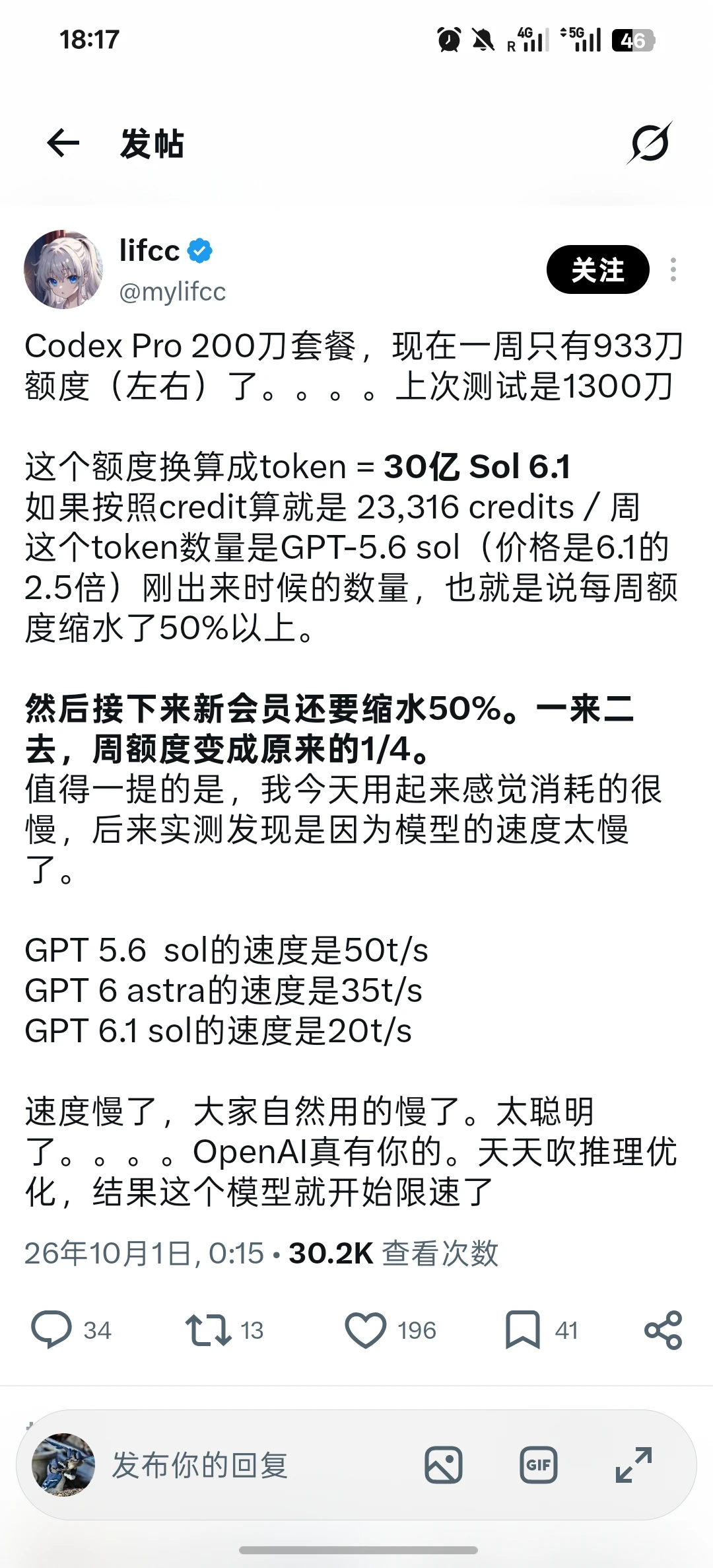
Keep the units and comparison baseline clear
From $1,300 to $933, the decrease is approximately 28.2%. The post’s “more than 50%” claim involves additional comparisons with an older model’s pricing and token allowance. Its “one quarter” conclusion also assumes another cut for new subscribers. Those claims do not follow from the two dollar figures alone.
Dollars, three billion tokens and 23,316 credits cannot be treated as interchangeable without specifying the model, input/output mix, caching and execution conditions. Official OpenAI documentation says usage depends on factors including model choice, task complexity, context and tool use; users should check their usage dashboard. A personal conversion is not a guaranteed weekly dollar allocation.
Compare completed work, time and usage
For the same output length, generating tokens at 20 rather than 50 tokens/s would take 2.5 times as long. Slower consumption can make an allowance feel more durable without increasing the work completed. It does not, by itself, establish deliberate throttling: waiting for the first token, reasoning, tools, networking and service load all affect elapsed time.
A practical comparison uses the same task and settings, then records accepted results, total time and allowance consumed. Capacity determines how much you can attempt, speed determines when it finishes, and quality determines how much rework remains. Together, they provide a better measure of subscription value.
This is a brief analysis, not an independent rerun. We did not find official confirmation for the post’s additional new-user cut, fixed throughput figures or deliberate-throttling claim. Sources checked October 2, 2026.
Sources & references
Copy the link to save or share this article.