Claude's $200 subscription has a new name and a different pitch. Since October 30, Max 20x is called Ultra and Max 5x is simply Max, with prices unchanged. Verified Ultra accounts no longer face the five-hour usage window. For anyone spending $100 to $200 a month on Claude, the change is about what the extra money actually buys.
The multiplier left the name
The Claude pricing page now describes Max as 5x Pro usage every five hours and every week, and Ultra as 10x Pro usage every week, with "No 5-hour limit for verified accounts." The Ultra help article puts it plainly: "The Max 20x plan is now called the Ultra plan." Notebookcheck adds that existing subscribers moved to the new names automatically.
Read together, the shift is clear. The old "20x" label made the $200 tier look like four times the capacity of the $100 tier. The new page ties weekly usage strictly to price: $20 buys 1x, $100 buys 5x, $200 buys 10x.
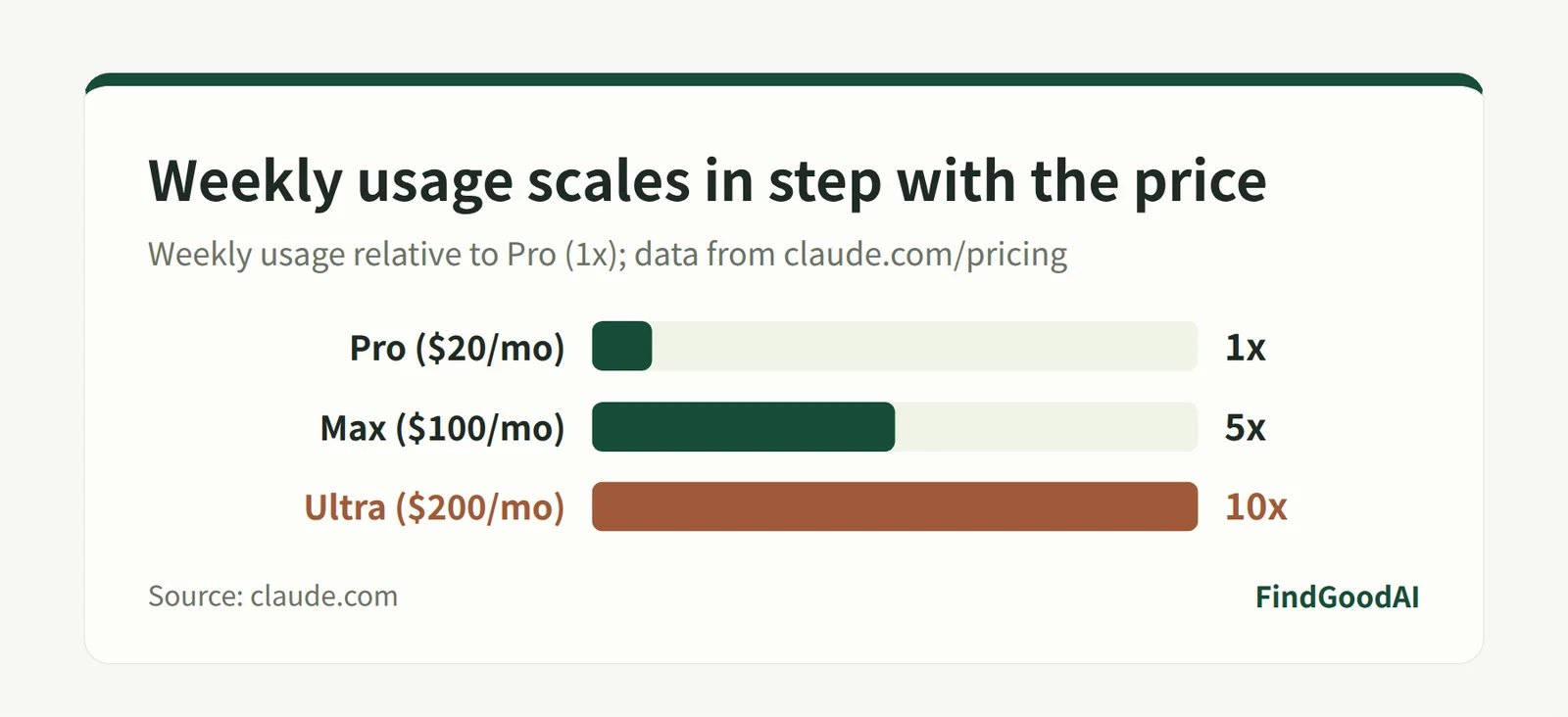
As labeled today, Ultra is no cheaper per unit of usage than Max. What it adds is the missing five-hour window and, per the pricing page, $200 a month in API credits versus $100 on Max.
Every multiplier rests on a relative baseline
One point gets lost in the plan comparisons. Both 5x and 10x are measured in units of Pro. The pricing FAQ does anchor Pro relative to Free, at least 5x more usage per five-hour session, but the same answer says there is no fixed message count because usage depends on conversation length and complexity, the model and the features you use; no token quota is published either. A footnote adds that how fast you hit a limit depends on the model, the length of your chats and the size of your files.
In practice, subscribers can verify the ratios between tiers and Pro's floor relative to Free. The absolute amount is defined by Anthropic, and the pricing page says plans are subject to change at its discretion. That goes a long way toward explaining why the same 5x tier feels ample to one user and runs dry by midweek for another.
Why sell time instead of volume
This part is our reading; Anthropic has not framed it this way.
A five-hour window may help smooth demand: users who exhaust it have to wait, potentially pushing some work to a later time. A weekly cap instead constrains total usage over the week. Removing the former while keeping the latter lets verified Ultra users concentrate their work without removing the overall allowance. Those are possible effects of the rules, not a confirmed model of costs or system load. The public material provides no concurrency, load or cost data from which to establish how much peak pressure Anthropic actually takes on.
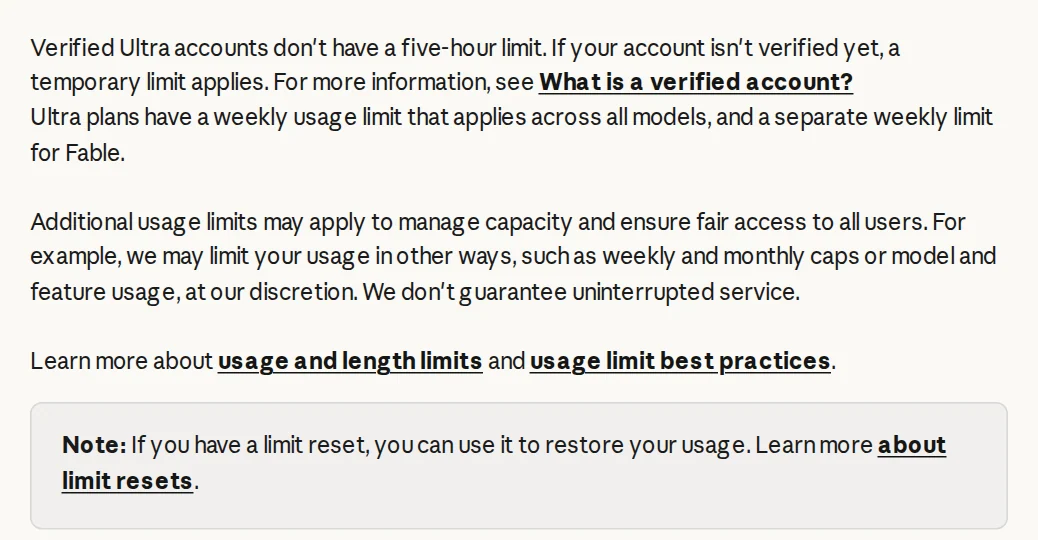
Two details in the help article fit that reading. Ultra has a weekly limit across all models plus a separate weekly limit for Fable, and the pricing table lists Ultra's Fable allowance at 50% of weekly limits, so the most expensive model is fenced off on its own. The article also reserves the right to add weekly or monthly caps or restrict models and features to manage capacity, and says service is not guaranteed to be uninterrupted.
The taglines line up too. Max is "For all-day work"; Ultra is "For your longest tasks." One assumes steady use through the day, the other a long run in one go. The other Ultra perks listed in the help article point the same way: priority access to new models and features, and longer multi-step tasks running in the background.
API credits tie the subscription to the developer bill
The other new variable is API credits, which the pricing page flags as a new perk: $100 a month on Max, $200 on Ultra, for building on the Claude Platform. Since Max already includes $100, Ultra's extra $100 narrows the real gap between the tiers only under one condition: your eligible monthly API spend runs past what Max covers, and the extra credits replace money you would otherwise pay. A developer whose spend already fits inside $100 is covered on Max, and the subscription gap stays a full $100. For people who work only in the chat interface, the credits are worth close to nothing.
Our read is that Anthropic is using these credits to pull heavy individual subscribers onto its developer platform. The subscription keeps the daily habit; the credits get people building their own tools on the platform, and two revenue lines start to connect.
Verification moves the gate to the account
The no-window benefit comes with a condition. Anthropic says it verifies Ultra accounts automatically, using factors like account and payment history, and that unverified accounts get a temporary limit. Users can check under Settings, then Usage: no Current session bar means verified.
That is close to everything on the public record. Notebookcheck reports that new accounts keep the temporary limit until verification completes, and the help article says verifying a phone number at checkout does not lift it. How the factors are weighed and how long verification takes are not disclosed.
The help article explicitly says automatic verification is intended to prevent fraud and abuse. It provides neither a comparison of different abuse risks nor figures for the cost of verification. For a new subscriber, the practical drawback is potentially going without the plan's headline benefit for a while, with no published waiting time around which to schedule work.
Who gains, who recalibrates
Existing Max 20x subscribers who kept hitting the five-hour wall gain the most: same price, and the most common interruption is gone.
Anyone who read "20x" as four times the 5x tier's capacity needs to reset expectations. Notebookcheck reports that "the total amount of usage stays the same" and that Ultra still offers 10 times the weekly usage of Pro. That is a media report; Anthropic's help article states only the current 10x and offers no before-and-after comparison. On that account, what changed is naming and presentation: "20x" invited a per-week reading, while the new label spells out 10x Pro per week. There is no evidence the $200 tier was ever cheaper per unit of usage, so no discount has been taken away. The labeling is simply more transparent.
Would-be upgraders face two more constraints. The help article says Ultra is monthly only, with no annual discount, and the $200 price applies to web subscriptions; mobile pricing may differ.
For someone considering a move from Pro to Max, the current Fable distinction is verifiable: Pro requires usage credits, while Max includes it within the allowance. Max's pricing card also marks its $100 monthly API credit as a new benefit. Both deserve a separate value assessment; the current comparison does not establish that the upgrade calculation is unchanged from before.
What to watch
Two things. Whether Anthropic publishes clearer verification criteria, and whether the "lift the window, keep the weekly cap" approach spreads to Max. If Max loses its five-hour window too, the two tiers would differ only on weekly usage and API credits, and Anthropic's plan structure would get noticeably simpler.
Sources & references
Copy the link to save or share this article.