On November 18, 2026, Google Antigravity is removing GPT-OSS-120b from its model selector alongside Claude Sonnet 4.6 (thinking) and Claude Opus 4.6 (thinking). Viewed on its own, the countdown banner looks like routine housekeeping for an older open-weight option. Placed alongside Google's November 11 forum clarification and a rapid string of November product releases, however, the cleanup marks a clear structural shift in who gets third-party models inside Antigravity.
Why the November 2 deadline slipped to November 18
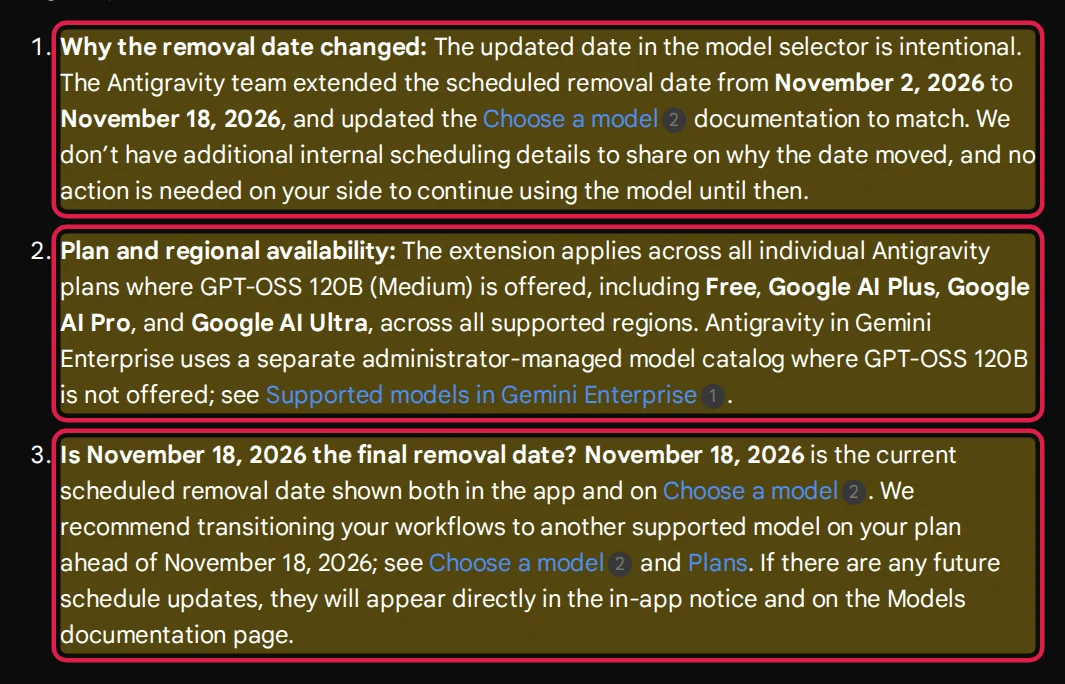
The scheduling trail shows the delay was deliberate. On November 3, a developer posted on the Google AI Developers Forum asking why Antigravity's in-app notice had shifted the GPT-OSS 120B removal date from November 2, 2026 to November 18. In a November 11 official reply, Google staff member Ambati_Rajendra confirmed the date change was intentional and applies across Free, Google AI Plus, Google AI Pro, and Google AI Ultra plans in every supported region.
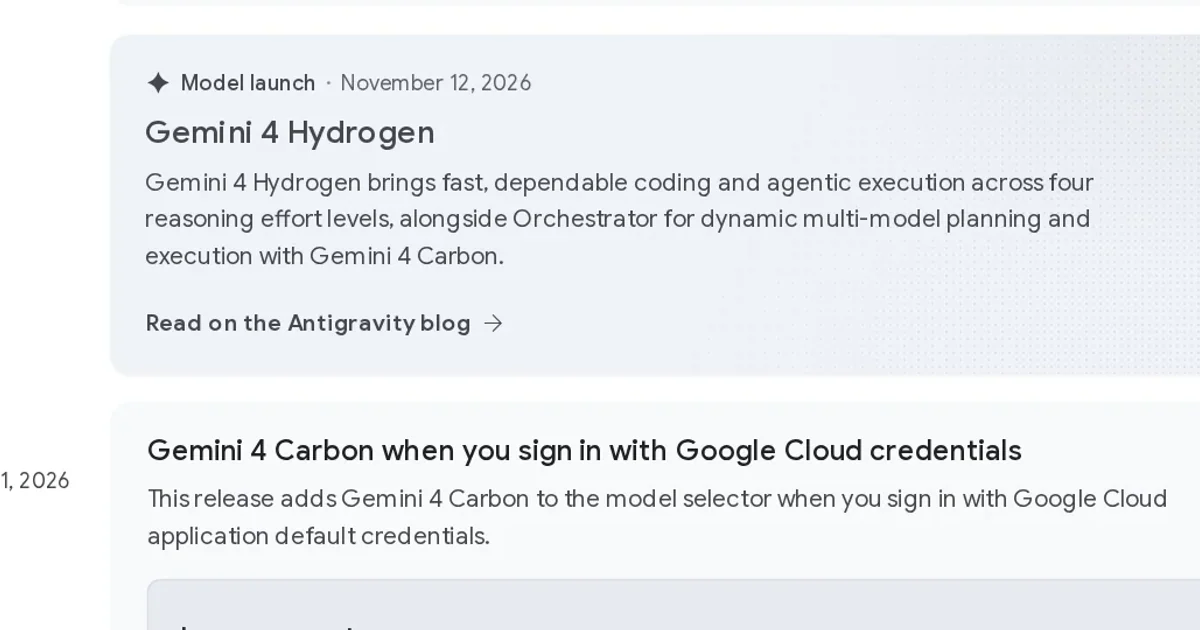
Although the forum response said the team had no internal scheduling details to share, the Antigravity Changelog fills in the timing gap. On November 10, Google launched flagship Gemini 4 Carbon for long-horizon software engineering and scientific work, then followed on November 11 (v2.31.2) with Carbon support for Google Cloud application default credentials. On November 12, Google shipped Gemini 4 Hydrogen—its fast everyday coding model across all tiers—and Orchestrator for pairing Carbon or Argon planning with Hydrogen execution. A day later, v2.32.0 updated the model selector menu to resize dynamically and show a Refresh button when models fail to load.
Had Antigravity enforced the original November 2 removal date, Free and Plus developers would have lost all three entry-level external models before Gemini 4 Hydrogen even arrived. Extending the deadline past November 12 created a brief overlap window so consumer tiers could land on native Gemini 4 models before external options vanished.
Counting the matrix: open weights out, Anthropic only for paid tiers
While community chatter focused on GPT-OSS 120B (Medium), the full reasoning table in Antigravity's Choose a model documentation makes clear that November 18 sweeps away the entire non-Gemini layer at the bottom of the lineup. Tallying every row across the official grid highlights how unevenly the cut lands.
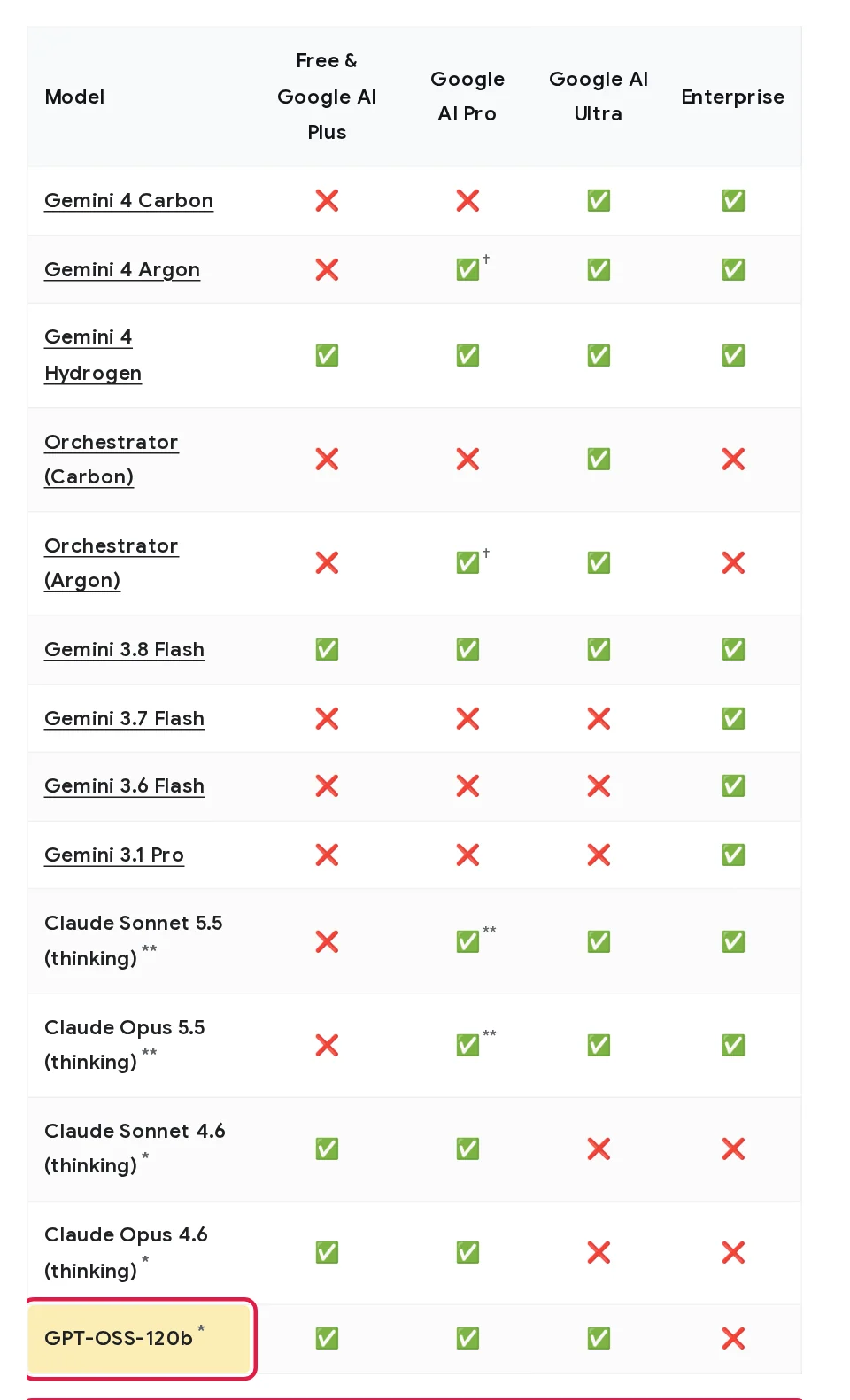
Before November 18, Free and Google AI Plus accounts can pick from 5 reasoning options: 2 Gemini models and 3 retiring third-party entries. Once the cutoff passes, those plans drop to 2 models (Gemini 4 Hydrogen and Gemini 3.8 Flash) and zero external providers. Paid Google AI Pro shrinks from 9 models to 6, and Google AI Ultra trims from 9 to 8. Gemini Enterprise sits untouched at 9 models because its administrator-managed catalog never included any of the three retiring entries.
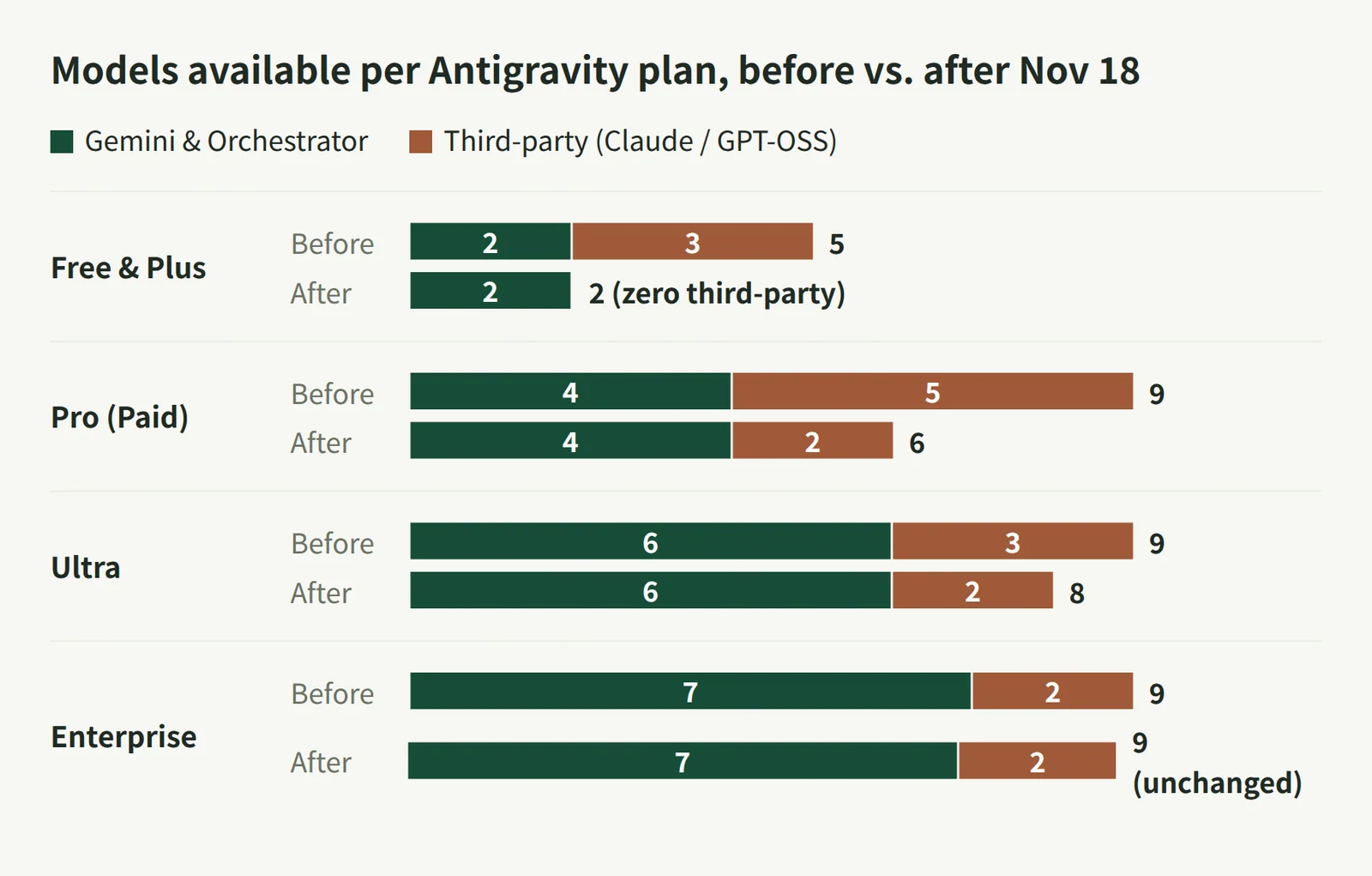
Two policy boundaries inside that table carry broader weight for the ecosystem. First, Claude Sonnet 5.5 (thinking) and Claude Opus 5.5 (thinking) are locked behind a double-asterisk rule limiting them to non-trial Google AI Pro, Ultra, and Enterprise subscriptions. That means developers evaluating Antigravity on a standard Pro trial lose third-party access on November 18 right alongside Free users. Second, GPT-OSS-120b was the sole OpenAI-origin and open-weight entry in the official selector. Once it leaves, third-party choice inside the hosted workspace narrows exclusively to Anthropic.
Importing rival workflows while blocking BYOK
Reading the model retirement alongside Antigravity's November 9 v2.30.0 release and Plans documentation exposes the underlying platform strategy. In v2.30.0, Google added migration tooling that lets Antigravity import MCP servers, skills, custom commands, subagents, and instruction files directly from Claude Code, Codex, and Cursor into user-owned plugins. Yet on inference and billing, Google is moving in the opposite direction of an open model router.
Under the Plans structure, Antigravity does not carry a standalone subscription; quotas scale with your Google AI plan across two separate pools shown in the usage menu: Gemini Models and Claude and GPT models. Free accounts refresh weekly, while Pro and Ultra refresh every five hours up to a weekly cap. Above those baselines, Pro and Ultra users can opt into purchased AI Credits billed strictly at standard Gemini Enterprise consumption rates. Crucially, the Plans page states there is no support for bring-your-own-key (BYOK), bring-your-own-endpoint setups for extra rate limits, or custom organizational contract tiers.
Put those two moves side by side and Google's calculus is straightforward. Antigravity wants developers to bring their workflows, skills, and project context over from competing coding agents, but it is no longer willing to subsidize third-party or medium-reasoning open-weight inference on free, Plus, or trial accounts now that Gemini 4 Hydrogen is ready. Multi-vendor optionality—meaning Anthropic's Claude 5.5 lineup—becomes a gated differentiator reserved for full-paying Pro, Ultra, and Enterprise customers. After November 18, the simplest signal of whether Google intends to bring back another open-weight or non-Anthropic partner will be watching the usage meter documentation to see if the Claude and GPT models label quietly drops the GPT name.
Sources & references
Copy the link to save or share this article.