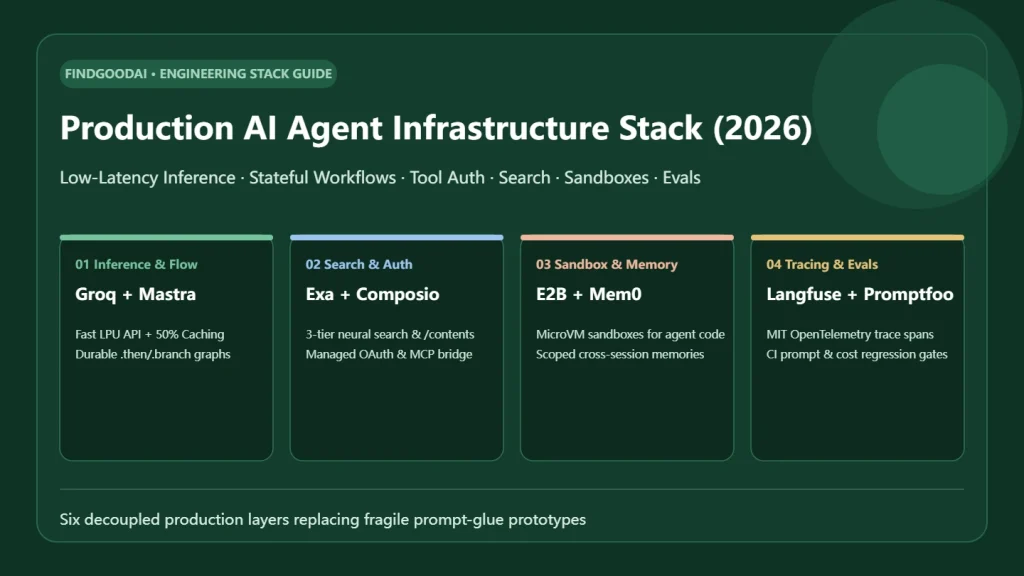
Building an impressive AI agent demo takes an afternoon: wire a frontier chat completion call to three tool definitions and stream tokens back to the browser. Turning that same prototype into reliable software exposes recurring operational fractures within days—interactive requests stall for eight seconds inside reasoning loops, third-party Slack or GitHub OAuth tokens expire mid-task, LLM-authored Python executes with access to container secrets, or monthly inference bills spike with no clear attribution per feature. Moving cleanly past prompt-glue prototypes starts by separating responsibilities across the six architectural layers curated in our new AI Agent Infrastructure Stack collection.
Six decoupled infrastructure layers and open protocol edges
The most costly architectural mistake is locking model weights, user credentials, and trace telemetry inside one closed “all-in-one” framework. Resilient systems keep every layer swappable around three open standards—OpenAI /v1 HTTP compatibility, the Model Context Protocol (MCP), and OpenTelemetry (OTel) spans:
| Stack Layer | Primary Picks | Failure Mode Solved | Open Standard / Isolation | Key Cost & Latency Lever |
|---|---|---|---|---|
| 1. Inference Tier | Groq · OpenRouter · vLLM | Interactive voice/chat stalls and rigid rate limits | Standard OpenAI /v1 HTTP contract |
50% cached-input discount; 50% async Batch offloads |
| 2. Orchestration | Mastra · PydanticAI · CrewAI | Lost state on crashes & unvalidated LLM tool args | Durable checkpoints + typed schemas | suspend() / resume() replaces blind polling |
| 3. Tool Auth Bridge | Composio | Leaked API secrets & fragile OAuth token refreshes | Scoped per-user auth vault & MCP | 250+ connectors without custom glue maintenance |
| 4. Live Web Search | Exa · Crawl4AI · Firecrawl | Noisy HTML bloat & stale model pretraining data | Clean highlights & verifiable Websets |
Fast ~350ms ($5/1k) vs Deep ~3.5s ($12/1k); /contents $1/1k |
| 5. Memory & Sandbox | Mem0 · Qdrant · E2B | Stateless amnesia & arbitrary host code execution | Tenant-keyed memory + microVM isolation | Firecracker sandboxes protect host disks & secrets |
| 6. Tracing & Evals | Langfuse · Promptfoo · Helicone | Silent prompt regressions & unattributed spend | OpenTelemetry (OTel) spans + MIT core | Span-level cost tracking + pre-merge CI eval gates |
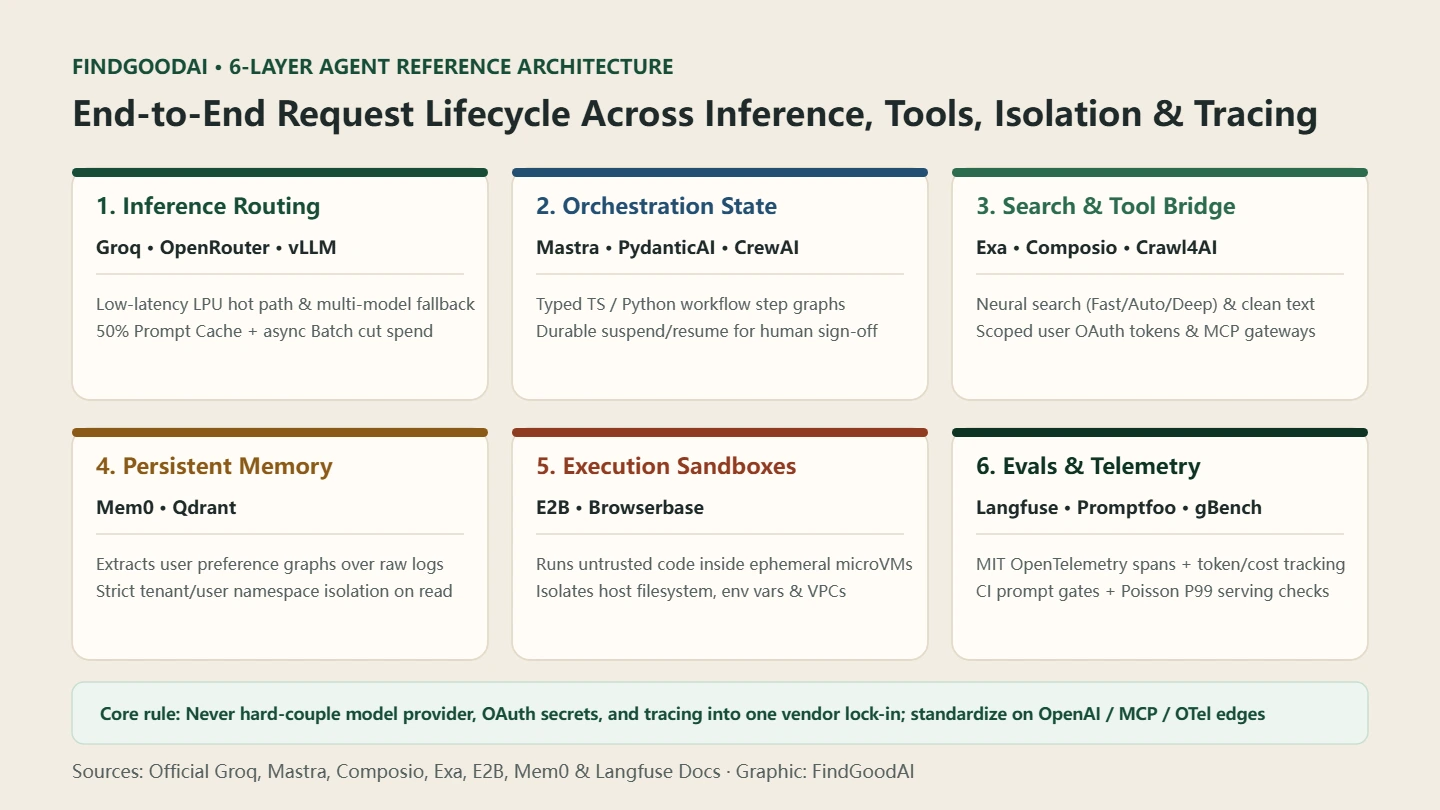
Layers 1–2: Fast inference routing and durable workflow graphs
In multi-step agent execution, latency compounds fast: a loop performing one planning step, two web lookups, and a synthesis pass runs three sequential inference calls before replying to the user. Routing latency-sensitive turns through Groq immediately tightens the interactive hot path. Groq exposes drop-in OpenAI SDK compatibility backed by custom LPU hardware while preserving two explicit cost levers documented in its pricing model: repeated system prompts and large tool-definition prefixes automatically qualify for Prompt Caching (50% discount on cached input tokens), while non-urgent enrichment or nightly eval runs can shift to the 24-hour asynchronous Batch API (also 50% off standard token rates).
Once inference stops bottlenecking users, fragility moves straight to control flow. Unbounded while loops drop steps when APIs blip or silently mutate data before a human reviews edge cases. For TypeScript and full-stack product teams, Mastra solves this under the Apache 2.0 license by unifying model calls across 40+ AI SDK providers with structured .then(), .parallel(), and .branch() workflow graphs. Crucially, Mastra supports built-in suspend and resume checkpoints so threads persist full execution snapshots cleanly before outbound emails, repository writes, or billing changes until human sign-off arrives (while Python backends frequently reach for typed validation libraries like PydanticAI to enforce strict output contracts).
# Routing real-time inference & search tiers
groq_req = {
  "base_url": "https://api.groq.com/openai/v1",
  "stream": True,          # Interactive user turns
  "batch_window": "24h",   # 50% discount for evals
  "prompt_cache": True     # 50% off cached prefixes
}

exa_tiers = {
  "fast": {"p50_ms": 350, "usd_per_1k": 5},
  "auto": {"p50_ms": 900, "usd_per_1k": 7},
  "deep": {"p50_ms": 3500, "usd_per_1k": 12},
  "contents": {"usd_per_1k_pages": 1}
}
// Mastra workflow state graph + suspend checkpoint
const agentRun = createWorkflow({ id: "ops-run" })
.then(fetchVerifiedWebContext)
.then(draftCustomerReply)
.then(requestHumanSignOff) // suspend() persists state
.branch([
[isApproved, executeViaComposio],
[isRejected, logAuditAbort]
])
.commit();Layers 3–5: Managed OAuth isolation, tiered search, memory, and microVMs
The instant an agent connects to live websites, private SaaS workspaces, or code execution engines, teams need hard technical isolation across three risk boundaries rather than trusting system-prompt instructions:
- Scoped OAuth delegation via Composio: Never embed long-lived API keys in prompt context, and avoid maintaining bespoke refresh-token pipelines across dozens of vendors. Composio centralizes OAuth 2.0, API-key management, webhook triggers, and MCP server exposure across 250+ enterprise applications—binding connected accounts cleanly to an explicit
user_idso agents only see authorized tool schemas while raw refresh tokens remain sealed inside the auth vault. - Search routing across latency tiers with Exa: Standard keyword search snippets often force agents to ingest bloated boilerplate HTML. Neural search platform Exa exposes predictable performance and spend controls: use
Fast(~350ms, $5 per 1,000 searches) for responsive conversational turns, defaultAuto(~900ms, $7/1k) for general research, andDeep(~3.5s, $12/1k) only for multi-step competitive or technical synthesis, alongside clean/contentsextraction at $1 per 1,000 pages and entity-verifiedWebsetslists. - Persistent memory and isolated microVM sandboxes (Mem0 + E2B): Re-sending full chat histories across sessions inflates token spend while still forgetting user formatting rules; pairing vector storage with Mem0 distills scoped user preference facts and relationship graphs keyed cleanly per tenant. Meanwhile, any agent empowered to write and execute arbitrary Python or shell code must run inside ephemeral Firecracker microVMs like E2B rather than sharing host application containers where leaked environment variables or internal VPC routes sit one shell command away.
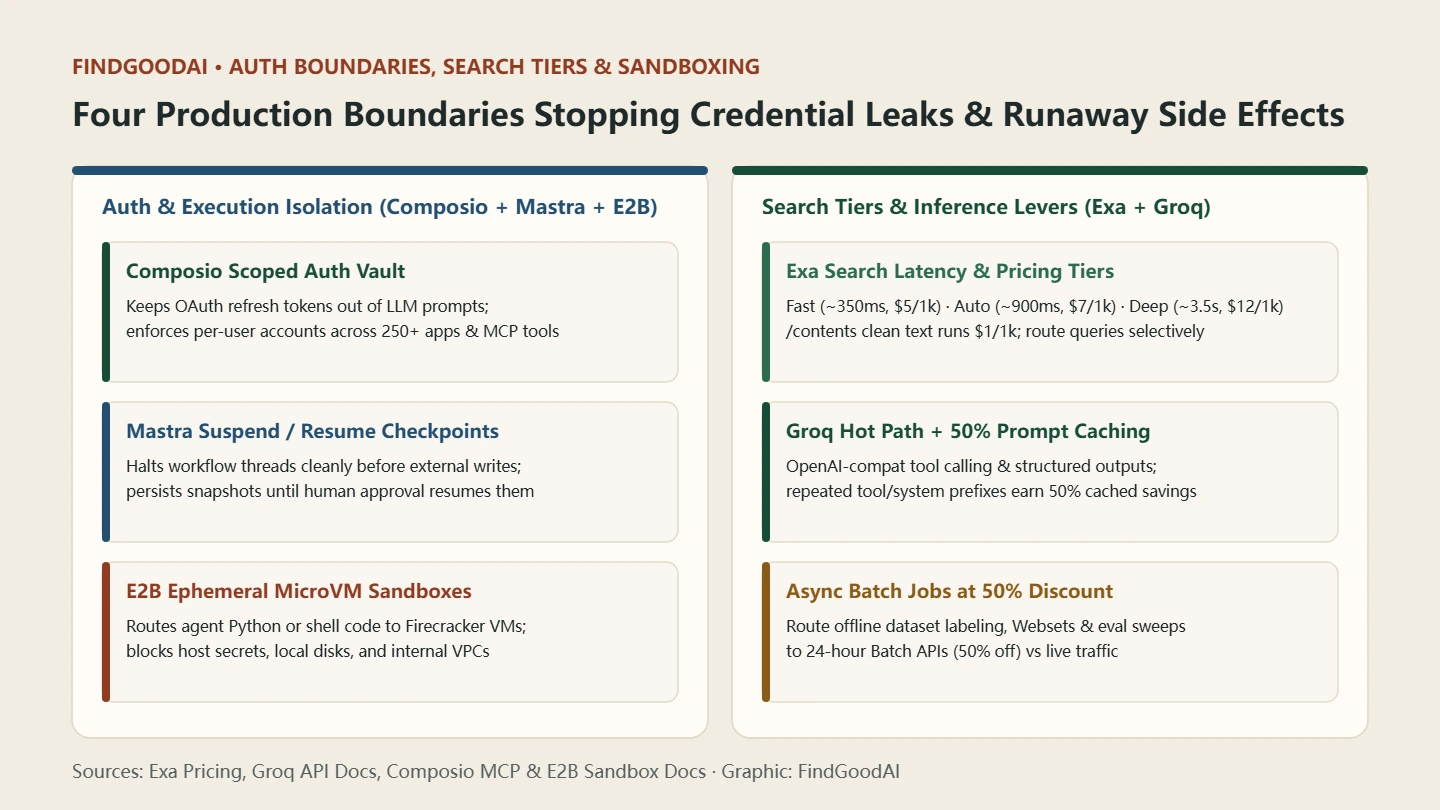
Layer 6 and rollout sequence: OTel spans, CI eval gates, and buy-vs-build
Having the first five layers wired cleanly still fails in production if engineering teams cannot pinpoint why a workflow stalled at 2 AM. Here teams must separate proxy-level logging from deep span tracing. Swap-in HTTP proxy gateways (such as Helicone) excel at capturing fleet-wide rate limits, model spend, and HTTP caching with a single Base URL edit, yet stay blind to local memory retrieval, search stalls, or multi-branch workflow retries happening inside your application process. Adopting Langfuse—available under an MIT open-source self-hostable core alongside managed Cloud—closes that visibility gap using OpenTelemetry (OTel) spans to stitch every model turn, decoupled prompt template version, Exa retrieval latency, Composio execution, and online LLM-as-a-Judge quality score onto one trace timeline. Teams formalizing pre-release developer discipline can pair those traces with our end-to-end coding agent workflow guide.
Before deploying prompt edits or swapping underlying weights to production, lock down a pre-merge verification gate: execute deterministic tool-schema assertions and boundary checks inside CI using Promptfoo, and verify self-hosted endpoints against open-loop tail-latency SLOs so a single noisy dependency never cascades across concurrent user threads.
# Scoped OAuth tool bridge + MIT OTel tracing
from langfuse import observe

@observe(name="agent-support-turn")
def run_turn(user_id: str, query: str) -> str:
  # Fetch OAuth tokens scoped only to user_id
  tools = composio.get_tools(
    user_id=user_id,
    toolkits=["GITHUB", "SLACK"]
  )
  # Execute untrusted scripts inside E2B MicroVM
  return execute_with_sandbox(tools, query)
# Pre-merge regression gate before deployment
tests:
- description: "Tool schema returns JSON & zero secrets"
assert:
- type: is-json
- type: not-contains
value: "OAUTH_REFRESH_TOKEN"
- description: "P99 self-hosted TTFT stays within SLO"
cmd: "gbench --golden-only --remote-endpoint $URL"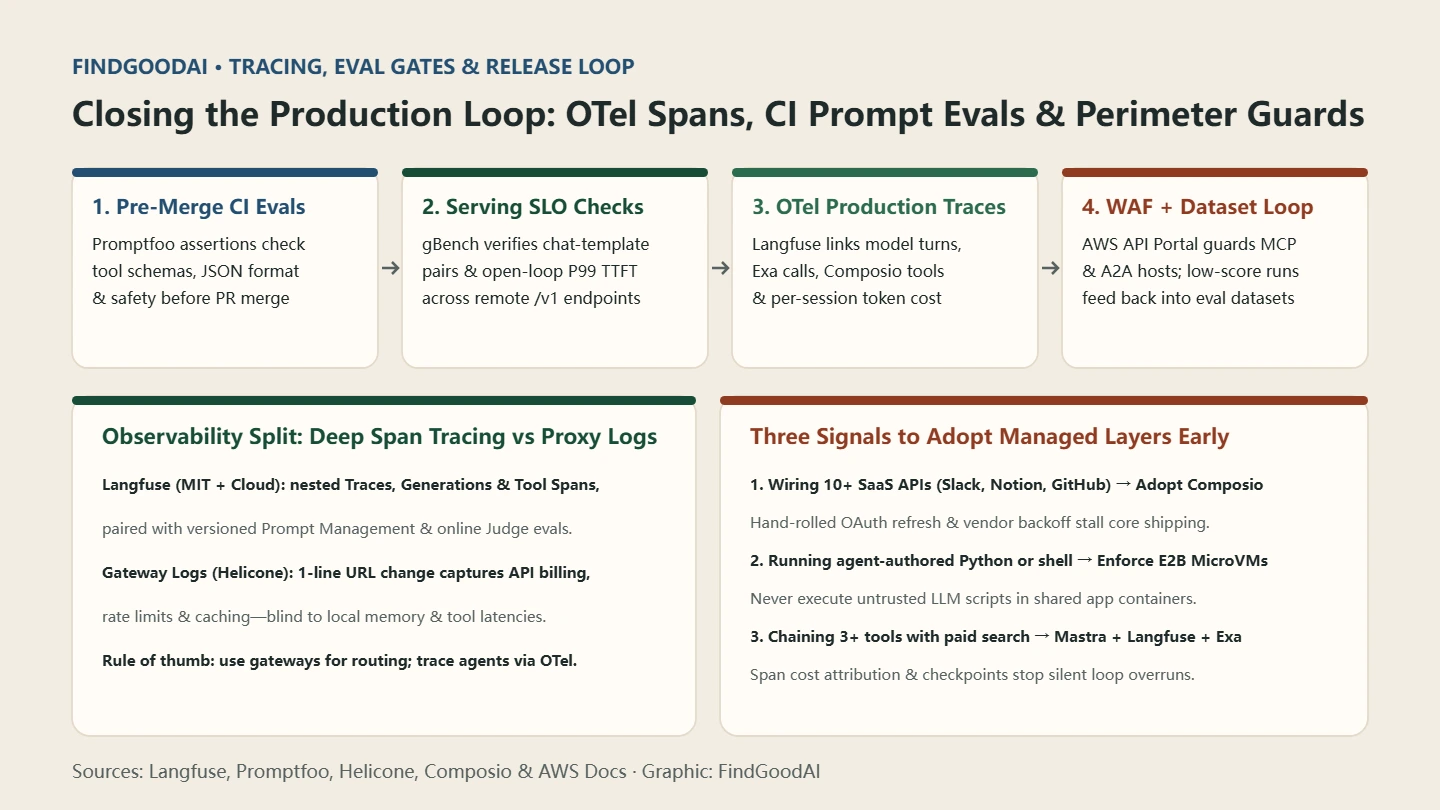
Finally, adopt these layers in measured stages rather than over-engineering week one. Start an initial two-person MVP with fast inference routing (Groq) + structured orchestration (Mastra or PydanticAI) + OpenTelemetry tracing (Langfuse) so latency and per-task budgets stay observable immediately; add Composio and E2B the moment workflows touch customer OAuth tokens or arbitrary code execution; and introduce tiered Exa research pipelines, Mem0 long-term memory, and automated Promptfoo CI regression suites as production usage scales.
Frequently asked questions
Should a small team adopt all six agent layers during week one of building an MVP?
No. Start lean with three essentials—fast inference routing, a typed orchestrator or workflow engine, and OpenTelemetry span tracing. Bring in Composio once workflows mutate user SaaS accounts, E2B before executing LLM-written code, and Mem0 plus CI eval suites as recurring volume grows.
Why run Langfuse OTel tracing if an LLM gateway already logs every completion call?
HTTP proxy gateways only see request/response payloads entering the model provider and miss what happened inside web search, vector lookups, or retried tool functions. Span-level tracing correlates prompt template versions, individual external tool latencies, and end-to-end session spend together.
Why use Composio’s auth vault instead of passing OAuth tokens into prompt context?
Storing credentials inside prompts exposes secrets to indirect prompt injection, telemetry logs, and silent expiration failures. Scoping tokens inside a user-keyed auth vault keeps refresh secrets isolated on the backend while the agent receives clean declarative tool definitions.
How should engineering teams split queries across Exa Fast, Auto, and Deep modes?
Route interactive chat and latency-sensitive UI flows through Fast (~350ms) or default Auto (~900ms), reserving Deep (~3.5s) strictly for multi-step research synthesis where recall justifies extra spend. Use the $1/1k /contents endpoint to extract clean page text without excessive overhead.
When are standard Docker containers no longer enough compared with E2B microVMs?
Standard containers work well for fixed, audited application code you wrote yourself. As soon as an agent can compose and run arbitrary Python or shell code, ephemeral Firecracker microVMs eliminate shared host-kernel and secret-exposure risks.
Sources
- FindGoodAI: AI Agent Infrastructure Stack Collection
- Groq API Pricing, Prompt Caching & Batch Docs
- Mastra TypeScript Agent Framework Docs (Apache 2.0)
- Composio Docs: Managed OAuth Vault & MCP Server
- Exa Search API & Latency Tiers Documentation
- Langfuse Documentation: OTel Tracing & Evals
- E2B Documentation: Isolated MicroVM Sandboxes
- Mem0 Documentation: Persistent Agent Memory Layer
Copy the link to save or share this article.