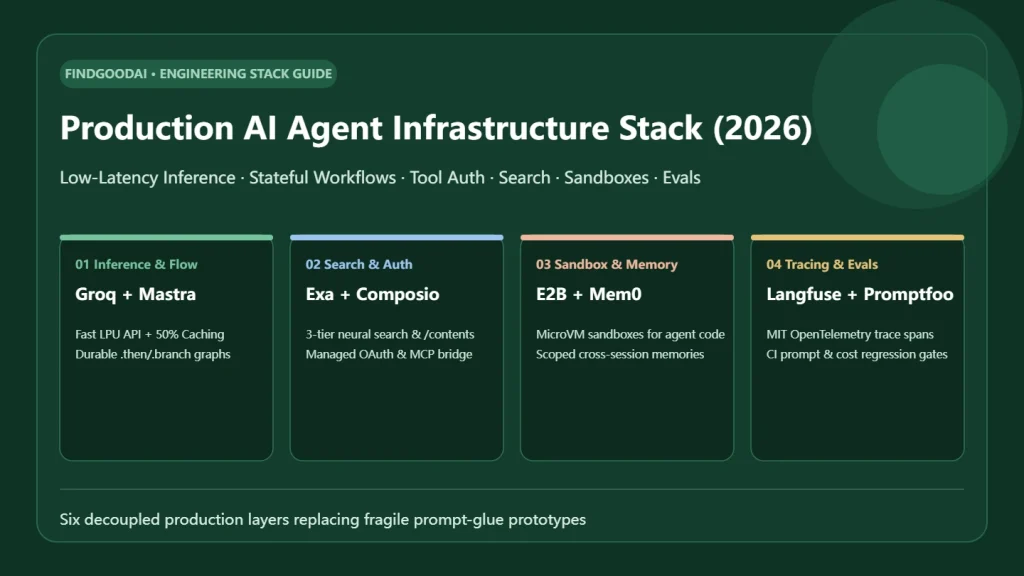
Turning an AI agent prototype into a reliable production system requires far more than picking a flagship model endpoint. Once real users send unpredictable inputs, multi-step tasks break without six coordinated infrastructure layers: deterministic orchestration, cross-session memory, token-efficient web retrieval, managed OAuth and MCP authentication, isolated execution sandboxes, and observability plus fast inference routing. This collection compares 12 verified tools—anchored by Mastra, Langfuse, Composio, Exa, and Groq—showing where each tool fits, what free allowances exist, and which operational limits appear as traffic grows.
AI Agent Infrastructure Stack Comparison (12 Tools)
| Tool | Stack Layer | Free Entry / License | Best Fit & Core Limit |
|---|---|---|---|
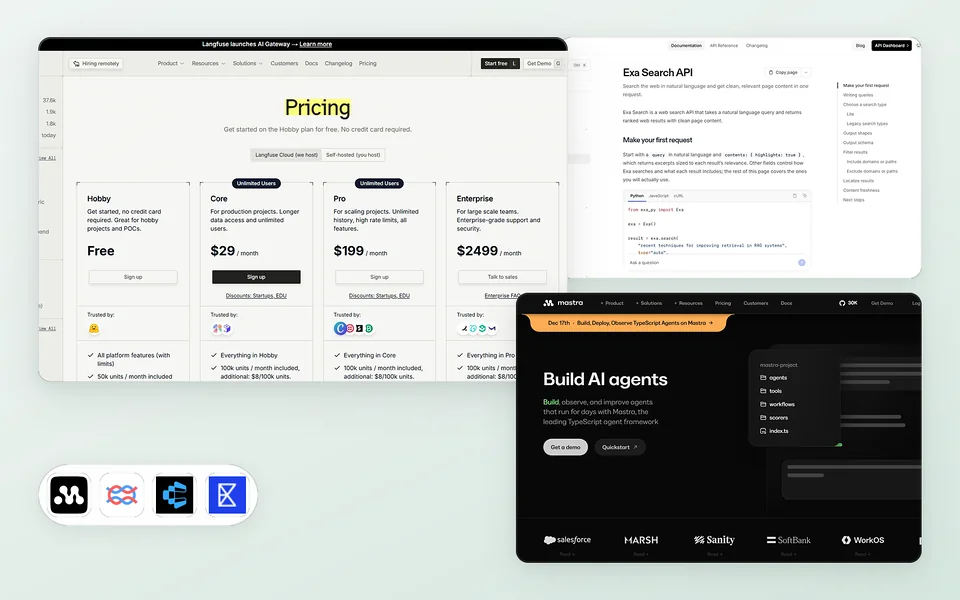
| Mastra | TS Agent Framework | Apache-2.0 core; Cloud Free $0 (100K events) | Full-stack TypeScript agents & workflows; `ee/` governance is dual-licensed |
| Pydantic AI | Python Agent Framework | MIT open source; Logfire free tier | Strict Python tool schemas & dependency injection; Python-only stack |
| CrewAI | Multi-Agent Crews | MIT open source; AMP Basic Free | Role-based sequential & crew flows; enterprise SLAs require paid plans |
| Mem0 | Persistent Memory | Apache-2.0 self-host; Cloud Free 50K BYOK adds | Cross-session preference distillation; 30-day cap on free hosted inference |
| Exa | Neural Web Search | Starter $0 ($10/mo credits + $10 bonus) | Token-efficient search highlights at 10 QPS free; ZDR starts on Growth ($1K/mo) |
| Crawl4AI | Web Crawling | Apache-2.0 free local & Docker | Clean LLM-ready Markdown on known URLs; scaling proxies managed by you |
| Composio | Managed OAuth / MCP | Hobby $0 (100K calls/mo, 20K managed apps) | 2,000+ app connectors & Firewall; Pro ($29/mo) unlocks 10,000 RPM |
| E2B | Code Sandboxes | Apache-2.0 runtime; $100 trial ($0 Hobby) | Cloud microVMs for untrusted code; 10 concurrent sessions & 1h runtime cap |
| Langfuse | Tracing & Evals | MIT self-host; Cloud Hobby $0 (50K units) | Hierarchical traces, prompt labels & AI Gateway; self-host runs ClickHouse |
| Promptfoo | CLI Eval & Red-Team | MIT local CLI; CI regression gates | Automated pre-merge security & accuracy evals; CLI workflow setup |
| Helicone | LLM Proxy & Gateway | Apache-2.0 OSS; Hobby $0 (10K req/mo) | Fast header-based proxy logging & caching; lighter dataset workflows |
| Groq | LPU Fast Inference | Free $0 (30 RPM / 200K TPD); $0.075/1M+ Paid | Ultra-fast substeps (~500–1,000 tps) & 50% batch/cache; Preview lacks SLA |
1. Orchestration & Runtime Frameworks: Mastra, Pydantic AI, CrewAI
Your orchestration choice should match your engineering team’s primary language and state control requirements rather than chasing low-code canvas demos. When to pick Mastra: Built natively in TypeScript for React, Next.js, and Node.js teams, Mastra combines typed Agents, deterministic .then() workflows with explicit retries, LibSQL/Postgres thread memory, and built-in Scorers inside one Apache-2.0 codebase. Its main limit is that specialized governance modules under ee/ carry the commercial Mastra Enterprise License, and verbose trace logging can quickly exhaust Cloud Free’s 100,000 monthly observability events ($10 per extra 100K events). When to pick Pydantic AI: Choose it for Python services that demand IDE-checked tool signatures, dependency injection, and fast graph validation, keeping in mind it stays strictly inside Python. When to pick CrewAI: Ideal when research or back-office tasks map naturally onto separate planner, researcher, and reviewer roles—watch out for prompt bloat when agents over-delegate back and forth without bounded iteration limits.
2. Persistent Memory & Live Web Context: Mem0, Exa, Crawl4AI
Multi-turn agents fail silently either when conversation transcripts exhaust context budgets or when naive web scrapers inject navigation menus and boilerplate script tags. When to pick Mem0: Add Mem0 when assistants must remember preferences, past tickets, or project conventions across weeks without replaying full chat logs. Its compression engine runs free via Apache-2.0 Docker + Qdrant self-hosting or on Cloud Free (up to 50,000 BYOK adds/month), though Mem0’s included inference credits expire after 30 days. When to pick Exa: Use Exa whenever agents search open-ended web topics, code repos, or company intelligence and need compact, citation-grounded highlights instead of noisy raw HTML. The no-card Starter tier grants $10 monthly credits (~2,500 Lite searches) plus a $10 onboarding bonus at 10 QPS, but unused free credits reset monthly and Zero Data Retention requires upgrading to Growth ($1,000/month billed annually). When to pick Crawl4AI: Pair Exa’s URL discovery with open-source Crawl4AI when you already know target documentation portals and need deterministic headless browser extraction into clean Markdown at zero per-page API cost (remember you must manage anti-bot rotation and proxy pools yourself at high volume).
3. Action Connectors & Execution Sandboxes: Composio, E2B
Moving an assistant from passive answering to taking actions inside user accounts or generating runnable code introduces two severe failure modes: credential leaks and host compromise. When to pick Composio: Choose Composio when your agent needs authenticated actions across Slack, GitHub, Gmail, Linear, Notion, or HubSpot via one Session API or hosted MCP URL (session.mcp.url). It handles OAuth token refresh server-side, redacts secrets on reads, and adds a Firewall against hidden prompt injections in external tool outputs. Platform Hobby provides 100,000 free monthly tool calls, limited to 20,000 calls on Composio-managed OAuth apps before providing your own OAuth apps; on the For You track, Standard SSO/ZDR plans remain marked Coming soon. When to pick E2B: Run every agent-generated Python script, spreadsheet transformation, or shell command inside E2B’s isolated cloud microVMs instead of your application container. Hobby starts at $0 with $100 in trial credits, capping concurrency at 10 active sandboxes and 1-hour session durations unless upgrading to Pro ($150/month).
4. Observability, Pre-Ship Evals & Fast Inference: Langfuse, Promptfoo, Helicone, Groq
Silent regressions happen whenever an upstream model shifts weights or a minor system-prompt edit breaks JSON tool calls. When to pick Langfuse: Adopt Langfuse as the primary telemetry hub for nested agent spans, cost per user/session, versioned prompt labels, and human annotation queues. All core platform modules—including the new AI Gateway—are MIT-licensed for self-hosting (expect to operate PostgreSQL, ClickHouse, Redis/Valkey, and S3), while Cloud Hobby gives 50,000 monthly units with 30-day retention and a 2-user cap. When to pick Promptfoo: Add Promptfoo in local workflows and GitHub Actions CI so every pull request passes deterministic JSON, red-team injection, and regression assertions before reaching users (note it focuses on offline CI testing rather than live production log ingestion). When to pick Helicone: Prefer Helicone if you only want a drop-in proxy header gateway for request logging, rate-limit dashboards, and semantic caching with minimal infrastructure setup. When to pick Groq: Route latency-critical classification, tool-routing checks, voice pipelines, and fast draft passes to GroqCloud LPU endpoints (~500 tokens/sec on GPT-OSS 120B at $0.15/$0.60 per 1M tokens, ~1,000 tokens/sec on 20B), keeping Preview models out of production SLAs and enabling Spend Limits once moving off the 30 RPM Free plan.
Practical Combinations by Team Stage
- Solo / Zero-Monthly-Cost Prototype Stack ($0): Run Mastra (or Pydantic AI) locally alongside self-hosted Mem0, Crawl4AI, Promptfoo CI, Composio Hobby (100K calls), Exa Starter ($10/mo free), Groq Free, and Langfuse Cloud Hobby (50K units).
- Small Product Team in Early Production: Upgrade Langfuse to Core ($29/mo, 90-day retention & unlimited seats) and Composio to Pro ($29/mo, 10,000 RPM), put agent-executed scripts inside E2B sandboxes, and move search to Exa Developer pay-as-you-go.
- Regulated Private-VPC Deployment: Self-host MIT Langfuse, Apache-2.0 Mastra/Mem0/Crawl4AI, and E2B’s open runtime inside private cloud networks paired with Zero Data Retention model contracts.
Frequently Asked Questions
Can teams assemble an open-source agent stack without SaaS vendor lock-in?
Yes. Orchestration (Mastra, Pydantic AI, CrewAI), memory (Mem0), crawling (Crawl4AI), evals (Promptfoo), tracing (Langfuse), and the E2B sandbox runtime are all MIT or Apache-2.0 licensed, leaving search (Exa), managed OAuth hosting (Composio), and LPU hardware (Groq) as swappable cloud APIs.
When should a team run both Exa and Crawl4AI instead of picking just one?
Use Exa when agents need open-ended semantic discovery across unfamiliar domains with minimal prompt tokens via Highlights, then hand explicit target URLs to free local Crawl4AI when full-page structured Markdown extraction is required.
Why keep Promptfoo alongside Langfuse?
Promptfoo excels as a developer-friendly local and CI red-team test runner before code merges, while Langfuse captures live production traces, user feedback, prompt versions, and online judge scores after deployment.
How much traffic does the $0 cloud tier combination cover before upgrades?
Across Hobby/Starter tiers you get 50,000 monthly Langfuse units, 100,000 Composio developer tool calls, ~2,500 Exa Lite searches per month, 100,000 Mastra observability events, and 200K tokens/day per core Groq model—enough for internal tools and early beta cohorts.
Official Sources
- Mastra Framework & Pricing
- Langfuse Open-Source Observability
- Composio Developer Platform
- Exa Search API
- Groq LPU Inference Cloud
Who it is for
- Engineering teams moving AI agent prototypes into reliable production
- Full-stack TypeScript & Python developers comparing open-source vs free cloud tiers
- Architects needing safe OAuth connectors, code sandboxes, and regression evals
Getting started
- Choose an orchestration core matched to your stack—Mastra for TypeScript or Pydantic AI/CrewAI for Python.
- Pair Mem0 persistent memory with Exa neural search or local Crawl4AI extraction for grounded context.
- Add Composio MCP connectors and E2B microVMs for safe action boundaries, plus Langfuse and Promptfoo for tracing and CI evals.
Workflow steps
- Keep day-one MVP monthly SaaS cost at $0 by combining open-source runtimes with no-card free tiers (Langfuse Hobby, Exa Starter, Composio Hobby, Groq Free).
- Promote untrusted script runs into E2B microVMs and filter third-party payloads with Composio Firewall before scaling.
- Trace p95 latency and token cost per step in Langfuse, routing sub-tasks to Groq to control spend.
Before you begin
- Exa Starter $10 monthly credits reset without rollover, and Zero Data Retention requires Growth ($1,000/mo billed annually).
- Langfuse self-hosting requires operating PostgreSQL, ClickHouse, Redis, and S3 alongside the MIT app container.