vLLM
CodingvLLM is an Apache-2.0 open-source LLM inference and serving engine featuring PagedAttention, continuous batching, and OpenAI/Anthropic-compatible APIs, 100% free to self-host.
LlamaIndex pairs the MIT-licensed RAG and agent framework plus local LiteParse with LlamaParse, a document parsing platform offering 10,000 free monthly credits.
LlamaIndex bridges messy real-world documents and LLM applications through two complementary pillars: an MIT-licensed open-source toolkit (LlamaIndex Framework for Python/TypeScript RAG, tool-calling agents, and event-driven Workflows, alongside the local open-source LiteParse parser) and the hosted LlamaParse platform for high-accuracy parsing, structured JSON extraction, classification, splitting, and managed indexing.
Editorial suggestion: Complex PDFs—such as SEC 10-K filings, research papers, product datasheets, and court records—are usually where RAG quality breaks down first. Starting with LlamaParse’s $0/month Pay-as-you-go plan gives you 10,000 free credits every month to convert multi-column layouts and dense tables into clean Markdown or typed JSON, while the open-source LlamaIndex framework lets you keep retrieval and embeddings completely under your control.
Financial filings & equity research RAG
Automated contract & invoice data extraction
Academic paper & technical datasheet search
Event-driven document agent workflows
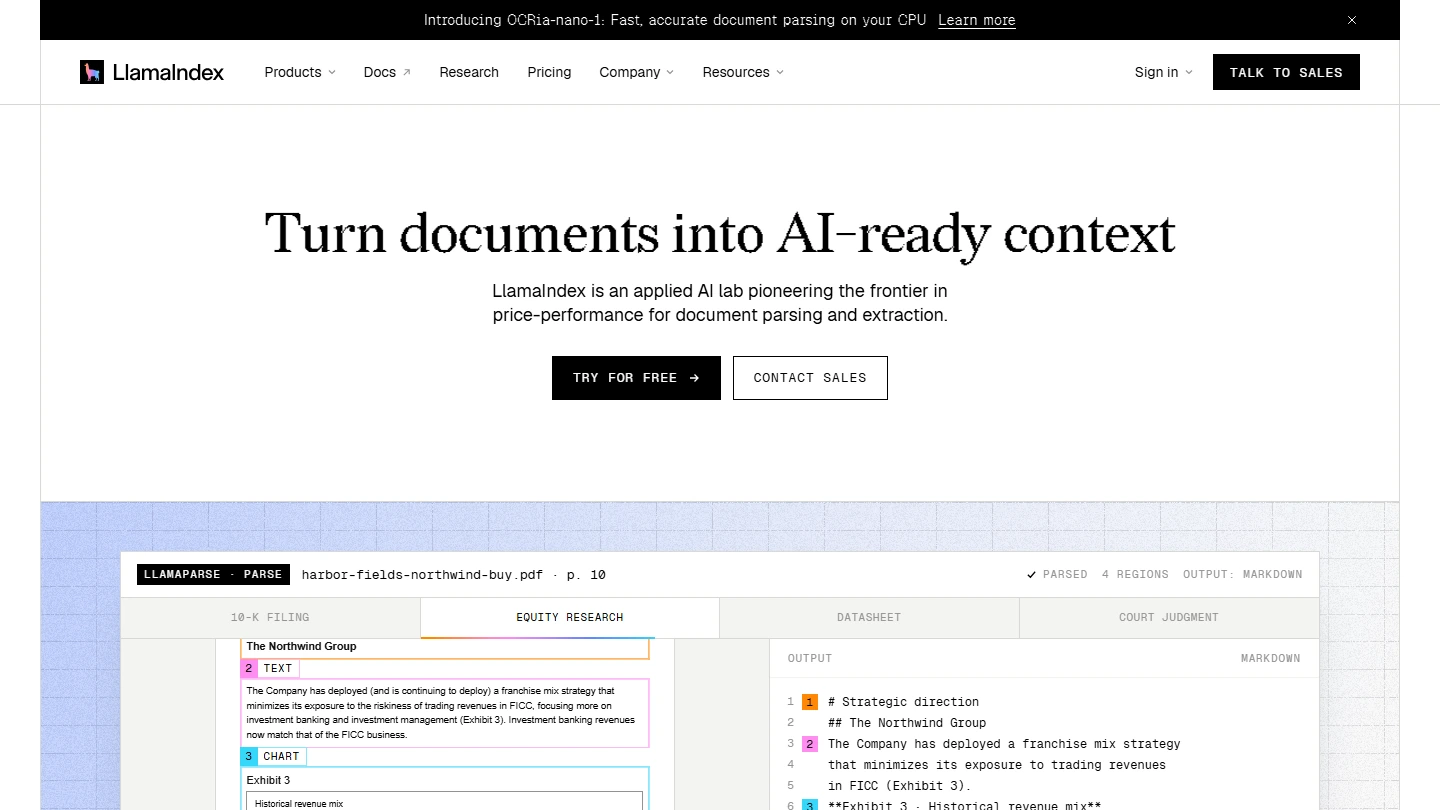
Official product image. Click to inspect the details.


Official examples and public-page captures; these are not results from a paid-feature trial.
Outline and number text blocks, multi-page tables, charts, headers, and footers in complex PDFs and convert them directly into clean Markdown.
Extract typed JSON matching your schema, classify incoming files, split multi-document packets, and keep indexes synced via managed ingestion.
Build retrieval pipelines, citations, text-to-SQL, and multi-step event-driven agent Workflows in Python using composable open-source connectors.
Run LiteParse locally for layout and OCR with no cloud dependency, or call LlamaParse via official Python, TypeScript, Go, and Java SDKs.
Install the framework or sign up for LlamaParse
Parse sample PDFs into Markdown or JSON
Index parsed documents into your vector store
Wrap the index inside a query engine or agent
Run pip install llama-index "llama-cloud>=2.8" and create a free LlamaParse account ($0/month, 10,000 monthly credits) to get your API key.
Upload a tricky PDF using client.parsing.parse() with tier="agentic" (or run local LiteParse) and inspect the extracted tables and regions.
Feed parsed Markdown into VectorStoreIndex backed by Pinecone, Qdrant, or Weaviate, or set Settings.embed_model for local embeddings.
Expose your index as a tool for a LlamaIndex agent or Workflow, and add evaluation and observability callbacks before production rollout.
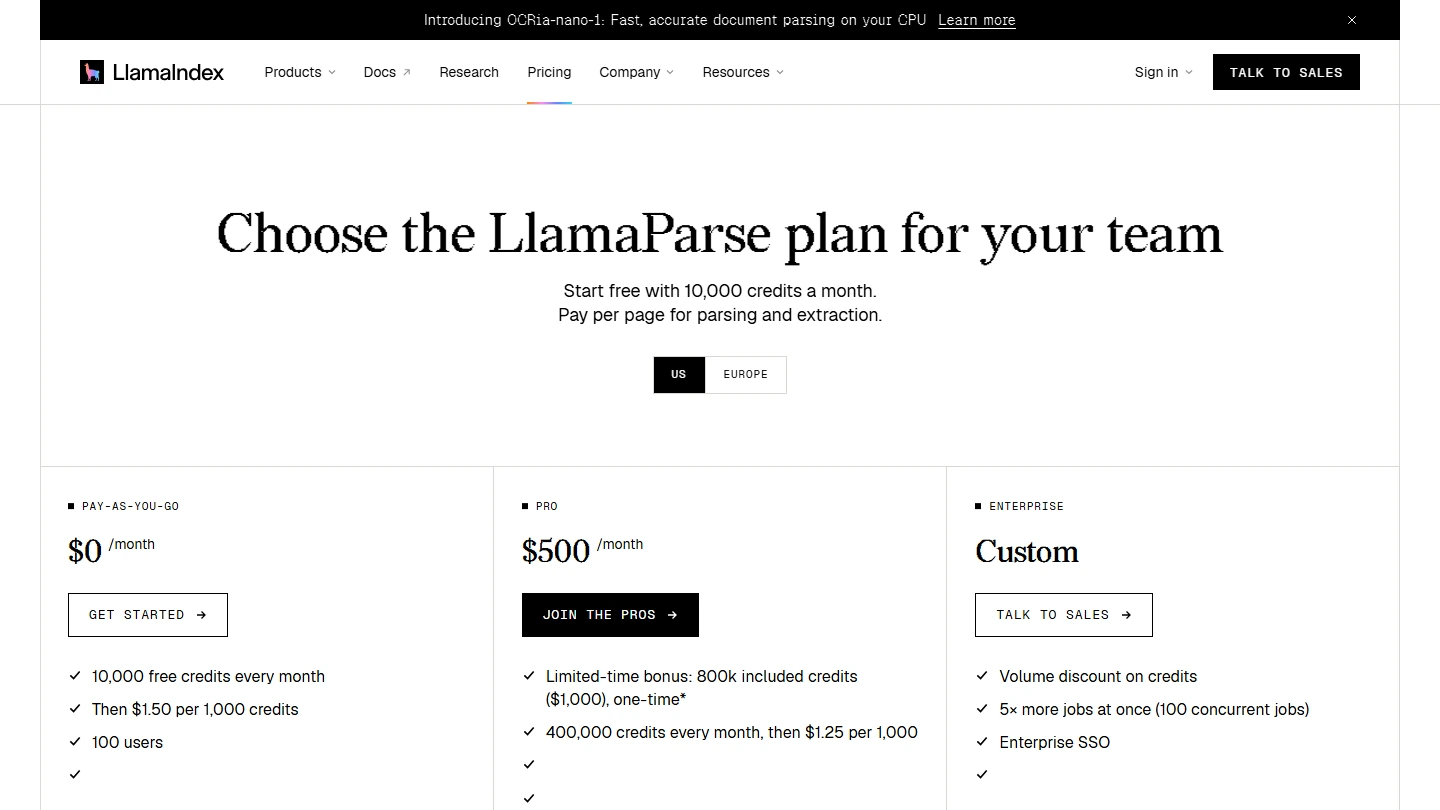
The LlamaIndex Framework, LiteParse, ParseBench, and ExtractBench are open source under the MIT license and free to self-host. For managed document parsing on LlamaParse, the Pay-as-you-go plan starts at $0/month and includes 10,000 free credits every month (up to 100 users and email support), followed by $1.50 per 1,000 additional credits, with regional hosting choices in the US and Europe.
The Pro plan costs $500/month for 400,000 monthly credits (then $1.25 per 1,000 credits), 100 users, and priority Slack support (with promotional one-time bonus credits offered for business email domains). Enterprise uses custom pricing with volume credit discounts, 5x concurrency (100 concurrent jobs), Enterprise SSO, single-tenant deployment in your own AWS/Azure/GCP cloud or on-premises, a dedicated account manager, and HIPAA-compliant processing with a BAA.
Yes. The LlamaIndex Framework and local LiteParse parser are MIT-licensed and free to self-host, while LlamaParse Cloud’s Pay-as-you-go tier costs $0/month and includes 10,000 free credits every month.
LlamaIndex renamed its hosted LlamaCloud platform to LlamaParse, bringing Parse, Extract, Classify, Split, and managed Index services together under developers.llamaindex.ai/llamaparse.
LiteParse is a lightweight open-source parser that runs locally on your own machine with built-in OCR and no API key, while LlamaParse is a managed platform tuned for complex scans, financial tables, charts, and high-concurrency batch jobs.
Yes. The pricing page offers explicit US and Europe region toggles for Pay-as-you-go and Pro, and Enterprise supports HIPAA-compliant processing with a BAA as well as single-tenant VPC or on-premise deployment.
The flagship open-source framework targets Python (with TypeScript/JS packages available), and LlamaParse provides official SDKs for Python, TypeScript, Go, and Java.
Yes. LlamaIndex includes a local-models tutorial and supports Ollama, vLLM, Qdrant, Weaviate, and Pinecone so embeddings and inference can stay fully local or hybrid.
Explore platforms, inputs and outputs, licensing, and access requirements.
These tools and curated collections overlap with parts of the workflow; compare the specific task, export requirements and current plan rather than treating them as identical products.
LlamaIndex states AICPA SOC 2, HIPAA, and GDPR compliance for its hosted platform, offers both US and Europe region selection on LlamaParse, and supports single-tenant cloud (AWS/Azure/GCP) or on-premises deployment plus HIPAA BAAs on Enterprise. Teams with strict air-gapped or zero-egress rules can use the MIT-licensed LlamaIndex Framework and local LiteParse parser without sending documents to external APIs.
Loading experiences…
Bring a real task and see how it fits the way you work.
User experiences