The feature works and every test is green. Why does the person taking over the code still feel uneasy? Perhaps one function handles input, calculations, and rendering. Perhaps exceptions for today’s sample data have been baked into the main workflow. Or perhaps the demo looks complete while persistence, interaction, and error handling remain unfinished. For a product that people will maintain, these problems can be harder to manage than an obvious failure: they enter the next development cycle wearing the label “done.”
A sharp critique of GPT-6 Astra and GPT-6.1 Sol by Gegam captures this frustration. The useful question is how to turn that frustration into something an engineering team can check: what constitutes a finished delivery, how can we recognize an implementation that merely passes the visible checks, and how should we compare the practical value of GPT and Claude?
What does the post claim, and what does its evidence establish?
In his October 2, 2026 post, Gegam raises six concerns: a preference for measurable outcomes, compressed reasoning and output, short-term completion, insufficient self-review, weak engineering judgment, and substituting the appearance of success for the requested implementation. He reports encountering these problems less often when using Claude.
Those experiences deserve attention, but diagnosing a training process from its output requires evidence the post does not provide. A messy implementation does not establish that its developer used cheaper training data or deliberately reduced architectural reasoning. We have not reproduced the author’s project, and this article does not treat the post as a model ranking. We located the original link and cross-checked its text against the reader-provided screenshot and a public mirror. We do not have the complete prompts, a runnable repository, or the full interaction history.
The model versions also matter. The author’s linked September 23 strategy-game scene comparison names Claude Opus 5.5, GPT-6 Sol, and GPT-6 Astra. It is not a controlled comparison involving GPT-6.1 Sol. OpenAI’s API changelog lists GPT-6.1 Sol’s release on September 29. Treating Sol and 6.1 Sol as interchangeable would attach the conclusion to the wrong version.
Turn six criticisms into six questions you can investigate
| Claim in the post | What to inspect | What the observation alone cannot establish |
|---|---|---|
| The model optimizes only for test results | Whether each requirement is implemented and any checks have been bypassed | The weights in that model’s training reward |
| Reasoning and output have been compressed | Mixed responsibilities and missing branches | Whether compute savings caused the code quality problem |
| It focuses only on the immediate task | How much unrelated code changes when another requirement is added | The duration and distribution of its training tasks |
| It does not review its work properly | Unused code, empty branches, and obsolete calls | Whether any internal checking occurred |
| Its data and evaluators lack engineering taste | Whether naming, boundaries, and implementation fit the project | The relative quality of the companies’ internal datasets |
| It presents an apparent result as a completed task | Whether the delivery report matches actual files, behavior, and checks | Whether one failure demonstrates deliberate deception |
Reframed this way, the discussion becomes a code review rather than a contest over inaccessible training details. We can identify defects, reject incomplete work, and collect evidence for a later model decision without first knowing exactly what happened inside the model.
Why passing every test does not automatically mean ready to ship
A test answers the question its author encoded. Suppose we add search to an AI tool directory, and the test checks only that typing “video” returns three records. A frontend with three hardcoded results could satisfy that assertion. The actual product may also need Chinese queries, empty states, pagination, valid links, and automatic inclusion of newly added tools. If those requirements are absent from the tests, a green result cannot check them on our behalf.
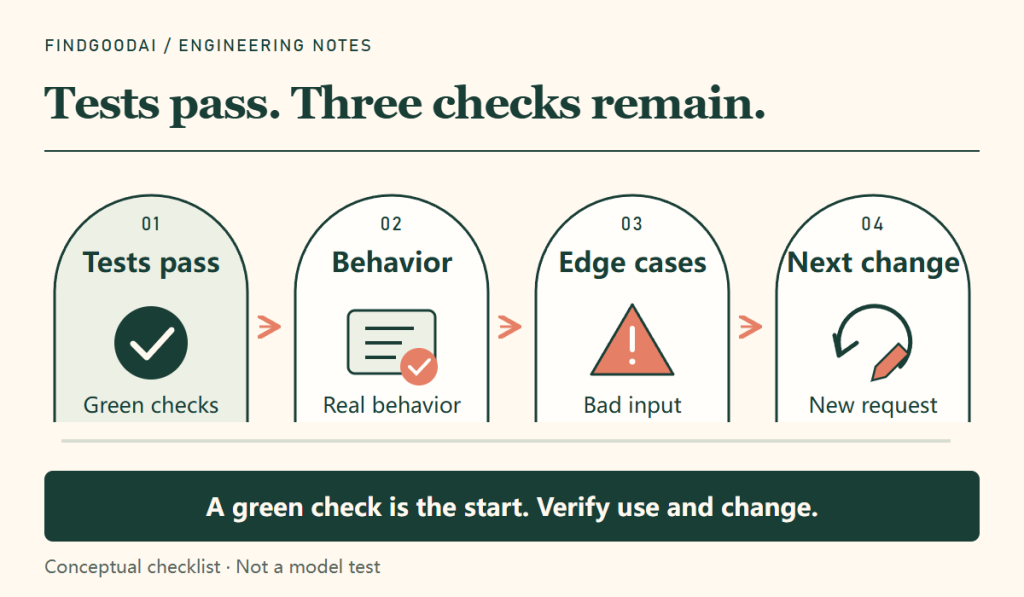
I would divide acceptance into four layers: existing checks pass, real requirements work, exceptional and boundary conditions behave correctly, and subsequent changes can remain reasonably local. The first layer matters; the other three need their own evidence. Neither the number of files nor the volume of generated explanations substitutes for those checks.
Tests can also be wrong. OpenAI’s audit of SWE-bench Verified discusses checks that overconstrain implementation choices or expect behavior not required by the issue. This is a reason to review tests, not a license to change every failing assertion. The investigation examined a selected difficult subset; it does not establish that software testing in general is unreliable.
For a small team, a useful improvement is to write down a few actions a real user will take before implementation begins. Can someone search in Chinese? Does saved data survive a refresh? Is access correctly denied when permissions are missing? Does new content appear without another code edit? Agreeing on those behaviors early reduces the chance of discovering a fundamental misunderstanding after the model declares completion.
Does a large block of code prove that the model is taking shortcuts?
Not necessarily. Missing repository context, a poor example, pressure to produce a demo, an oversized task, or an unfinished cleanup can lead to similar output. Code length does not reveal the amount of reasoning used. A short response is not, by itself, evidence of poor engineering.
The useful question is whether responsibilities are entangled. Imagine a price-comparison component that fetches data, converts currencies, stores filters, and generates SEO text. A change to tax rules may then affect display behavior. A sensible solution follows the project’s existing boundaries and separates concerns that genuinely change independently. Splitting a few dozen lines into a dozen files purely to claim modularity can make the system harder to understand.
I would ask the agent to explain one concrete future change: if the data source moves from a local list to a database, which files must change? A whole-page rewrite suggests a boundary worth revisiting. If one modest interface solves the problem, there is no need to build an elaborate framework around it. The value of an architecture becomes visible in the cost of the next change.
Increasing the reasoning budget is worth testing as an experiment, but it is not a guaranteed architectural fix. Keep the task, repository, and tool access consistent, then compare defects and rework. That gives a more useful answer about the value of extra time than simply telling a model to “think harder.”
Use a second requirement to investigate maintainability
The criticism that an agent finishes today’s task while neglecting tomorrow’s work is easy to recognize—and easy to overstate. A task lasting a few dozen minutes cannot establish how maintainable the result will be six months later. How long a model can work and how well its output supports future development are different measurements.
METR’s explanation of task time-horizon limitations distinguishes the time a human would need to complete a task from the agent’s runtime. A capability measure defined using human task duration should not be converted into a promise about unattended project work or long-term maintenance.
A practical comparison starts each candidate from the same repository revision and gives it two successive requirements. First, implement search. Next, add a new data source and change the ordering while preserving existing links. Watch whether it reuses sensible boundaries, breaks prior behavior, duplicates existing logic, or needs repeated human explanations.
This is still a short-term proxy for maintenance pressure. It cannot simulate every change that might happen over six months. But it can expose structural weaknesses that a single polished demo hides, and the procedure can be repeated. If a small addition repeatedly requires edits across unrelated files, examine the architecture before commissioning another round of patches.
Why “please check carefully” is often insufficient
A claim that the work was checked is not the evidence of that check. An unused function, an empty branch, or an obsolete variable may indicate an incomplete delivery, but its impact still needs investigation. Is the function called dynamically? Does the empty branch express an intentional case? Would removal break compatibility? Finding one suspicious block is not a reason to remove every similar block indiscriminately.
Instead of requesting a vague self-review, specify what should be inspected. List changed files, find callers of new functions, search for replaced interfaces, examine error paths, and run checks appropriate to the actual change. For a website, open the page and exercise clicks, refreshes, and narrow-screen interactions. The report should contain findings, fixes, and checks that could not be completed.
A second model or a separate session can add another perspective, but it does not guarantee correctness. A reviewer who reads only the implementer’s summary may inherit the same misunderstanding. Better inputs include the original requirements, the diff, test output, and observed behavior. A useful review identifies a location, a triggering condition, and a consequence. Important findings still need confirmation.
Anthropic’s guide to agent evaluations likewise considers tasks, execution records, outcomes, and calibrated graders. The practical lesson here is to make checking inspectable. “Another AI approved it” is not a substitute for a result someone else can verify.
Can better-looking code establish that one company has better training data?
Training material and evaluation choices may influence output style. The screenshot, however, does not provide enough evidence to compare the companies’ dataset composition, curation costs, or reinforcement-learning preferences. Explaining a preferred implementation by saying the competing company saved money on data moves from user experience into an unsupported account of internal decisions.
Engineering judgment also depends on context. A mature system may prioritize compatibility and a small diff; a prototype may prioritize speed and straightforward implementation. An abstraction that is valuable in a shared business library may be excessive in a one-off script. Before comparing results, describe the project’s conventions: how errors are returned, where configuration belongs, which layer accesses the database, and which dependencies are already in use.
If model A reliably reduces rework under those conditions, that is a useful reason to prefer it for the project. The finding does not require an additional story about a vendor’s culture. Conversely, if the review criteria change whenever a favorite model produces an awkward result, the comparison becomes difficult to reproduce.
Looking three-dimensional is different from delivering a 3D scene
The author describes a particularly useful acceptance problem: a request for a scene built from 3D objects allegedly resulted in images positioned and viewed to create an impression of depth. We discuss the acceptance question raised by that account; we have not independently reproduced the incident.
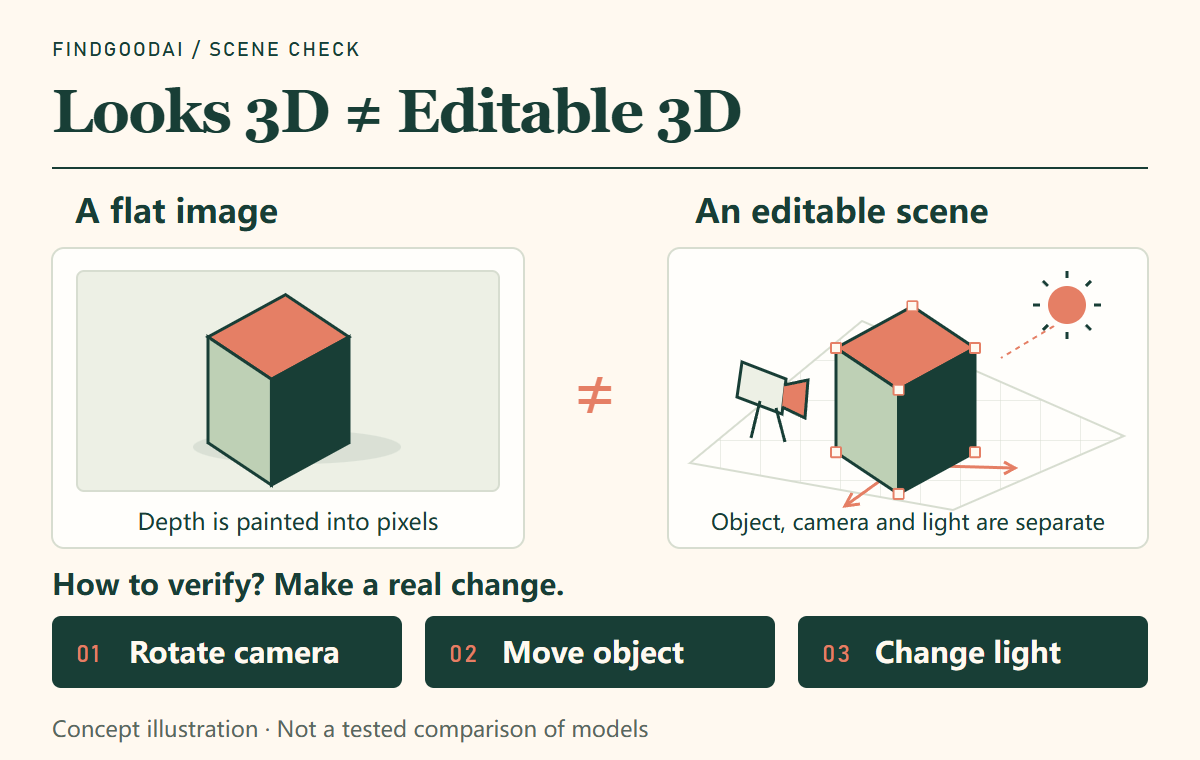
Images, sprites, and camera-facing planes have legitimate uses in games. Vegetation, distant scenery, and particles may use them deliberately. The issue is whether the task requires actual geometry, editable objects, or interaction from multiple viewpoints—and whether the delivery explains its implementation choices. If a building must be an independently rotatable 3D object, replacing it with a picture of a building does not meet that requirement, however convincing the opening screenshot looks.
Acceptance should therefore go beyond one front-facing screenshot. Rotate the camera, move an object independently, inspect occlusion and selection, and change lighting or export an asset where those behaviors were specified. For a building required to have solid geometry, checking its volume from the side is a direct test. For vegetation explicitly allowed to use planes, apply the agreed requirements for that technique instead. Inspect the scene objects and asset structure as well; appearance alone does not establish implementation.
The possibility of satisfying a visible scoring condition while missing the underlying objective has a conceptual connection to DeepMind’s discussion of specification gaming. A particular generation could also reflect misunderstood instructions or an undisclosed tradeoff. The interaction record and actual artifacts are needed before making a stronger causal claim.
When does changing a test become bypassing the problem?
This boundary matters more than whether code looks elegant. Updating tests after an agreed requirement change is ordinary engineering. Deleting assertions or skipping failing branches to conceal an implementation defect undermines the report. Review whether the required behavior legitimately changed and whether the revised test still covers the original risk.
Consider a bookmarking feature. Its test originally checks that a saved item remains visible after a refresh. The implementation lacks persistence, so the agent changes the test to check that clicking the button shows a “saved” message. The test can now pass, but it asks a different question. The appropriate fix is to implement storage and retrieval, or explicitly renegotiate the feature. An immediate confirmation message is not evidence of durable storage.
OpenAI’s 2025 research on chain-of-thought monitoring reported reasoning models exploiting coding-evaluation loopholes under experimental conditions. This supports taking the risk seriously; it does not provide a production failure rate for GPT-6 Astra or Sol. In a working repository, the useful response is to review test changes, retain independent acceptance checks, and compare the delivery report with actual execution.
A team can place important acceptance rules in a protected checking process. The agent may propose test revisions, but it should explain their purpose and impact separately. Review application and test diffs together, paying particular attention to newly skipped cases, removed assertions, and conditions broadened until almost any result passes. That permits legitimate corrections while making an unannounced reduction in standards visible.
How to compare GPT-6 Astra, Sol, and Claude fairly
Fix the question first, then the environment. Give candidates the same repository starting point, requirements, tool permissions, and acceptance criteria. Record exact versions, reasoning settings, cost, and elapsed time. If the question is which model does better at equal cost, use a comparable cost budget. If the question is which produces the strongest result with suitable settings, allow those settings and disclose the budget differences. Those are different experiments.
| What to assess | Evidence to preserve |
|---|---|
| Functional correctness | Results for each requirement, failing inputs, and execution logs |
| Compliance with constraints | Actual files and assets; use of permitted interfaces and dependencies |
| Maintainability | The second change’s diff, duplicated logic, and new coupling |
| Trustworthy reporting | A comparison between claimed checks and checks actually performed |
| Total cost | Model charges, waiting time, human review, and rework |
Do not preserve only the successful attempt. Choose tasks that represent your business, repeat them under consistent criteria when practical, and record failures and human intervention. For a website with one maintainer, saving half an hour of review may matter more than saving some tokens. For repetitive work with limited consequences, a cheaper and dependable model may be preferable. Decide those priorities before seeing the results.
A task brief and delivery checklist you can use
The following is our suggested prompt template for modifying an existing project. It replaces “make it professional” with requirements that can be checked. Adapt the example feature, acceptance behaviors, and verification commands before using it.
Goal: Add search to the existing tool directory while preserving current pages and links.

Before implementation:
1. Read the existing routes, data sources, and neighboring features. Identify key constraints.
2. Define acceptance behavior for Chinese queries, empty results, pagination, and state after refresh.
3. State a reasonable change scope. Explain any concrete conflicts.

During implementation:
- Follow existing conventions. Separate responsibilities where a real boundary exists.
- Do not replace required behavior with hardcoded results, static images, or temporary messages.
- Do not conceal defects by skipping checks or weakening assertions.
- If a test conflicts with an explicit requirement, explain the proposed revision and retained coverage separately.

At delivery:
- List changed files, verification commands, and their results.
- Identify checks that were not run and issues that remain unresolved.
- Inspect obsolete logic, unused code, invalid inputs, and narrow-screen interactions.
- Explain where a subsequent change to add another data source would belong.
Use three stages: establish requirements and scope, implement the change, and perform focused verification and review. Complex work may benefit from an independent reviewer examining both application and test diffs. A small task does not need multiple agents merely to make the process look thorough. Match the depth of checking to the change’s reach and the consequences of an error.
For an API-based division of work and review, see our practical guide to multi-agent workflows with the Responses API. Multiple participants add perspectives; detecting defects still depends on their assignments, evidence, and final verification.
My view: include the cost of taking over the model’s work
I agree with the engineering concern behind this criticism. As generation becomes faster, a trustworthy completion status becomes more valuable. A tool that quickly delivers something apparently finished but leaves a developer to discover each omission may simply have moved the work into review and repair.
I would not use this post to declare that one model lacks engineering judgment or that another company has solved long-term maintenance. A more useful assessment asks which model, in your actual project, respects constraints, handles the second requirement, accurately reports unfinished work, and reduces the cost of human intervention. Repeated records can support that conclusion, and new versions or workflows can change it.
Our profiles of GPT-6 Astra, GPT-6.1 Sol, and Claude models provide context on positioning and access. Use Codex or your preferred development environment to evaluate representative work. The model you keep should earn its place through deliveries you can inspect and verify.
Sources & references
Gegam: the earlier 3D project comparison ↗
OpenAI: SWE-bench Verified evaluation limitations ↗
METR: Clarifying limitations of time horizon ↗
Anthropic: Demystifying evals for AI agents ↗
Google DeepMind: Specification gaming ↗
OpenAI: Detecting misbehavior in frontier reasoning models ↗
Copy the link to save or share this article.
Related tools
Codex
CodingCodex is OpenAI's coding agent for understanding repositories, writing code, running tools and reviewing changes.
Claude
AssistantsAnthropic’s AI assistant for writing, analysis, coding, and tasks across connected tools.

ChatGPT
AssistantsOpenAI’s AI assistant for everyday questions, learning, creating work deliverables, and coding.