
Sources & references
Quick start and persistent storage ↗
A self-hosted AI chat interface for local and compatible cloud models, with document knowledge, reusable workspaces and optional tools.
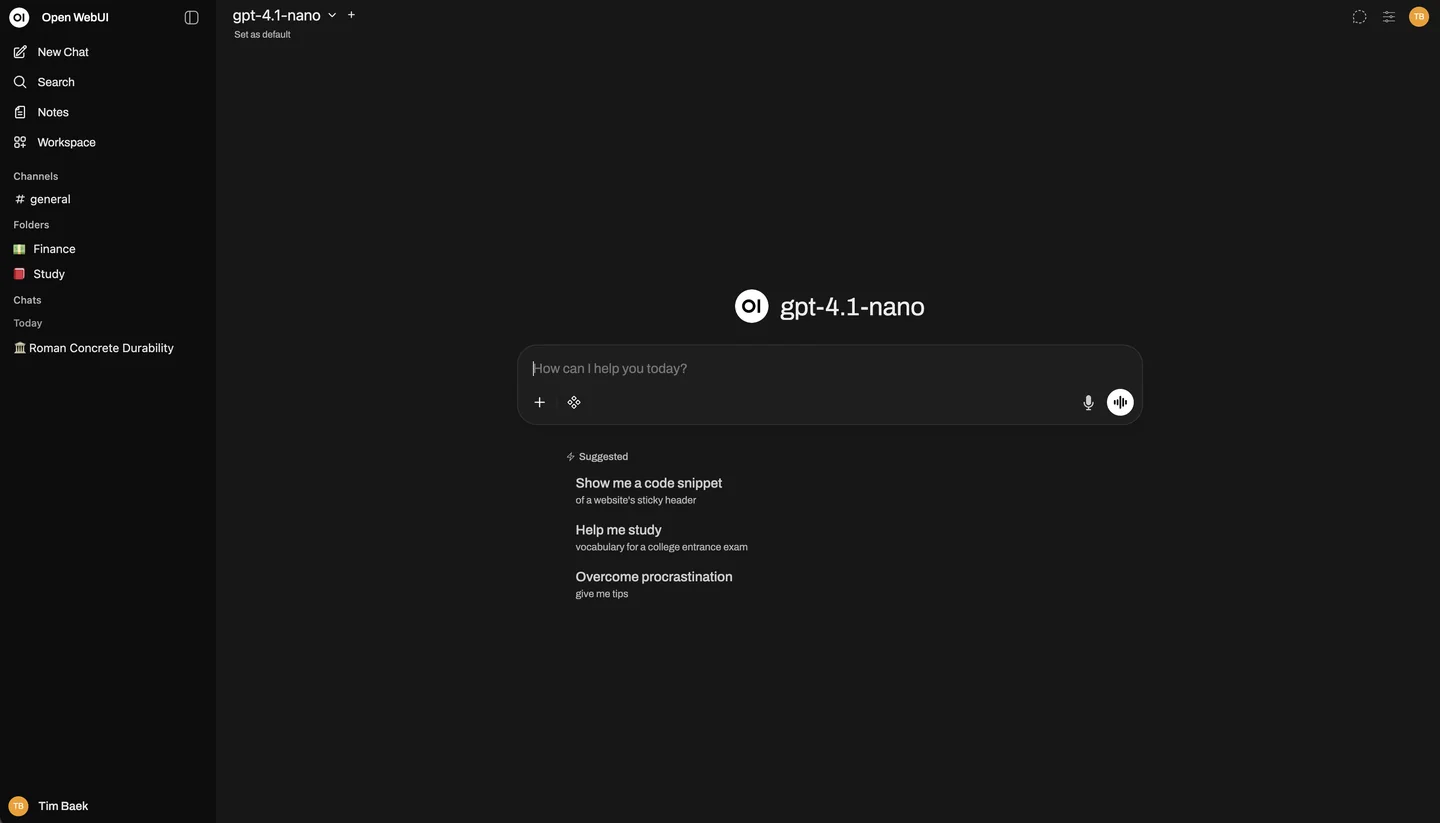
Open WebUI is the conversation layer between a person and one or more AI model services. It can sit in front of a local Ollama installation or a compatible external API, adding a browser interface, organized conversations and document workflows. This is useful when a raw model endpoint works but is inconvenient for everyday reading, writing or team use.
It is not itself a language model. A successful installation still needs a reachable model service, and a larger model still needs suitable hardware or a paid provider. Begin with one model and ordinary chat, then introduce retrieval and tools. That sequence makes it easier to distinguish a connection problem from a document-indexing issue or an extension failure.
A shared household model interface
Research notes with source checks
A consistent writing workspace
A controlled tool experiment
Official product image. Click to inspect the details.
Deploy with persistence
Connect one model
Add a small knowledge collection
Set access and backup rules
Example prompt or task: Use the attached notes to explain the decision, the supporting evidence and the unresolved questions. Identify which source supports each factual statement. Keep suggestions separate from facts found in the notes.
This editorial task tests whether retrieval is useful rather than whether the model sounds confident. Include a question the notes do not answer and check that the response acknowledges the gap.
Software access does not include unlimited cloud inference. The current license includes branding requirements.
Open WebUI offers a free self-hosted software route under its current license. Server rental, storage, electricity and any external API or search service remain separate costs. A completely local model setup can avoid per-request cloud billing after the necessary models are downloaded.
The current license contains branding conditions. An exception concerns deployments with at most 50 natural-person end users over a rolling 30-day period, alongside other authorization options. That provision concerns branding; it should not be misreported as a universal 50-user free-use ceiling. Consult the full license for your intended deployment.
No. It is interface software. The models come from local inference services or configured providers, with their own requirements and terms.
A fully local model, retrieval and tool setup can operate without cloud inference after downloads. Enabling external search or cloud APIs creates network dependencies.
The browser interface and installable app experience can access your deployment. Model inference normally remains on the connected server, not automatically on the phone.
Only for components that actually run locally. Cloud model, embedding, search and tool requests can still transmit the content they need.
Persistent storage is essential. Follow the documented volume arrangement and back up the data before replacing or upgrading the application.
An extension can execute code or access services within its permissions. Review its source and purpose, and keep permissions aligned with the actual task.
The current custom license sets conditions and exceptions. Check those terms rather than assuming a blanket MIT-style permission.
Explore platforms, inputs and outputs, licensing, and access requirements.
The application is managed through a browser and can be deployed using documented Docker or Python-based options. Its data directory in the standard container is /app/backend/data. Persist that directory; an expendable container is different from expendable user data.
The documentation also recommends a stable WEBUI_SECRET_KEY for predictable session behavior across restarts. Model files, the model server and Open WebUI data are separate components. A backup plan needs to identify which component contains conversation history and which contains reusable downloaded weights.
Map every connected service before storing private reference material. A local browser tab is not proof that a request stayed local. Also consider access to stored chats, uploaded files, administrator settings and backups, not just the endpoint that generates text.
Install only extensions whose behavior you understand and limit administrative access. The current Open WebUI license includes branding requirements; model licenses and document rights remain independent. This listing describes a free self-hosting path, not a promise that every possible hosted service or white-label arrangement is unrestricted.
Reviewed October 3, 2026. Product facts come from the official sources below. Suggested projects, prompts and review methods are FindGoodAI editorial guidance, not measured performance results.
Quick start and persistent storage ↗
Loading experiences…
Saved tools are private. Approved comments are public; edits return to moderation. Comment counts include approved comments and replies. Each person has one rating. New ratings are automatically approved; withdrawn, unapproved or invalid ratings do not count. Share real experiences and avoid spam, private information or personal attacks.
For moderation appeals or data requests: support@findgoodai.com
Bring a real task and see how it fits the way you work.
User experiences