
Humata
ProductivitySearch, summarize and compare uploaded documents with source-linked answers. Humata adds team-oriented document access and page-based plans for ongoing knowledge work.
Questions across filesCited passages
A free self-hosted research workspace for collecting sources, asking questions, writing notes and creating audio summaries with separately configured AI providers.
Open Notebook is a research workspace that brings sources, notes and model-assisted conversations together. The project describes multiple notebooks, search, content transformations and podcast generation, while allowing the operator to choose supported AI providers. It is independently developed and should not be confused with Google NotebookLM.
The useful distinction is control over the research environment. You can decide where the application runs, what material enters a notebook and which model handles a task. That does not automatically make every workflow offline: extraction, embeddings, chat and speech may each use a different configured service.
Prepare an article research file
Build a personal study notebook
Compare document versions
Make an audio review draft
Official product image. Click to inspect the details.
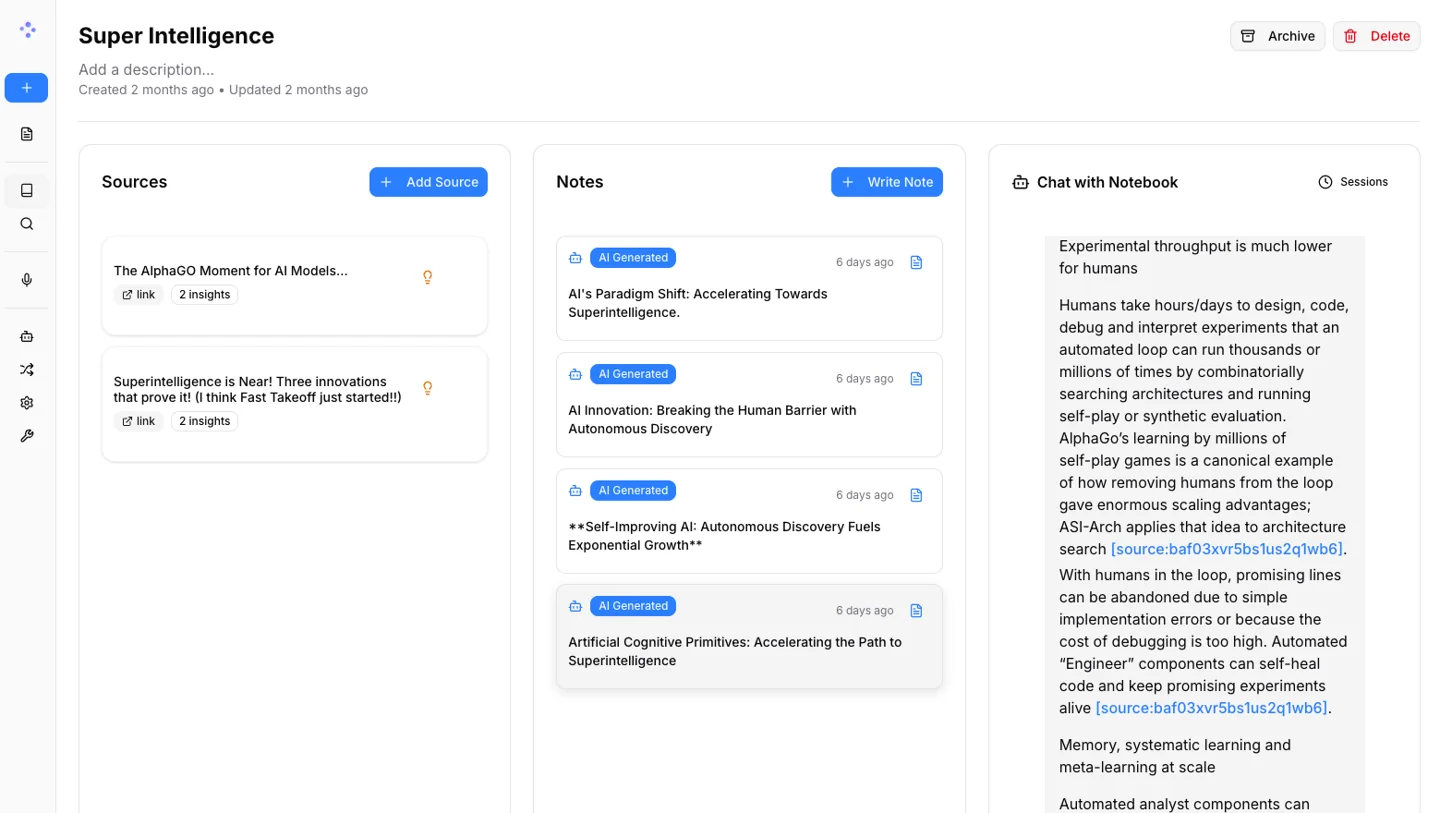
Choose the deployment and models
Add a small source set
Ask a bounded question
Save a reviewed result
Example prompt or task: Using only the selected sources, compare their explanations of this topic. Separate shared findings, disagreements and missing evidence, and provide source references that I can check before saving the note.
This is an editorial workflow example. References are aids to verification, not a guarantee that a generated statement is supported.
A documented local-model route avoids a required cloud-model subscription. Each enabled processing stage still needs appropriate resources and configuration.
Open Notebook is MIT-licensed software that can be self-hosted without purchasing an application subscription. The official local setup describes a route using local language and embedding models, with the user supplying the hardware and storage.
Cloud language models, embedding APIs, transcription and text-to-speech services may each add costs. Podcast support in the application does not include unlimited paid voice generation. Check the provider combination for the exact workflow rather than assuming the whole notebook is free because the interface is open-source.
The MIT application is free to self-host. Models, hosting and speech resources are separate.
No. It is an independent open-source project.
The official documentation includes a local-model route. Configure both language and embedding needs.
No. Check extraction and processing status.
The chat workflow provides source-context choices.
No. The selected generation and speech providers determine the resource cost.
No. Check the referenced source passage before relying on a claim.
Explore platforms, inputs and outputs, licensing, and access requirements.
The project documents container-based and developer installation routes. It uses persistent application and database storage, so backups and a clear update process matter when notebooks become important working records.
Scanned documents and image OCR require the appropriate processing engine, while audio and video need suitable transcription configuration. Web extraction can fail or return incomplete text. A small import review is often more useful than immediately adding hundreds of files.
Self-hosting controls the application location, but configured cloud providers may receive selected text or audio. Map the extraction, embedding, chat and speech stages before importing sensitive material.
Configure credentials, encryption settings and access controls according to the deployment guide. Preserve source rights and avoid exposing a personal research instance publicly with development settings or shared secrets.
Reviewed October 3, 2026. Product facts come from the official sources below. Suggested projects, prompts and review methods are FindGoodAI editorial guidance, not measured performance results.
Loading experiences…
Saved tools are private. Approved comments are public; edits return to moderation. Comment counts include approved comments and replies. Each person has one rating. New ratings are automatically approved; withdrawn, unapproved or invalid ratings do not count. Share real experiences and avoid spam, private information or personal attacks.
For moderation appeals or data requests: support@findgoodai.com
Bring a real task and see how it fits the way you work.
User experiences