

Sources & references
Current LobeHub product overview ↗
Current LobeHub introductory documentation ↗
The project formerly called LobeChat now presents itself as LobeHub: a workspace for agents, models, tasks, pages, memory and connectors. Cloud credits and self-hosted infrastructure are separate decisions.
LobeHub is the current identity of the open-source project long known as LobeChat. The official GitHub repository and current documentation describe a broader agent workspace, not only a chat interface. Users can open a conversation for immediate exploration, make tasks that need follow-up, save longer results as Pages, attach resources, and configure connectors or skills for specific agent jobs. The product can be used as a hosted cloud service or through a separately operated self-hosted deployment. These paths should be evaluated against different cost, maintenance and data-control needs.
Build a first agent around one narrow, verifiable task. For example, give a research agent a small set of approved documents and ask it to answer a question with source references. Compare the answer with the original files, then decide whether the same agent needs a connector or memory. A connector may read or act on another service, so grant only the permissions needed. Keep a human review point before sending messages, modifying records or publishing material. More agents do not automatically produce a better result; clear task boundaries matter.
The current cloud pricing page lists a Free allowance of 500,000 Credits per month, Starter at five million, Premium at 15 million and Ultimate at 35 million. The visible discounted per-month figures are tied to yearly billing, while a comparison table shows higher true month-to-month prices. Credits map to model token usage, so message counts are only examples and vary by model and prompt length. A self-hosted instance does not mean model inference or server operations are free; providers and infrastructure require their own budgeting.
Document-grounded team agent
Research and writing workflow
Private experimental workspace
Official product image. Click to inspect the details.
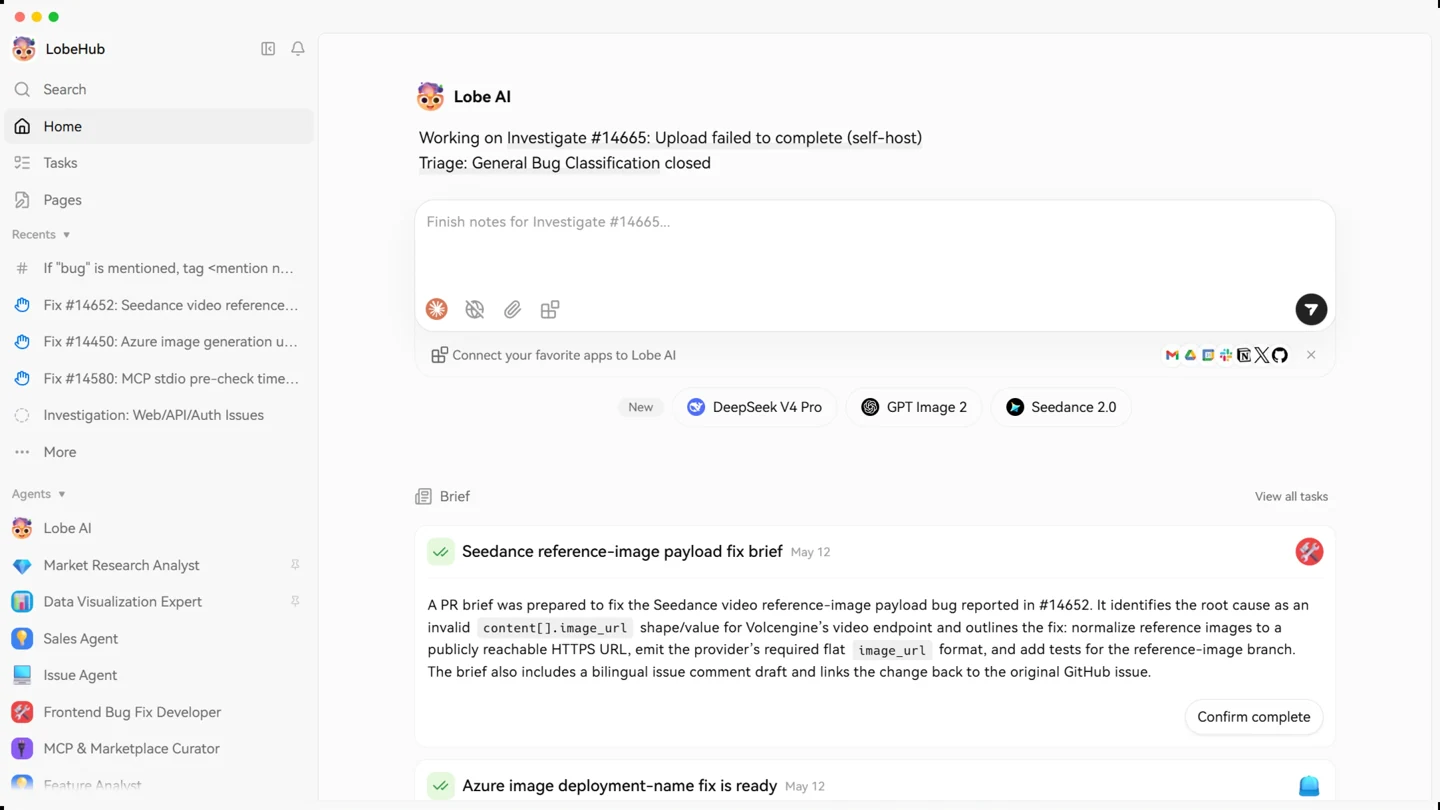
Create agents for defined jobs and keep conversations, tasks and saved work in a coherent project context.
Switch among supported providers while inspecting credit use per model instead of assuming each answer costs the same.
Give agents source documents and preserve longer outputs as standalone pages that can be reviewed later.
Provide methods and narrowly scoped external access for repeated work, with review before consequential actions.
Run the project on chosen infrastructure when appropriate, but plan upgrades, security, secrets and model-billing separately.
Choose cloud or self-hosted
Create one narrow agent
Test answers and permissions
Measure cost and maintain history
Compare setup time, data-control needs, update burden and model-provider cost before creating an account or server.
Give it a specific outcome, approved references and a stop point for human review.
Check citations against files; grant connector access only after the task proves it needs it.
Track cloud Credits or self-hosted provider tokens, preserve important Pages and review changes before scaling.
See plan details below.
The hosted LobeHub Cloud page currently lists Free at 500,000 monthly Credits; Starter, Premium and Ultimate show five million, 15 million and 35 million respectively. The promotional-looking $9.9, $19.9 and $39.9 per-month figures appear with yearly billing selected; the comparison table lists month-to-month prices of $12.9, $24.9 and $49.9. Verify the active billing toggle and model access before subscribing.
Cloud Credits represent token consumption, so expensive models, long inputs and large outputs use the allowance at different rates. The project is open source and can be self-hosted, but that shifts rather than eliminates model-provider, server, storage and maintenance costs. Enterprise or custom private deployment is quoted separately. Do not equate the free cloud balance with unlimited model access or self-hosted usage.
The official project now presents itself as LobeHub, with a broader agent-workspace focus.
The official project is open source and provides deployment paths; verify current documentation before using an older Docker guide.
No. Credits track model usage, while message examples depend on model and text length.
No. Remote model APIs and local infrastructure can still incur costs.
It gives an agent access to an external service or tool; scope permissions to the task and review consequential actions.
Give it one small document-grounded task and check every cited answer before adding memory or tools.
Explore platforms, inputs and outputs, licensing, and access requirements.
LobeHub is the current product and repository brand; older LobeChat guides may describe a prior interface or Docker image. Consult current documentation when deploying. Cloud plan Credits are not a hardware entitlement, and a local installation may still call paid remote models.
Agents with documents and connectors can see sensitive files or act in third-party services. Use least-privilege tokens, separate test and production workspaces, and require review for external writes. Self-hosting changes where the application runs but does not by itself keep data from any model provider selected for inference.
Current LobeHub product overview ↗
Current LobeHub introductory documentation ↗
Loading experiences…
Meta’s Muse is a personal AI agent that emails, books travel, fills forms and shops, asking before sensitive steps. Mostly free in the US, Canada and Singapore.
Explore Comet, the Perplexity AI browser: page research, tab-aware assistance, supported platforms, free browser access and paid agent limits explained.
A creative platform combining AI-assisted story writing with anime-style image generation and editing.
Bring a real task and see how it fits the way you work.

User experiences