
Sider
AssistantsRead pages with Chat, handle browser tasks with Hand and customize your browsing experience with Code. Sider adds an AI workspace to the sites and documents you already use.
Chat beside the sourceHand browser tasks
A free local AI desktop application with downloadable models and LocalDocs, which brings relevant passages from your own folders into conversations.
GPT4All provides a desktop path to running language models on ordinary computers. Download a supported model and use it for chat without making every request to a cloud API. It also includes LocalDocs, which indexes selected folders and supplies relevant passages from those files when you ask a question.
The name does not mean the application is a free download of OpenAI’s GPT-4. GPT4All is a separate local-model ecosystem from Nomic, and each selected model has its own capabilities and license. Its practical appeal is control over local inference and straightforward access to personal reference material, with the tradeoff that quality and speed depend on the model and device.
Personal reference notes
Offline text organization
Compare local models
A small Python experiment
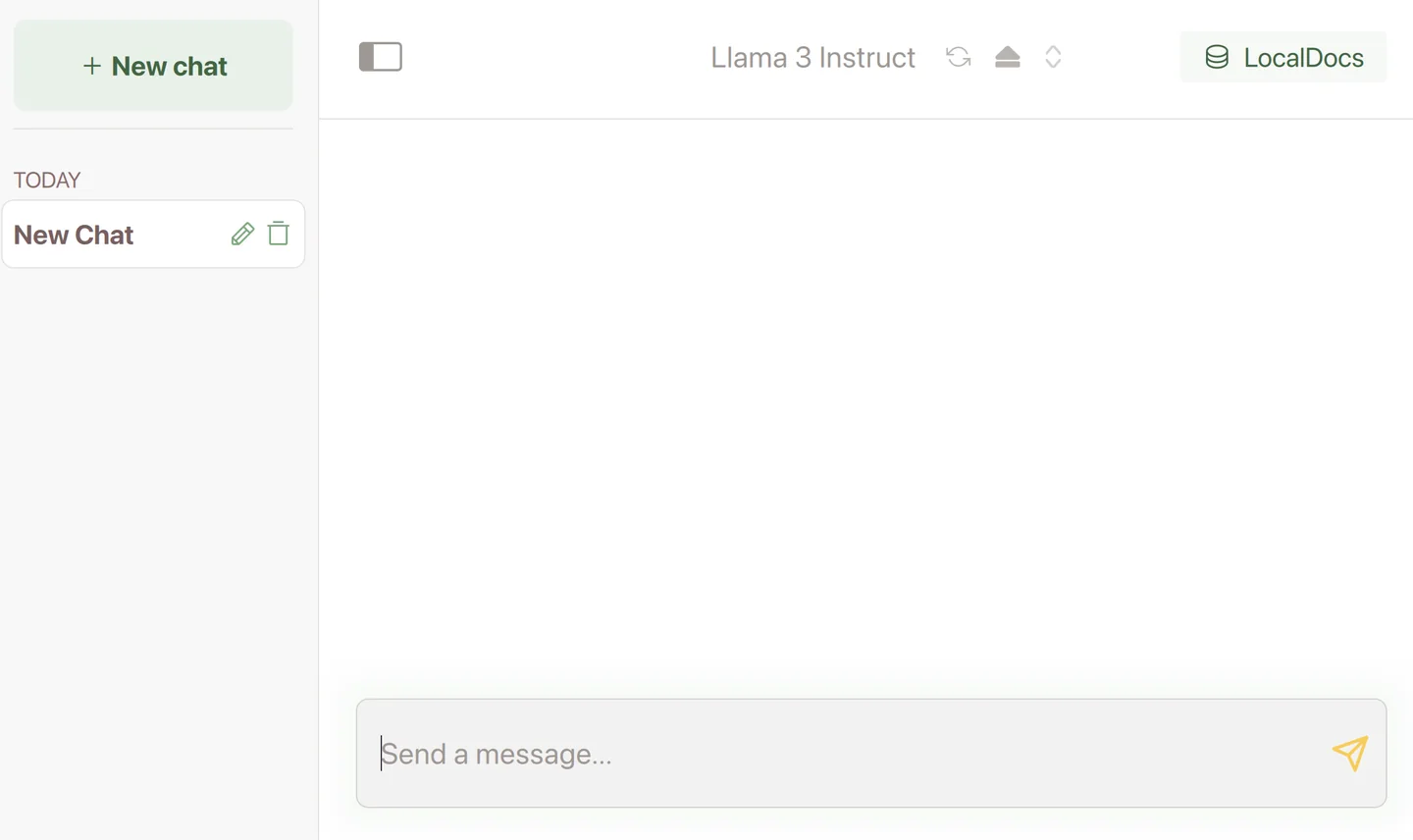
Official product image. Click to inspect the details.
Install and download one model
Verify ordinary chat
Create a small LocalDocs collection
Activate the collection and check sources
Example prompt or task: Using the selected notes, list the main requirements and unresolved questions. Identify the source file for each requirement, preserve dates and numbers, and state when the collection does not contain enough information.
This is an editorial task for checking a first collection. Retrieval selects snippets, so asking for every detail across a very large folder may exceed what a single response can reliably cover.
Local inference does not require paid API calls. Optional remote provider connections have separate conditions.
The application uses the MIT license and offers local inference without a required cloud API account. After downloads, ordinary local generation uses your own storage, compute and electricity rather than a per-message hosted allowance.
Individual model licenses differ, including restrictions that may affect commercial use. Optional remote API connections can also introduce charges and send prompts off the device. The free classification applies to the local application route, not to every model or provider accessible from the interface.
No. It is Nomic’s local-model application and ecosystem, not a free copy of another company’s hosted model.
Dedicated GPU hardware is not mandatory for the basic CPU route. Performance and workable model sizes still depend on your computer.
Local inference can work after required downloads. Remote API connections and obtaining new models still depend on network access.
It indexes folder text into searchable snippets and supplies relevant passages to the chat model. It does not permanently retrain the model on your files.
No. The model guide explicitly distinguishes remote API use: prompts leave the computer for the provider and responses return.
No universal promise applies. Model licenses differ from the application’s MIT license and must be checked individually.
Check indexing progress, the active collection, text extraction and relevance of retrieved snippets. The existence of a file in the folder is not proof it entered that response.
Explore platforms, inputs and outputs, licensing, and access requirements.
Official desktop options cover Windows, macOS and Linux. Hardware requirements vary by model and platform; a model file’s download size is not the complete memory footprint while running. Read the current system and model requirements together, and start with a smaller model on limited hardware.
LocalDocs turns folder contents into text snippets and vectors, then retrieves relevant snippets for a question. It is a retrieval system, not a guarantee that every file is read in full for every response. Keep original files organized and preserve the application’s data when migrating devices.
For local models and LocalDocs, processing can remain on the device. A remote provider changes that path, and the official model guide says prompts are sent to its API. Check which model is active before working with private files.
Back up original materials and reviewed outputs separately. The application license, model terms and document permissions are distinct, and source references should support human checking rather than replace it.
Reviewed October 3, 2026. Product facts come from the official sources below. Suggested projects, prompts and review methods are FindGoodAI editorial guidance, not measured performance results.
Loading experiences…
Saved tools are private. Approved comments are public; edits return to moderation. Comment counts include approved comments and replies. Each person has one rating. New ratings are automatically approved; withdrawn, unapproved or invalid ratings do not count. Share real experiences and avoid spam, private information or personal attacks.
For moderation appeals or data requests: support@findgoodai.com
Bring a real task and see how it fits the way you work.
User experiences