JetBrains Junie
CodingJunie combines a coding agent with planning, model choice and JetBrains development workflows. Use the CLI, supported IDE integration or repository automation to work on scoped code changes.
A free open-source agent with desktop, CLI and API interfaces for coding and other workflows, extensible through tools and configurable with supported local or hosted models.
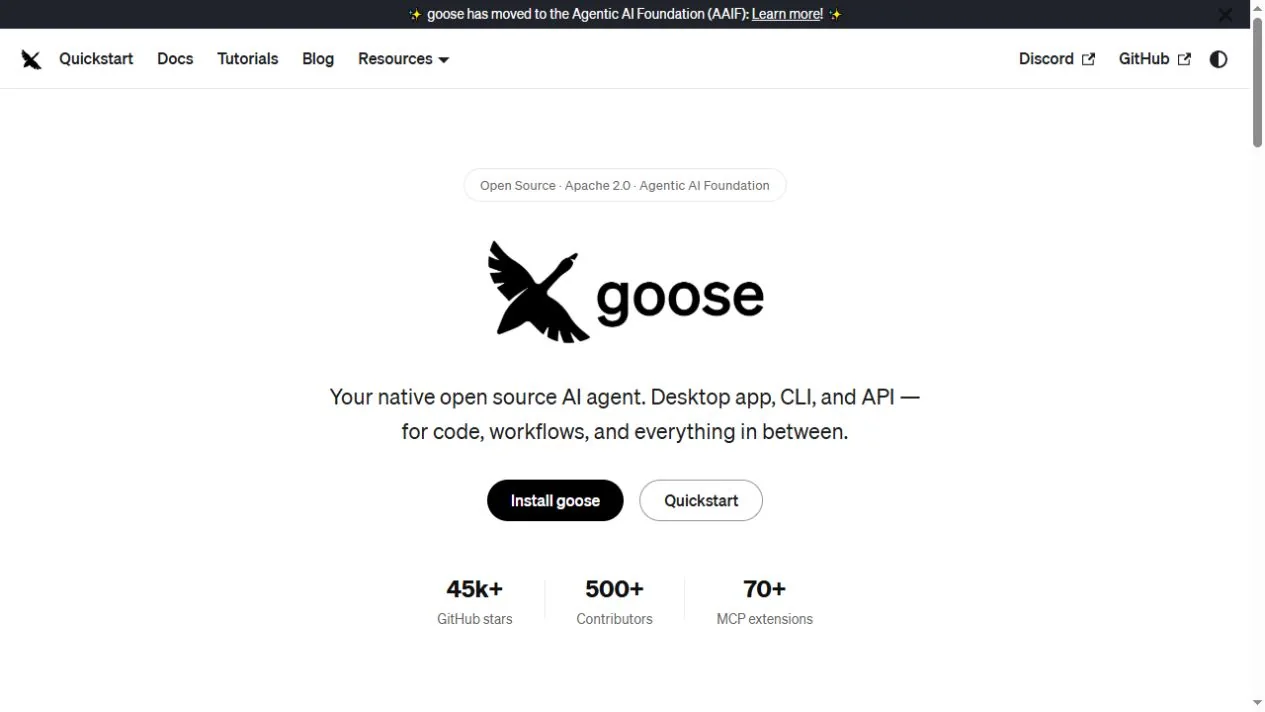
Goose is an extensible agent application that runs on your machine and can work with files, code and connected tools. Current official materials describe native desktop, command-line and API interfaces, along with use cases beyond coding such as research, writing and data work. The project’s current home is the Agentic AI Foundation.
Running the application locally and running the model locally are different choices. Goose can connect to a hosted provider or a supported local inference setup. Decide which arrangement fits the data and task, then configure the workspace and tool permissions accordingly before asking it to act.
Create a small utility
Analyze a permitted data file
Prepare a repository overview
Standardize a repeated task
Official product image. Click to inspect the details.

Install from the official project
Configure the model
Enable the minimum useful tools
Check and preserve the result
Example prompt or task: In this project folder, explain the application entry points and create a short developer onboarding note with file references. Do not change application behavior; identify any assumptions that need confirmation.
This is an editorial example for evaluating a bounded task. It is not a performance measurement or a promise of fully autonomous correctness.
The ongoing free route is the software and a suitable local configuration. Optional provider sign-up credits should not be mistaken for unlimited hosted use.
Goose is Apache-2.0 software and can be used without a software subscription. A supported local model provides a route that does not require per-request commercial model billing, although hardware, storage, electricity and model licensing still apply.
Hosted providers, existing model subscriptions, third-party extensions and external services have their own conditions. The quickstart may advertise introductory provider credits, but those are separate from the ongoing free software route described here. Estimate cost using the model and tools actually configured for your task.
The application is open-source software under Apache-2.0. Inference and external services are separate.
No. A hosted provider can still receive task context. Offline inference requires an appropriate local model setup.
Official materials also describe writing, research, data and automation tasks, though tool configuration can require technical knowledge.
Supported local-provider options exist. Confirm the model’s capability, requirements and tool compatibility.
It adds tools or data access. Review the actual permissions and only enable what the task needs.
No such promise is made here. Introductory offers are distinct from the free software license.
Recipes provide a supported way to package workflows. Keep the inputs, assumptions and review steps clear.
Explore platforms, inputs and outputs, licensing, and access requirements.
The current project offers desktop clients for major operating systems and a CLI with platform-specific prerequisites. Use the official guide rather than assuming the same shell command works identically in every Windows, macOS and Linux environment.
A recipe or integration makes a workflow repeatable, not automatically correct. Check how it handles missing input, unexpected tool output and partial completion. For shared workspaces, decide who can invoke actions and which external destinations are appropriate for the resulting files or messages.
Files accessible to the agent can become model context or inputs to connected services. Match the provider and extensions to the sensitivity of the material instead of assuming all processing remains local.
Control workspace and tool access deliberately. Before sharing a recipe, remove embedded credentials and private paths, and document any external action that another user would need to authorize in their environment.
Reviewed October 3, 2026. Product facts come from the official sources below. Suggested projects, prompts and review methods are FindGoodAI editorial guidance, not measured performance results.
Loading experiences…
Saved tools are private. Approved comments are public; edits return to moderation. Comment counts include approved comments and replies. Each person has one rating. New ratings are automatically approved; withdrawn, unapproved or invalid ratings do not count. Share real experiences and avoid spam, private information or personal attacks.
For moderation appeals or data requests: support@findgoodai.com
Bring a real task and see how it fits the way you work.
User experiences