
Humata
ProductivitySearch, summarize and compare uploaded documents with source-linked answers. Humata adds team-oriented document access and page-based plans for ongoing knowledge work.
Questions across filesCited passages
An AI research assistant for finding papers, organizing evidence and extracting information into reviewable tables, with a free Basic plan and paid advanced workflows.
Elicit is built around scientific evidence rather than general-purpose conversation. It helps find relevant papers, organize a research library and turn source material into summaries or structured outputs. Its search uses semantic relevance, making it useful when you know the question you want to investigate but have not yet found the field’s preferred terminology.
A good first project is a focused evidence table: identify relevant studies, record their methods and compare what they actually measured. This makes disagreements visible and gives you a route back to the original papers. A generated report can help organize that work, but should not be confused with a completed, independently validated systematic review.
Scope a dissertation topic
Build a methods comparison
Prepare a reading meeting
Update an evidence brief
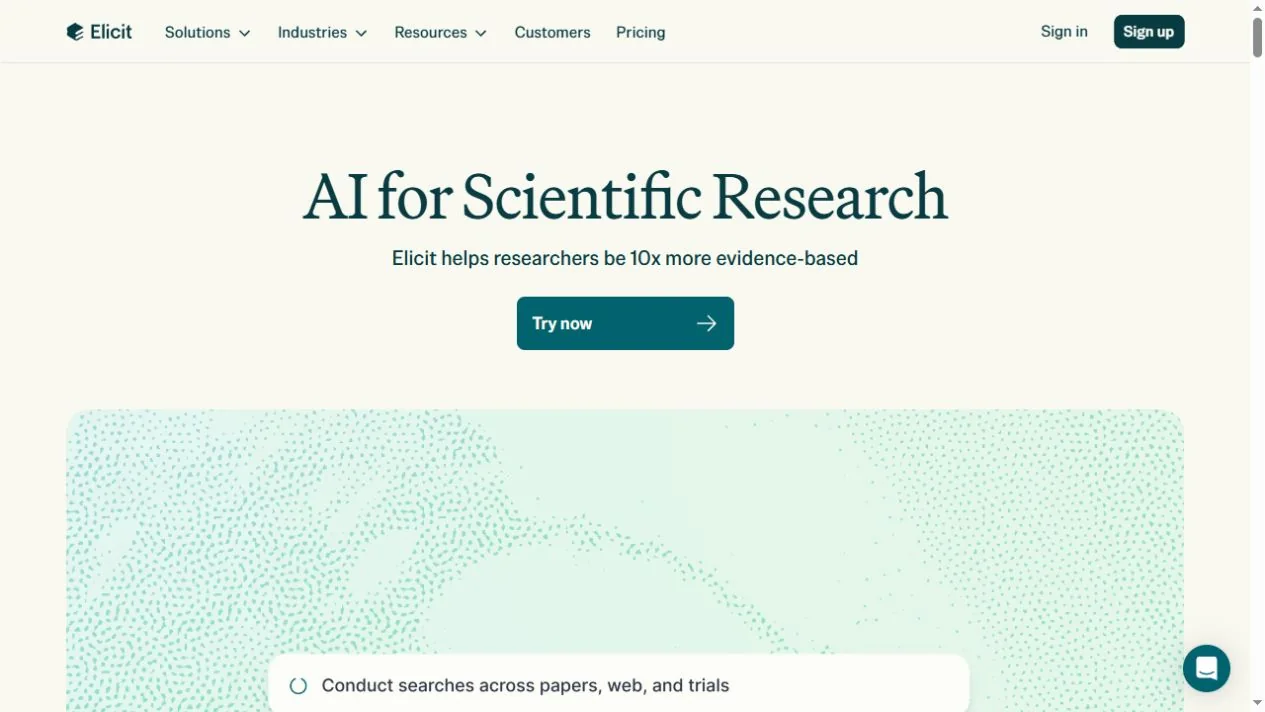
Official product image. Click to inspect the details.
Write the research boundary
Search and inspect
Extract a small table first
Synthesize with a record
Example prompt or task: Find research on retrieval practice in university courses. Compare study design, population, outcome measures and limitations. Separate direct findings from interpretation and mark unavailable information instead of filling it in.
This is a suggested research task, not a claim that a particular study exists or that Elicit retrieved every relevant publication.
Basic offers a free starting route. Reports and Research Agent usage are limited; verify export and extraction entitlements before planning a large review.
The official Basic plan provides an ongoing free entry for paper search, summaries and chat where full text is accessible. Research Agent and Research Reports have limited usage. These distinctions matter: free discovery does not mean every advanced review or extraction operation has unlimited capacity.
Paid plans expand usage and offer additional workflows or exports. Check the current pricing table for your organization type and billing period rather than relying on a single headline price. A subscription also does not grant universal access to paywalled literature; access rights and available source text remain separate issues.
Yes, Basic is a free plan with specified capabilities and limits. Advanced workflows can require a paid plan.
It can help prioritize and organize reading, but important findings and limitations should be checked in the original source.
Not universally. Source access depends on available full text and any legitimate access you already have.
Official materials describe reference imports, including Zotero. Check the current importer and metadata after importing.
Do not assume that. Export formats and advanced features are plan-dependent on the pricing page.
Not by itself. A systematic review requires a documented method, screening decisions and appropriate validation.
Mark it for review, inspect the source passage and keep uncertainty visible in the evidence table.
Explore platforms, inputs and outputs, licensing, and access requirements.
Elicit is a hosted research workspace. It can work with its indexed sources and supported material you provide, but coverage is not identical to every disciplinary database. For a comprehensive project, document which databases and search methods were used and where Elicit fits into that process.
Extraction quality depends on the source and the field definition. A missing value may mean the paper did not report it, the relevant passage was inaccessible, or the system failed to find it. Keep these possibilities distinct instead of converting every blank cell into a confident negative result.
Upload only papers and internal documents you are permitted to provide to a hosted service. Institutional access to a publication does not automatically establish permission for every form of redistribution or third-party processing.
For collaborative projects, agree on which collections can be shared and retain the reviewed evidence outside a transient chat. Use current service policies to decide whether unpublished work, personal data or confidential research material is appropriate for the selected account.
Reviewed October 3, 2026. Product facts come from the official sources below. Suggested projects, prompts and review methods are FindGoodAI editorial guidance, not measured performance results.
Loading experiences…
Saved tools are private. Approved comments are public; edits return to moderation. Comment counts include approved comments and replies. Each person has one rating. New ratings are automatically approved; withdrawn, unapproved or invalid ratings do not count. Share real experiences and avoid spam, private information or personal attacks.
For moderation appeals or data requests: support@findgoodai.com
Bring a real task and see how it fits the way you work.
User experiences