
Humata
ProductivitySearch, summarize and compare uploaded documents with source-linked answers. Humata adds team-oriented document access and page-based plans for ongoing knowledge work.
Questions across filesCited passages
A local document-processing toolkit that converts varied files into a common structured representation for search and generative AI. It combines PDF layout understanding, OCR and developer-friendly exports under an MIT software license.
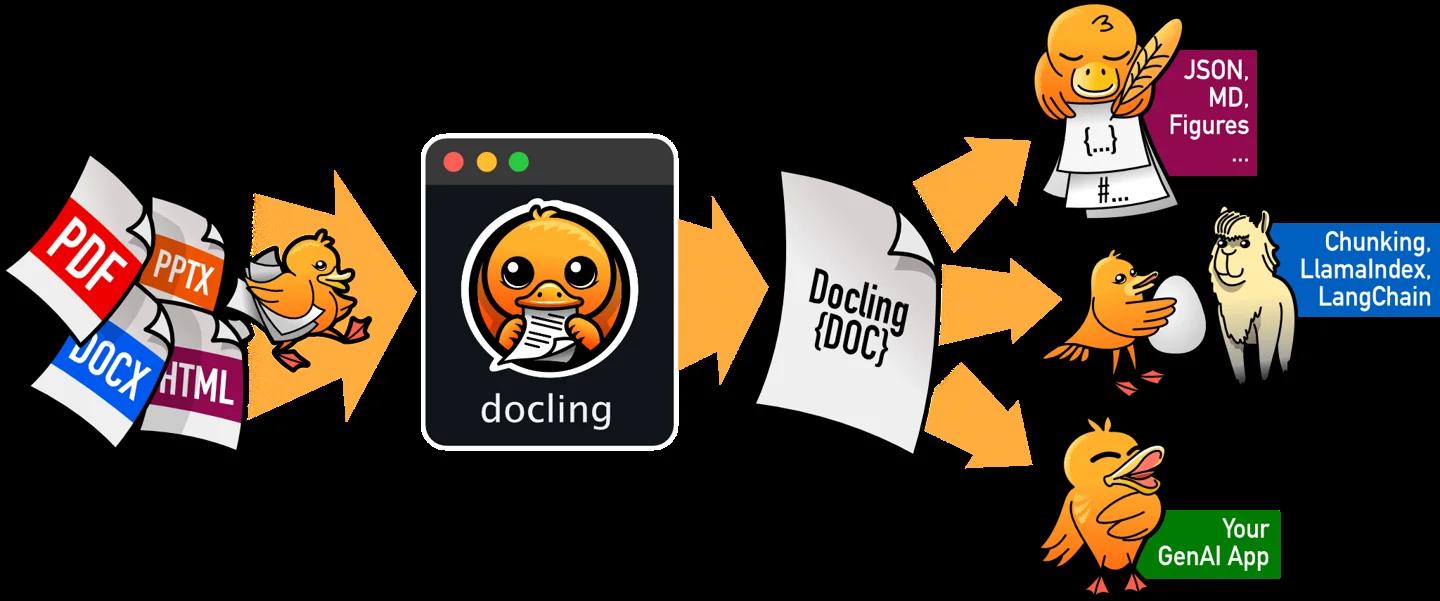
Docling is a toolkit for turning different document formats into a consistent representation that other software can use. It addresses the preparation stage of an AI system: understanding page layout, recovering text and tables, and exporting content without forcing every downstream application to handle each source format from scratch.
This is useful for mixed collections containing PDFs, office documents, web content and scans. Instead of equating conversion with a plain-text dump, Docling provides a structured document model. That structure helps developers keep relationships between elements and makes it easier to inspect what entered a search index or a retrieval-augmented generation pipeline.
Normalize a document collection
Prepare retrieval chunks
Inspect scanned archives
Extract a table for analysis
Official product image. Click to inspect the details.
Choose a representative sample
Install a suitable local setup
Convert and compare
Integrate gradually
Example prompt or task: Convert a mixed public document sample into structured content and Markdown. Preserve headings and tables, and record any pages whose reading order needs manual review.
This is an editorial validation task, not a claim that the toolkit converts every source with identical accuracy.
The software license does not automatically cover every downloaded model, remote service or source document.
Docling’s software is released under the MIT license and can be run locally without a mandatory service subscription. You still provide compute, model storage and maintenance, and a larger deployment can require acceleration or additional infrastructure.
Optional remote services, hosted integrations and downloaded models have their own conditions. The MIT software license should not be treated as a universal license for every model weight or source document used with the toolkit. Review these components separately when packaging or distributing a solution.
Yes. The project’s software license is MIT.
No. It prepares document content that another application can search or use for answers.
Yes, including workflows suitable for offline environments after resources are prepared.
It offers OCR support, with engine and language configuration to consider.
No. The project includes a structured document model and several export formats.
Do not assume that; model and service licenses are separate from the toolkit license.
Yes. Check cell structure, units and critical values before analysis.
Explore platforms, inputs and outputs, licensing, and access requirements.
The installation guide supports macOS, Linux and Windows configurations, with dependencies and acceleration varying by platform. Choose a supported environment and avoid assuming that a demo command implies every optional pipeline is already installed.
Offline operation is possible with the necessary local resources in place. A first run may otherwise need model downloads. Record the selected OCR engine, pipeline and model versions if the output will feed a repeatable production or research process.
Local processing can help keep document contents under your control, but inspect whether any optional enrichment or remote model service is enabled. Keep network behavior consistent with the data policy for the collection.
Protect intermediate files and indexes as well as the original documents. Conversion can expose hidden or forgotten text to a search system, so apply document-level access rules when the result is consumed by a shared application.
Reviewed October 3, 2026. Product facts come from the official sources below. Suggested projects, prompts and review methods are FindGoodAI editorial guidance, not measured performance results.
Loading experiences…
Saved tools are private. Approved comments are public; edits return to moderation. Comment counts include approved comments and replies. Each person has one rating. New ratings are automatically approved; withdrawn, unapproved or invalid ratings do not count. Share real experiences and avoid spam, private information or personal attacks.
For moderation appeals or data requests: support@findgoodai.com
Bring a real task and see how it fits the way you work.
User experiences