
A screenshot of @mgostIH’s X post caught my eye on October 7. The reaction is half disbelief, half delight: integer multiplication below n log n—and then a follow-up about the FFT. The screenshot shows the post at 6:51 and quotes OpenAI’s announcement of new mathematical results. I followed the trail from those cropped abstracts to OpenAI’s release note and the public manuscript repository.
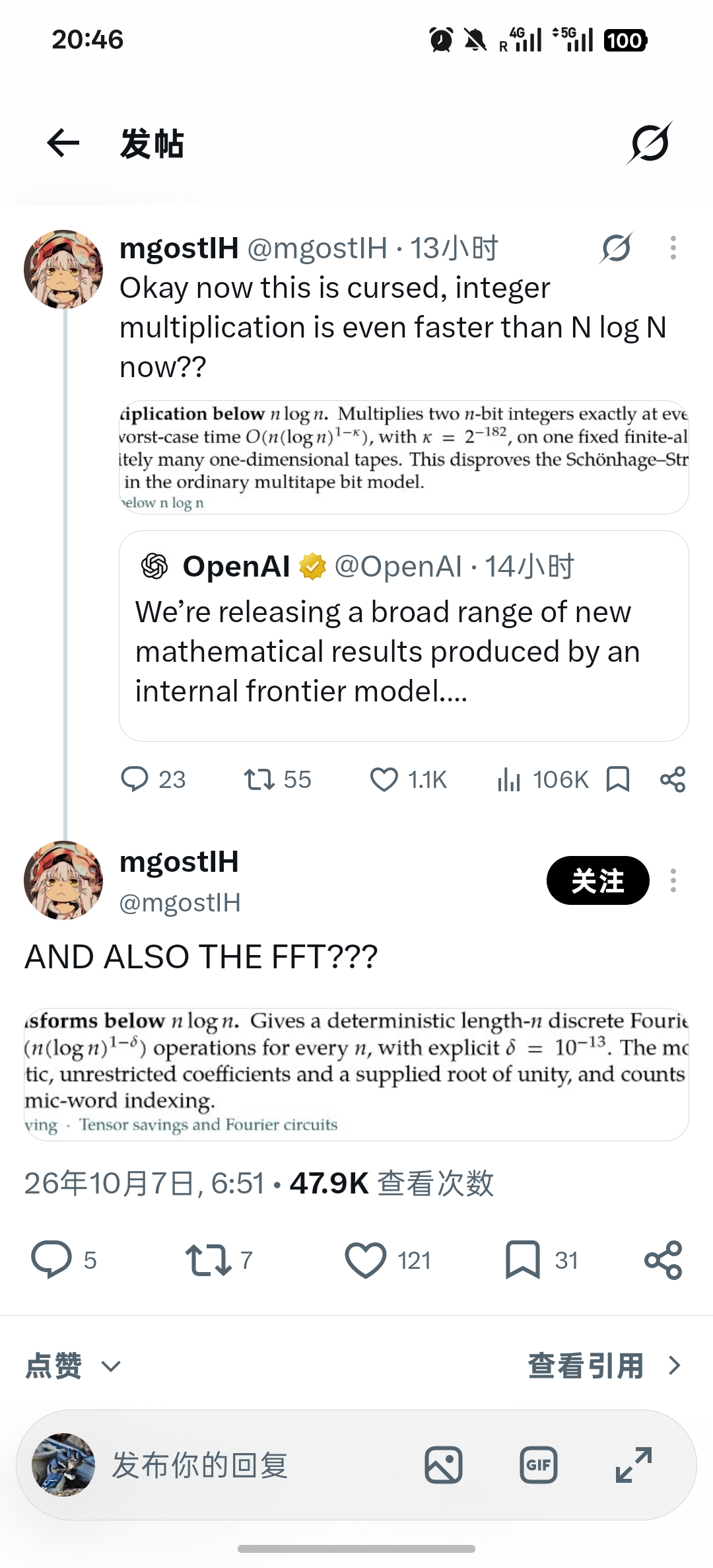
Both results are there. What interests me is less the headline than the boundary each paper claims to cross. “Below n log n” is a statement about asymptotic complexity in a specified model. It is not a promise that a laptop’s multiplication library or a production FFT will run faster next week.
The multiplication result: a microscopic exponent with a real mathematical sign
The integer-multiplication manuscript claims an exact, deterministic worst-case algorithm for two n-bit integers running in O(n(log n)^(1−κ)) time, with κ = 2^−182. Its machine is fixed, has a finite alphabet, and uses a fixed number of one-dimensional tapes. Within that ordinary multitape bit model, the paper says it overturns the Schönhage–Strassen conjecture that n log n was optimal.
That exponent is almost comically small. No practical input size makes it a reason to swap algorithms. Yet the distinction between zero and a positive κ is the entire point: this is a claimed change in the asymptotic shape, not a smaller constant on the old curve. If the argument stands, it opens a gap in a boundary many people expected to hold.
The Fourier result keeps a different score
The companion discrete Fourier transform manuscript gives O(n(log n)^(1−δ)) operations at every length, with δ = 10^−13. But these are exact complex-arithmetic operations with unrestricted coefficients and a supplied root of unity. Scalar preparation and indexing are counted under the paper’s rules. This is a different cost model from multiplying bit strings on a Turing machine, and the paper does not assert a finite-precision or numerical-stability improvement for everyday floating-point FFT software.
Placed together, the abstracts make a wonderfully surprising screenshot. Read carefully, they are two different theoretical claims. I would celebrate them on their own terms rather than turn them into a hardware-speed headline.
The next bottleneck is checking the work
OpenAI’s repository lists 722 manuscripts in 372 result families and says the collection has mixed verification status; not every manuscript has a Lean formalization. The integer-multiplication entry has no Lean link in the catalogue. The Fourier entry does link to a Lean scope note, but that note covers a related saving along an unbounded sequence of lengths, not a complete machine check of the all-length claim. This distinction matters more to me than another round of astonished social-media reactions.
My take: if independent readers confirm these proofs, we have an unusually striking result about computational limits. If they find errors, a public manuscript, version history and clearly scoped formal work give them something concrete to challenge. Either way, AI is accelerating the production of mathematical claims. The interesting test now is whether explanation, verification and correction can accelerate with it.
Sources: OpenAI’s announcement · repository README · integer-multiplication manuscript · Fourier manuscript · Lean scope note.