
Sider
AssistantsRead pages with Chat, handle browser tasks with Hand and customize your browsing experience with Code. Sider adds an AI workspace to the sites and documents you already use.
Chat beside the sourceHand browser tasks
A free, locally installed frontend for structured conversations with language models. SillyTavern adds character cards, personas, World Info, group chats and document-related context, while leaving model inference to a separately configured local or cloud backend.
SillyTavern is a locally installed interface for interacting with language models. It gives users detailed control over how a conversation is framed, what background information is supplied and which model backend produces the answer. It is especially useful for interactive fiction, role-based exercises and specialized assistants that need consistent instructions.
The application is not a model and does not provide unlimited inference by itself. Users connect a supported local or cloud backend. This distinction matters for cost, privacy and hardware: running the interface can be lightweight, while running a capable model on the same machine can require substantially more resources.
Develop an interactive story
Practice a role-based conversation
Create a specialized assistant
Compare model behavior
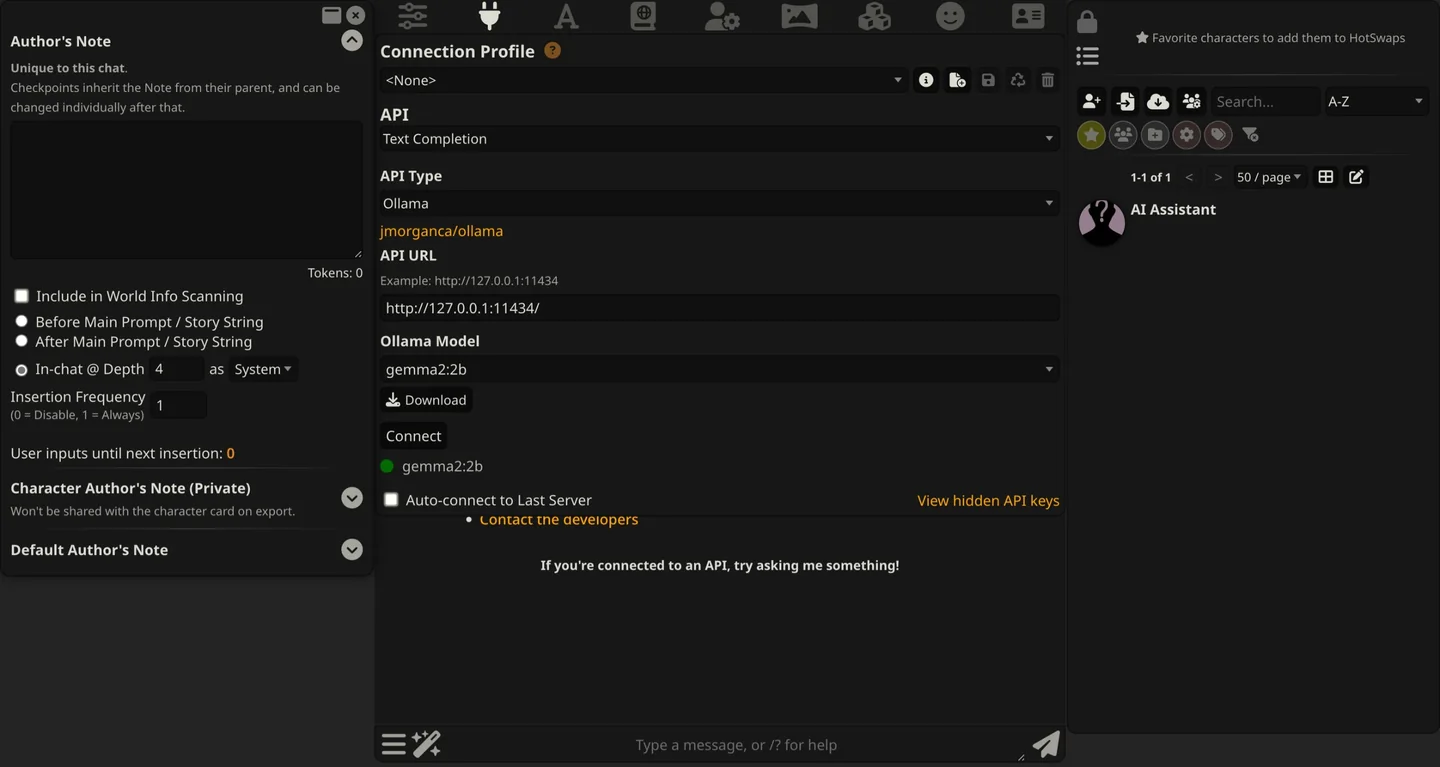
Official product image. Click to inspect the details.
Install the stable route
Connect one backend
Build a minimal conversation setup
Expand gradually
Example prompt or task: Act as a fictional museum guide in this educational scenario. Use only the supplied exhibit facts, ask one question at a time, and clearly distinguish historical information from invented dialogue. Do not invent dates when the reference material is silent.
This is an editorial starting workflow, not a measured performance result.
SillyTavern is free open-source software under AGPL-3.0. The interface requires an inference backend: local options use the user's hardware, while hosted model APIs can charge according to their own plans. Installing the frontend does not create free credits for those providers.
SillyTavern is free open-source software under AGPL-3.0. The interface requires an inference backend: local options use the user's hardware, while hosted model APIs can charge according to their own plans. Installing the frontend does not create free credits for those providers.
Optional voice, image, search and other integrations can add costs or setup requirements. Evaluate the complete configuration, including model storage and maintenance, rather than treating the word free as a guarantee that every connected capability has zero operating cost.
Yes. It is open-source software under AGPL-3.0.
No. A separately configured inference backend produces the responses.
Supported local API routes are documented, with hardware and model requirements of their own.
No. They can also describe a scenario or task-specific assistant role.
No. Entries are activated and budgeted according to the configured rules.
Not necessarily. Each provider has separate pricing and allowances.
It is primarily a configurable local frontend with a learning curve and optional integrations.
Explore platforms, inputs and outputs, licensing, and access requirements.
Current documentation describes a Node.js-based application and installation routes for Windows, Linux, macOS, Android through Termux and Docker. Platform instructions and backend requirements differ, so follow the route actually intended for the device.
World Info and character prompts influence the model but do not guarantee compliance or factual accuracy. Long histories also compete with reference material for context space. Keep essential instructions clear and inspect context behavior before relying on a complex setup.
Conversation data is sent to the configured inference backend as needed to generate responses. Local installation alone does not make a cloud-connected conversation private to the machine; inspect the chosen provider and any active extensions.
Treat imported character cards and extensions as third-party material. Review their content and code where appropriate, keep credentials out of shared files and check the AGPL-3.0 obligations before distributing or operating a modified version for others.
Reviewed October 3, 2026. Product facts come from the official sources below. Suggested projects, prompts and review methods are FindGoodAI editorial guidance, not measured performance results.
Loading experiences…
Saved tools are private. Approved comments are public; edits return to moderation. Comment counts include approved comments and replies. Each person has one rating. New ratings are automatically approved; withdrawn, unapproved or invalid ratings do not count. Share real experiences and avoid spam, private information or personal attacks.
For moderation appeals or data requests: support@findgoodai.com
Bring a real task and see how it fits the way you work.
User experiences