
Sources & references
DeepSeek official product site ↗
Official app and Harness downloads ↗
A general AI assistant for writing, reasoning and coding, with official mobile apps, a desktop work agent and separately billed developer APIs.
DeepSeek combines a consumer assistant, official apps and a developer platform. It is a useful starting point for turning a complicated question into a draft, explanation or piece of code that you can inspect. The official site separates the chat interface, API platform and Harness desktop product, so begin by choosing the workflow you actually need.
For everyday use, a precise question usually matters more than selecting the most elaborate mode. Describe your audience, attach only relevant material and say what a successful answer should contain. A good first task is one where you can recognize an omission or mistake.
Turn a difficult question into a checkable explanation
Compare requirements before writing code
Extract a consistent table from unstructured notes
Explore a supervised local-file workflow
Official product image. Click to inspect the details.
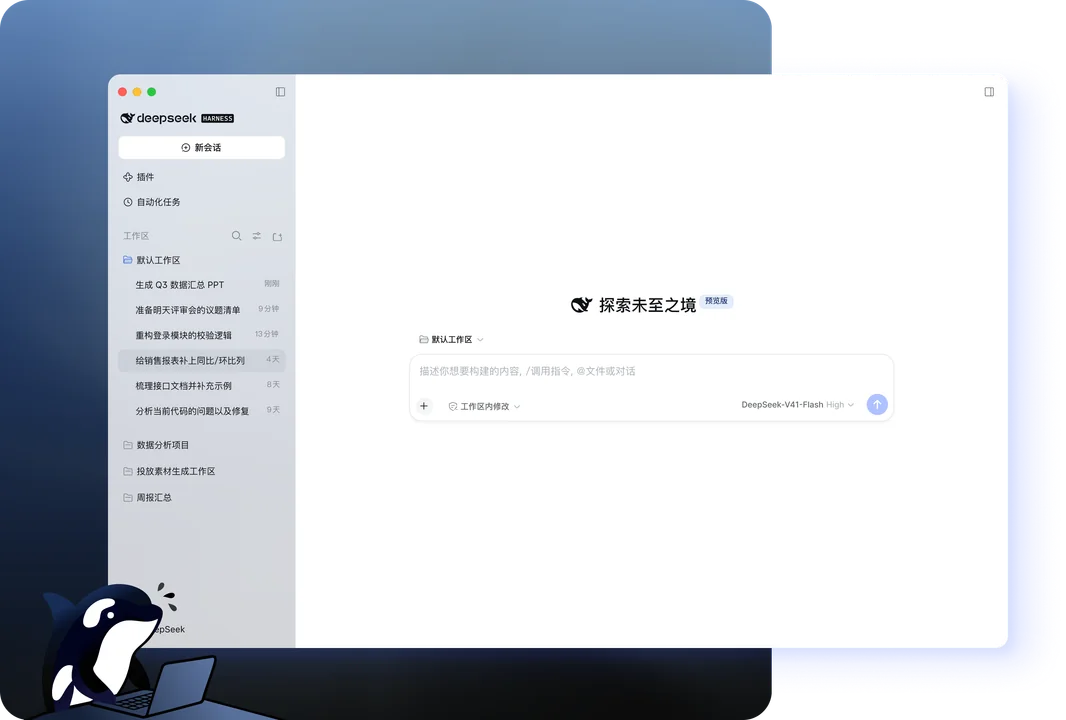
Choose chat, Harness or API for your task
Provide the material, intended reader and success criteria
Ask for an outline or small first result
Verify the answer and save the useful prompt
1. Define the deliverable. Choose a real but non-sensitive feature request. State who will read the result and what decision it should enable. A one-page implementation brief is easier to judge than a broad request to improve an entire product.
2. Supply the constraints. Include the current behavior, desired behavior and one failure example. Suggested prompt: “Review these requirements. Return missing assumptions, three edge cases and a minimal implementation plan. Separate confirmed facts from questions. Do not write code yet.”
3. Resolve the gaps. Answer the questions, then ask for the smallest useful draft. If you need structured output, define column names or JSON keys before generation. Keep the original inputs alongside the result so another reviewer can reproduce the reasoning.
4. Check and reuse. Verify the important conclusion, run any proposed code in your normal environment and record the corrections you made. Reuse the successful brief as a template, changing the task material rather than endlessly lengthening the instructions.
API currency is USD in the cited table; input, output and cache rates differ.
The official download page advertises free assistant access. Developer API calls use a separate balance and token billing. On the review date, the USD table lists deepseek-flash peak rates per million tokens of $0.006 cached input, $0.30 uncached input and $1.20 output; off-peak rates are half. Other models have different prices. Check the live table for the applicable schedule and model.
Budget from a representative completed task, including retries and revisions. A long requested answer may cost more than its short prompt suggests; free consumer access should not be treated as an API allowance.
Use it when a task needs comparison, planning or several dependent steps. For a short rewrite, a direct instruction may be sufficient. Compare the quality of the final answer and time spent, not the length of the explanation.
Ask for source links and dates, then open the sources yourself. An answer produced from model knowledge is different from a checked search result. For changing information, define the period and region in your question.
Do not assume so. The consumer app and developer platform are separate entry points, and API documentation describes balance-based billing. Check the platform account before connecting a third-party application.
No single promise covers all modes. Use the supported input type for the selected model or client. For tables and scanned material, verify a few extracted rows against the original before accepting a larger analysis.
Provide a small reproduction and an acceptance condition. Ask it to explain the changed behavior, then inspect the patch yourself. A working snippet outside your project does not establish compatibility with your dependencies or data.
Give both the same representative task and source files. Record factual corrections, manual editing and total completion time. This reveals whether the tool fits your workload better than an unrelated leaderboard score.
A model release supplies one component. The hosted product can add search, interfaces, account features and orchestration. Compare the actual capabilities and license of the deployment you plan to use.
Explore platforms, inputs and outputs, licensing, and access requirements.
The download page lists iOS and Android apps, plus Harness for Windows and Apple-silicon Macs. Its stated macOS requirement is version 13 or later. These clients serve different purposes: mobile chat is convenient for a question, while a local-file task belongs on the computer containing the files.
Inputs and export options depend on the chosen product. Save a useful answer with its source material and date. When your process needs a reliably machine-readable deliverable, use an API response with explicit fields instead of assuming a copied chat table will remain stable.
DeepSeek documents OpenAI-compatible and Anthropic-compatible API formats. Model identifiers and supported parameters should come from the current documentation rather than an old tutorial. The thinking-mode guide also explains how reasoning content interacts with multi-turn and tool-using requests.
The R1 repository license is MIT. That statement applies to that release; it is not a blanket license for the hosted website, every newer model or third-party deployments. Self-hosting also means choosing suitable hardware, an inference server and your own access controls.
The privacy policy covers prompts, files, history and service-improvement uses, describes processing in China and provides a route to exercise privacy rights, including a training opt-out. Review the policy that applies to your account.
For a useful first trial, substitute sample customer details and keep source documents in your own archive. Before creating a public conversation link, read the entire shared conversation; a clean final paragraph does not remove earlier sensitive context.
Reviewed October 3, 2026. Product facts are based on the official sources below. Example prompts, workflows and selection advice are FindGoodAI editorial guidance.
DeepSeek official product site ↗
Official app and Harness downloads ↗
Loading experiences…
Saved tools are private. Approved comments are public; edits return to moderation. Comment counts include approved comments and replies. Each person has one rating. New ratings are automatically approved; withdrawn, unapproved or invalid ratings do not count. Share real experiences and avoid spam, private information or personal attacks.
For moderation appeals or data requests: support@findgoodai.com
Bring a real task and see how it fits the way you work.
User experiences