Weaviate
CodingWeaviate is an open-source AI vector database featuring hybrid search, built-in vectorization, multi-tenancy and Query Agent, with an always-free $0/month cloud tier (10 GB disk).
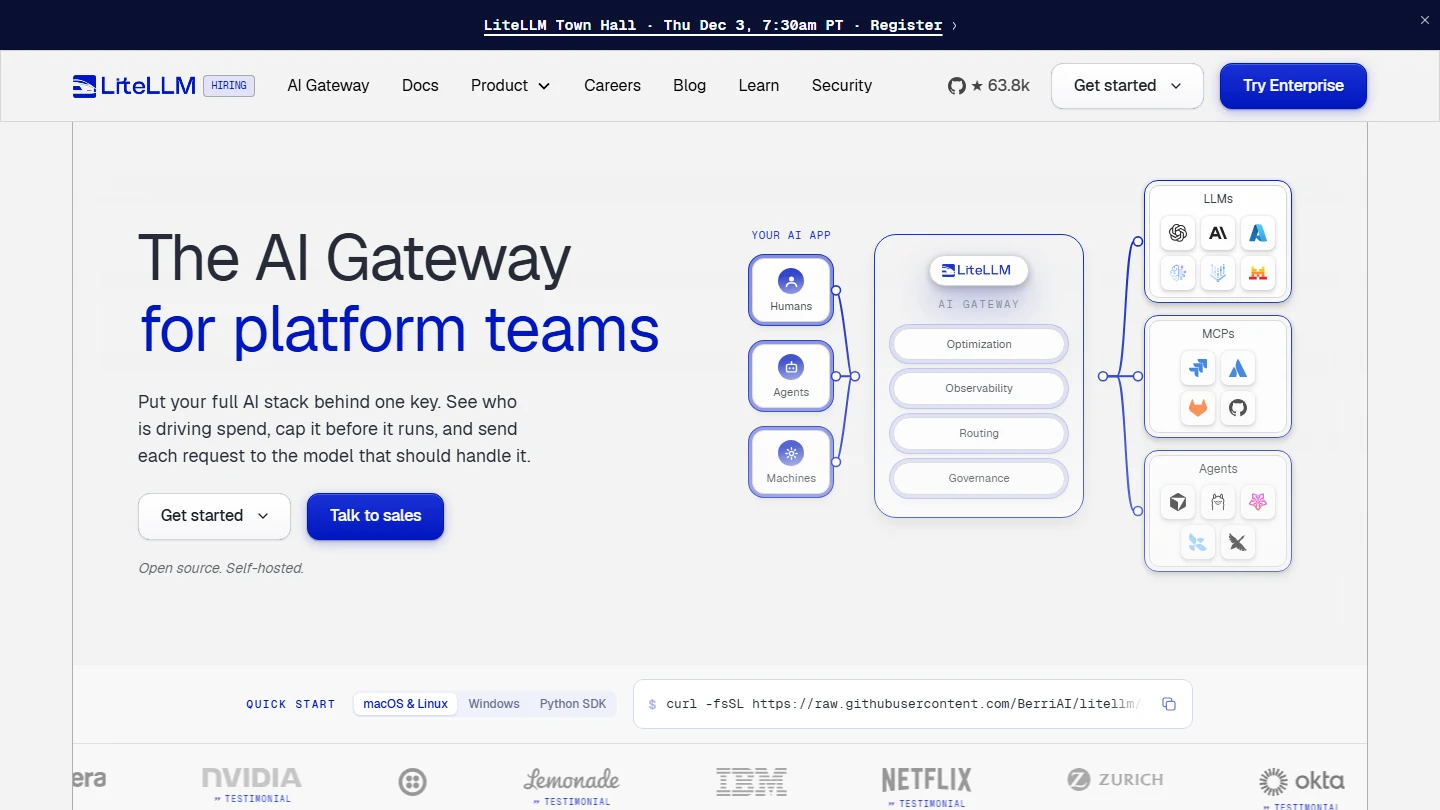
LiteLLM is an MIT-licensed open-source AI gateway and Python SDK unifying 140+ LLM providers, MCP servers and agents behind one OpenAI-compatible API, free forever to self-host.
LiteLLM provides a unified OpenAI-compatible interface to more than 140 LLM providers and 1,800+ models—including OpenAI, Anthropic, Gemini, Bedrock, Azure, and self-hosted endpoints—through either a lightweight Python SDK or a centralized self-hosted AI Gateway (Proxy Server). Instead of rewriting SDK integrations and error handlers for every model vendor, platform teams place a single gateway in front of applications, coding agents, and MCP tools, managing virtual API keys, per-team budgets, rate limits, fallbacks, and spend attribution from one control plane.
Editorial suggestion: LiteLLM is a strong fit for engineering teams that want full data sovereignty without per-token gateway markups. You can start in minutes with the Python SDK or Docker proxy, and try the newer Rust AI Gateway path when sub-millisecond overhead (0.66 ms p99 added latency) matters; organizations needing SSO/SCIM, secret-manager integration, and air-gapped SLAs can step up to Enterprise.
Centralized enterprise AI gateway
Multi-provider coding agent backend
Resilient production failover
Cost optimization & caching
Official product image. Click to inspect the details.


Official examples and public-page captures; these are not results from a paid-feature trial.
Call 140+ providers, 1,892 models, MCP servers and A2A agents through one OpenAI-format endpoint with automatic schema and exception translation.
Issue virtual keys scoped to users, teams or tags, enforce daily/monthly hard spend caps, set RPM/TPM limits and export chargeback reports.
Configure lowest-cost or complexity-based Auto Routing, multi-region load balancing, automatic provider fallbacks and Redis/S3/GCS caching.
Deploy via Docker, Helm or Terraform with Postgres and Redis, add Presidio/Lakera PII and injection guardrails, and export OTEL or Langfuse traces.
Choose Python SDK or Proxy container
Configure model list and provider keys
Issue virtual keys and budget limits
Point OpenAI clients to port 4000
Install uv add litellm (or litellm-core) for in-app calls, or pull docker.litellm.ai/berriai/litellm:latest for a shared gateway.
Define model aliases, upstream API keys and fallback deployments in a YAML config or via the Admin UI.
Connect Postgres and Redis, then mint scoped virtual keys with RPM, TPM and monthly dollar caps per team.
Update base_url to your proxy endpoint and attach Langfuse, LangSmith, Helicone or Prometheus callbacks for observability.
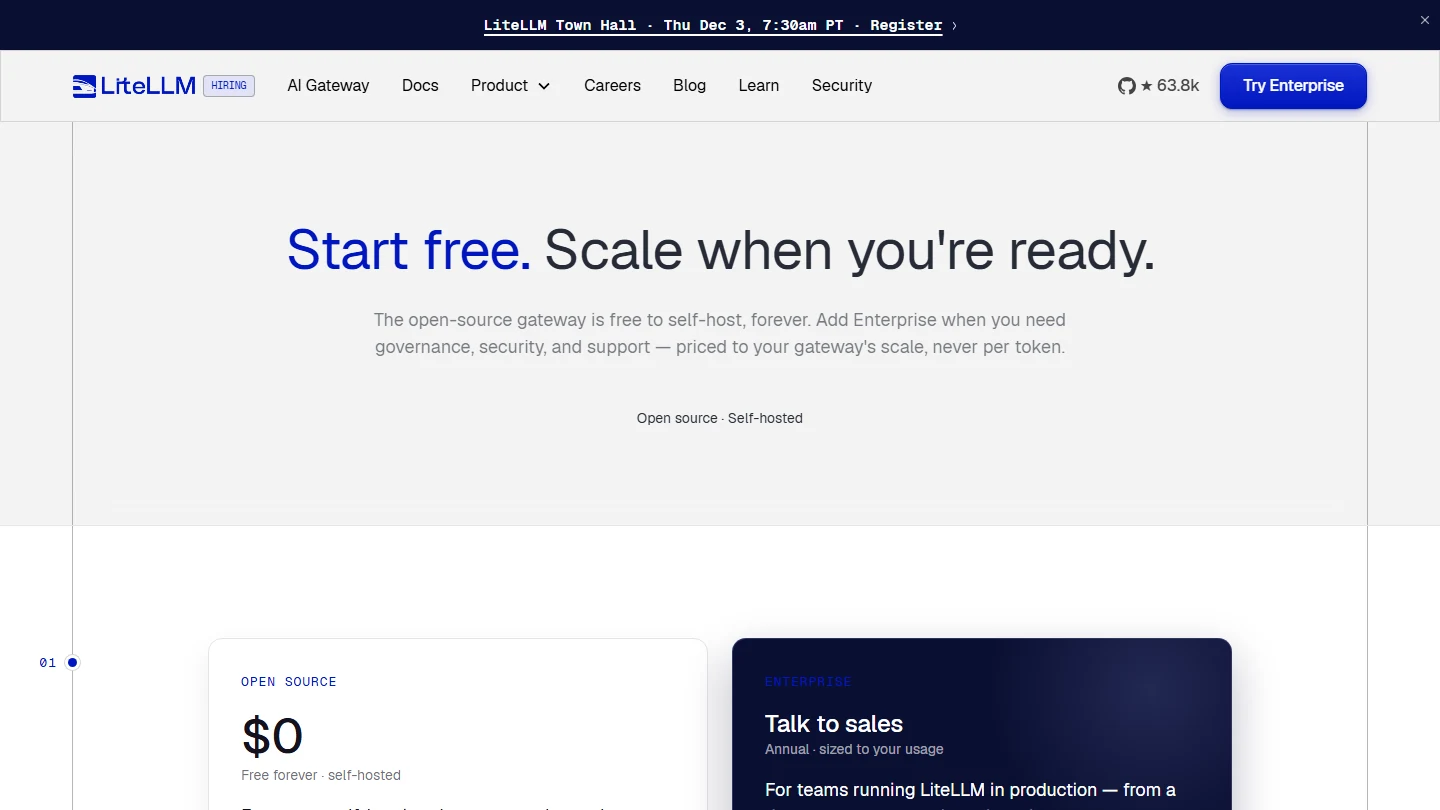
LiteLLM Open Source is MIT-licensed and $0 free forever to self-host without per-token or per-seat gateway fees. The free open-source edition includes 140+ LLM provider integrations, virtual keys, user and team budgets, RPM/TPM rate limits, load balancing and fallbacks, LLM guardrails, and Langfuse, Arize Phoenix, LangSmith, and OpenTelemetry logging.
LiteLLM Enterprise is billed annually on a custom quote sized to annual gateway request capacity, deployment architecture and support requirements—never per token. It adds SSO and SCIM provisioning, OIDC/JWT auth, audit logs, AWS Secrets Manager, HashiCorp Vault and Azure Key Vault integration, multi-region control plane, air-gapped deployment options, and up to 24/7 SLAs via dedicated Slack or Teams channels. Teams can request an instant 30-day Enterprise trial key from the website.
Yes. The MIT-licensed open-source SDK and AI Gateway are free forever to self-host in production with no per-token markup; you only pay your underlying LLM providers and hosting infrastructure.
The Python SDK (litellm or litellm-core) runs directly inside your Python process via completion(), while the AI Gateway (Proxy Server) runs as a standalone OpenAI-compatible HTTP service with virtual keys, budgets and an Admin UI for any language.
On LiteLLM’s published AI Gateway Bench benchmarks, the Rust gateway adds 0.66 ms at p99 latency, uses ~22 MB memory at rest, and sustains 2,800+ req/s at ~21% CPU on a single-client mock upstream.
Yes. Using virtual keys backed by Postgres and Redis, admins can set hard dollar budgets with daily or monthly resets and RPM/TPM limits; requests stop once a cap is reached.
Yes. Both the gateway and SDK support connecting MCP tool servers and invoking A2A agents behind centralized access control and spend tracking.
Yes. LiteLLM offers an instant 30-day Enterprise trial key via its Enterprise page and supports air-gapped deployment as well as AWS Marketplace procurement.
Explore platforms, inputs and outputs, licensing, and access requirements.
These tools and curated collections overlap with parts of the workflow; compare the specific task, export requirements and current plan rather than treating them as identical products.
Because LiteLLM runs inside your own infrastructure with no external telemetry, prompts, API keys and traffic stay within your network boundary. Official container builds are Cosign-signed non-root images scanned with Grype and CodeQL, and LiteLLM states SOC 2 Type II compliance. Self-hosted operators remain responsible for securing Postgres/Redis, TLS termination and upstream model provider data policies.
Loading experiences…
Bring a real task and see how it fits the way you work.
User experiences