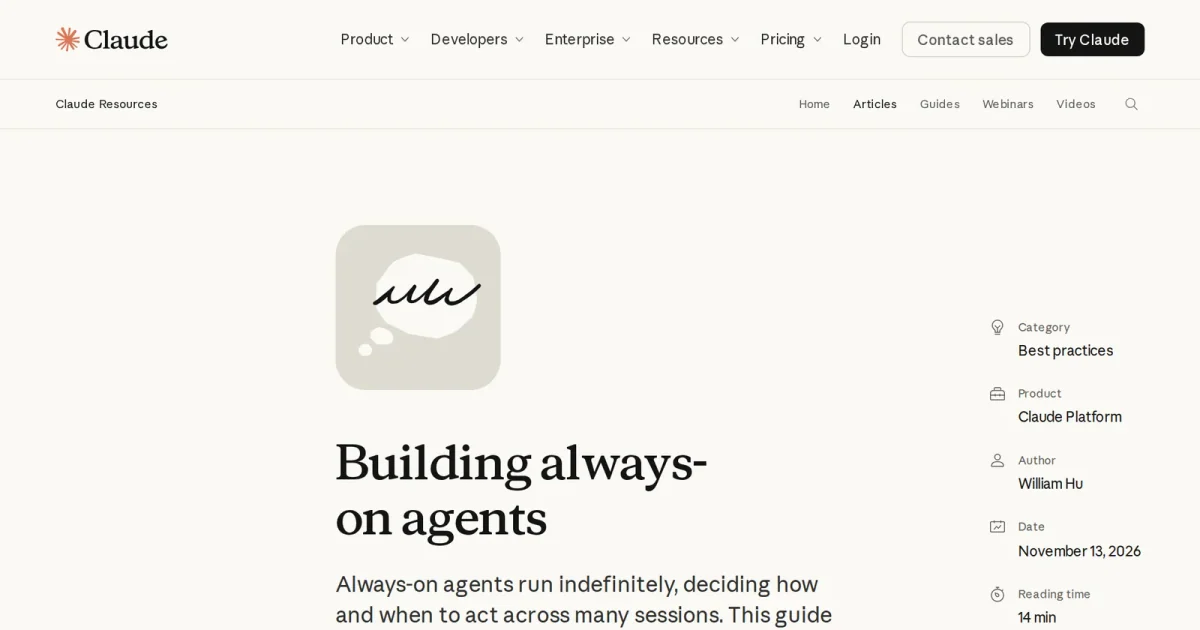
Anthropic is pulling the engineering bottleneck for background agents away from prompt tuning and back to classic backend queues and permission boundaries. Right near the top of its November 13, 2026 guide Building always-on agents, the company deflates a common industry pitch: an always-on agent is not actually running nonstop—that phrase only describes how the product feels to the user.
Under the hood, the agent spends most of its life asleep, waking up in short bursts when an event arrives, saving what happened, and going back to sleep. Putting this blueprint forward now reflects a clear change in economics: once long-horizon inference becomes affordable enough for routine background runs, reliability hinges on state persistence, credential isolation, and notification discipline.
Why Long-Horizon Work Saw the Steepest Price Drop
Anthropic attributes the return of always-on agents to better model judgment on when to check in with users and cheaper inference that disproportionately rewards multi-step tasks. On one long-horizon coding benchmark, Opus 5.5 cost 78% less per solved task than Opus 5, compared with 40% less on typical workloads.
Reading that claim alongside the Claude Platform pricing docs clarifies where the savings come from. Headline Opus 5.5 pricing moved from Opus 5's $5 input and $25 output per million tokens down to $4 and $20—helpful, yet far smaller than the benchmark gap. The bigger shift for wake-sleep loops that reload system prompts and memory on every run is prompt caching: Opus 5.5 cuts cache-read pricing from $0.50 (0.1x) to $0.20 (0.05x) per million tokens.
At the same time, Claude 4.6 and newer models (aside from Haiku 5.5) include the full 1M token context window at standard rates without long-context surcharges. That frees teams to tier workloads by model cost—pairing Opus 5.5 with Fable 5.2 ($8 input, $40 output, $0.20 cache hits) for hardest reasoning, Sonnet 5.5 ($2 input, $10 output, $0.10 cache hits) for everyday work, or Haiku 5.5 up to 100,000 tokens ($0.10 input, $0.50 output, $0.01 cache hits) for routing and triage.
Translating 'Always On' Back Into Classic Backend Infrastructure
The guide's central architectural point is that always-on agents share the same inner reasoning loop as ordinary chat agents. Everything distinctive sits outside the model across five primitives: an event inbox, timers, durable memory, permissions, and an outbox.
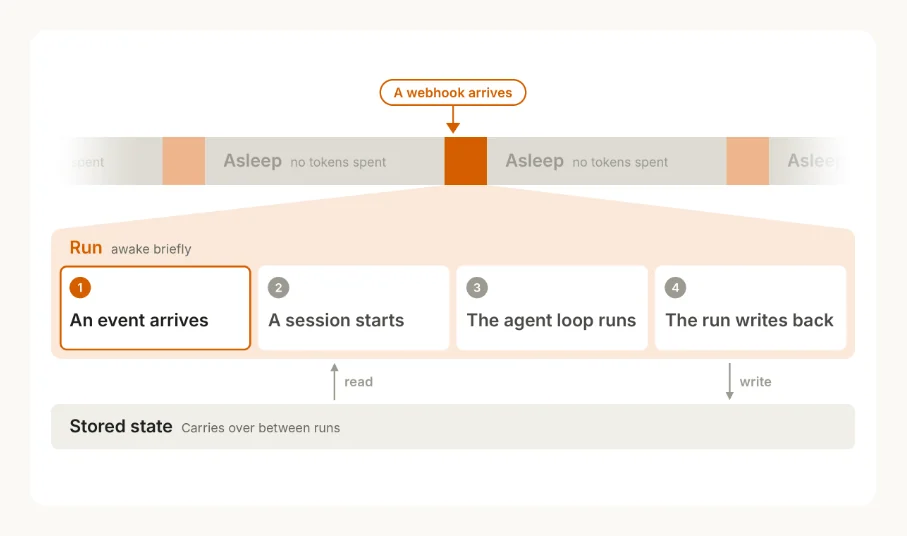
In practice, Anthropic is using standard asynchronous queues to patch the stateless nature of LLM calls. Direct webhook triggers are discouraged because simultaneous events spawn competing runs and crashes lose work; routing events through a durable inbox with a single serialized worker preserves state across restarts while leaving the core model loop unchanged.
Timers live in their own durable store, separated into one-time follow-ups and recurring schedules polled by a background scheduler. Memory maps to databases or object stores rather than worker local disk, storing external trackers as pointers while keeping user instructions, notes, prior messages, and task progress across runs—optionally curated offline by a dreaming pass that replaces stale entries and extracts cross-run patterns. Even so, Anthropic warns that every wake-up pays fixed token overhead for startup context, forcing teams to compact long sessions or roll into fresh ones.
Where Consumer Scheduling Ends and Managed Billing Begins
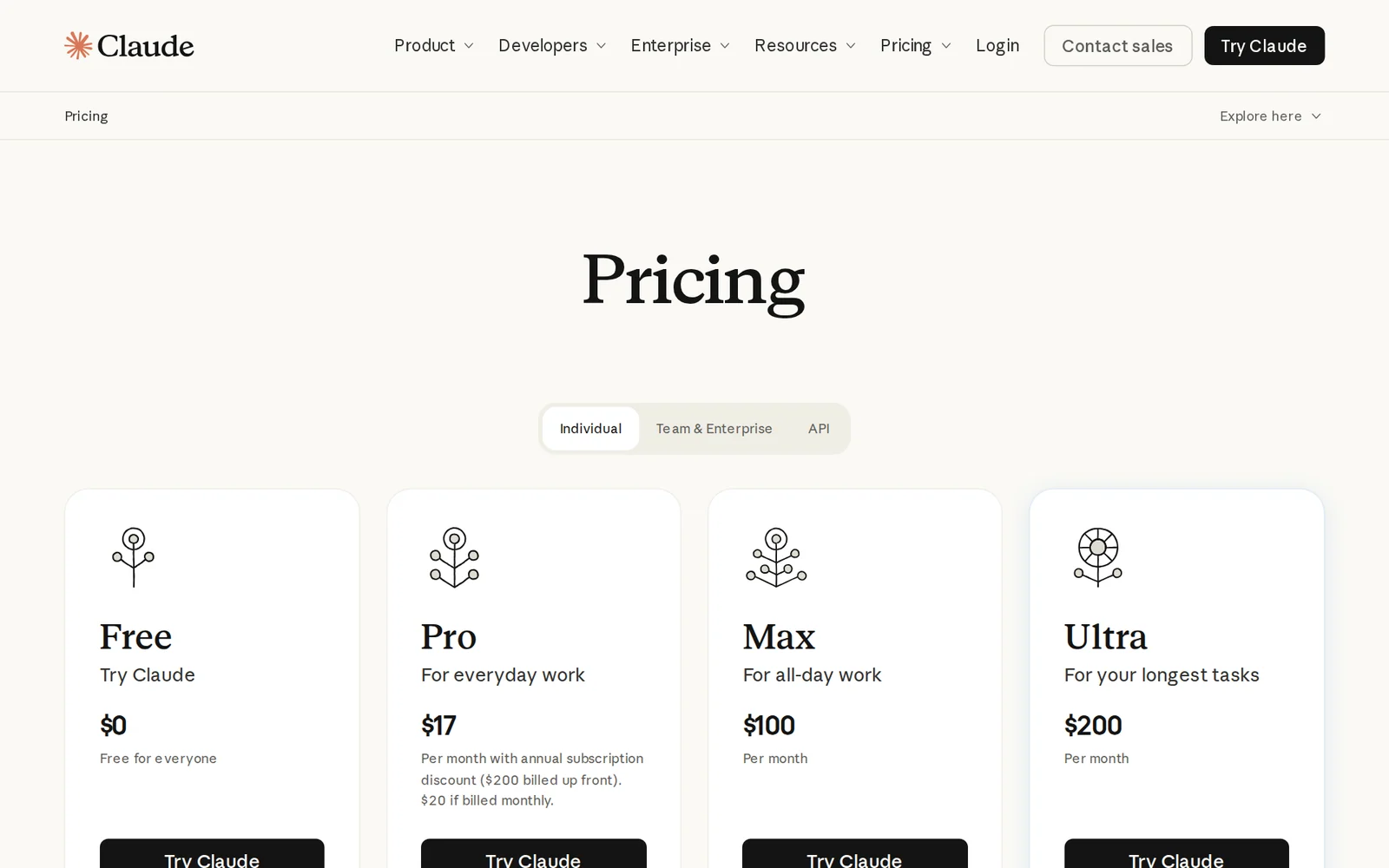
Pricing draws a clean boundary between personal convenience and production agents. On Claude's consumer pricing page, Pro ($17 per month billed annually at $200, or $20 monthly) includes handing off and scheduling tasks, while Max ($100 per month) and Ultra ($200 per month) layer on $100 and $200 in monthly Claude Platform API credits.
For developers building multi-user or webhook-driven systems, Claude Managed Agents bills on two axes: standard token usage plus $0.08 per active session-hour measured to the millisecond. Idle intervals spent waiting for a user reply or tool confirmation do not accrue runtime fees—aligning billing directly with Anthropic's wake-sleep model. In Anthropic's 1-hour Opus 5.5 worked example (50,000 input and 15,000 output tokens), caching 40,000 input tokens lowers the bill from $0.58 to $0.428, though interactive Managed Agents sessions forfeit the Batch API's 50 percent discount.
Human Oversight Simply Changed Shape
The practical question hanging over always-on agents is whether they free operators from constant supervision. Anthropic's sections on permissions and the outbox offer a grounded answer: classifier-driven auto mode can block dangerous calls so Claude reroutes safely, yet human review remains essential for high-stakes actions.
To keep people out of real-time babysitting without losing control, the guide separates credentials behind an external proxy and introduces deferred tool calls—pausing mid-execution, saving session state, and surfacing an async approval card via MCP Apps while the worker handles other events. Paired with a formal outbox dispatcher, evaluation suites for message pacing, and advice to start quiet and earn user attention slowly, Anthropic's blueprint signals that lower token bills only solve half the problem; trust boundaries and interruption budgets decide whether background agents actually stick.
Sources & references
Copy the link to save or share this article.