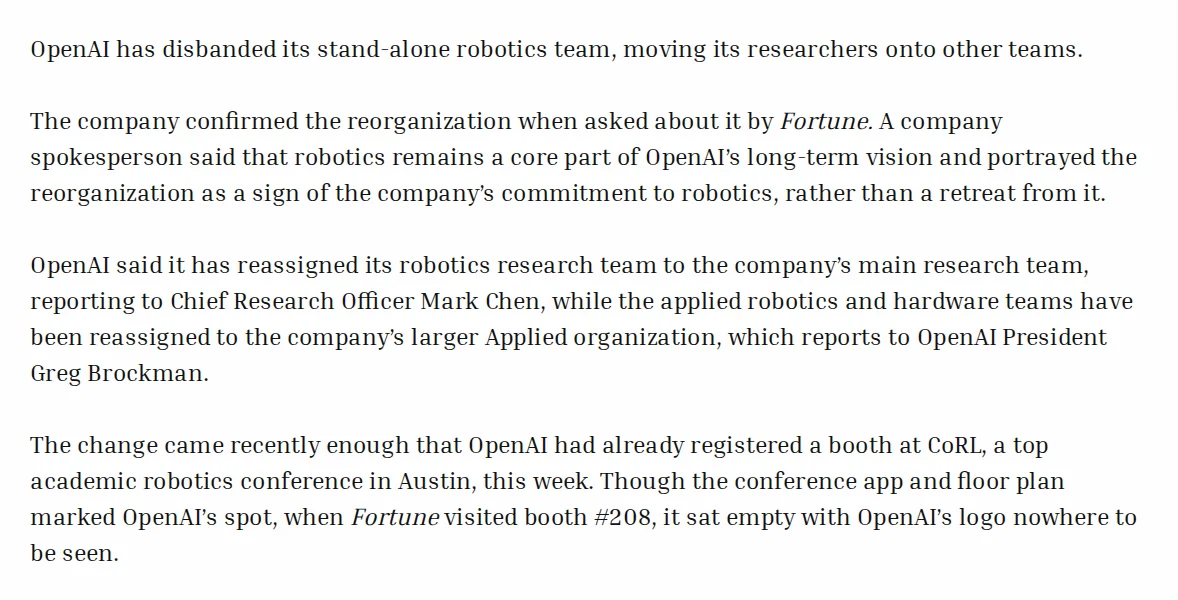
On the exhibition floor at CoRL 2026 in Austin, Texas, the conference map still listed OpenAI at Booth #208. Visitors who walked past found neither hardware demos nor company signage -- only a few former members of OpenAI's once-separate robotics unit talking in an empty space. An exclusive report published by Fortune on November 13, 2026 confirmed why: OpenAI has dissolved its stand-alone robotics team, folding robotics researchers into the main research organization under Chief Research Officer Mark Chen and moving applied robotics and hardware engineers into the Applied division under President Greg Brockman.
OpenAI framed the move not as a retreat from physical machines, noting that CEO Sam Altman still targets a first public demonstration of an in-house humanoid robot in 2027. What OpenAI actually scrapped is an organizational thesis -- the idea that physical robots require an isolated research stack building a dedicated digital brain.
From Sora World Models to Core Frontier Integration Within a Single Year
OpenAI has shut down a robotics division before, though for the opposite reason. When it wound down its early robotics effort in 2020, cofounder Wojciech Zaremba pointed to scarce physical robot data and argued that scaling language models on internet text offered a faster route toward artificial general intelligence. OpenAI rebuilt a dedicated robotics group in 2024 alongside a high-profile Figure partnership, saw Figure end that deal in February 2025 to build its own robot AI, and spent the past year searching for the right architectural bridge into embodied hardware.
According to OpenAI's account to Fortune, researchers started 2026 assuming that robotics progress would grow out of video generation models such as Sora, on the theory that rendering realistic motion required an implicit grasp of physics. Two shifts overturned that plan before year-end. One was financial discipline: facing heavy operating losses reportedly reaching $10.9 billion in the most recent quarter and preparing for a possible early 2027 IPO, Altman pushed the company to drop side quests -- ultimately shelving Sora itself to concentrate compute on core revenue-bearing models. The other was an empirical surprise: hooking GPT-6 Astra directly up to robot interfaces showed that a flagship multimodal model could execute manipulation tasks out of the box. Once core models started driving hardware directly, maintaining a separate robotics algorithm silo became hard to justify.
A 23.8-Point Simulation Lead Pressures Startups Selling Dedicated Robot Brains
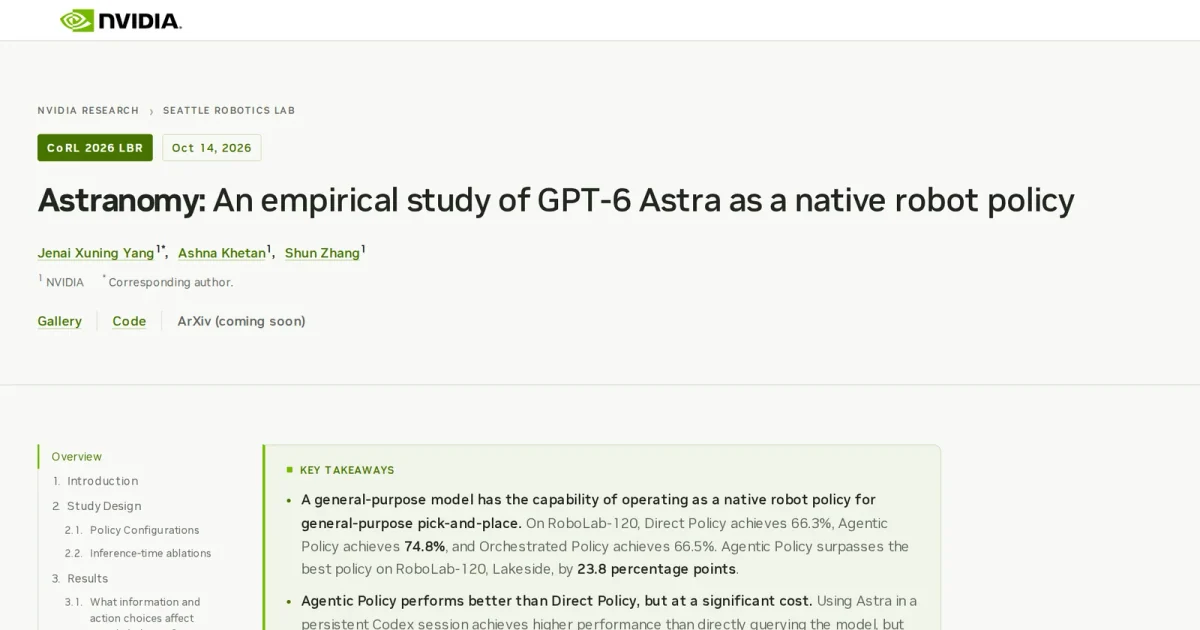
The strongest public evidence behind OpenAI's bet comes from Astranomy, a CoRL 2026 study by researchers at the NVIDIA Seattle Robotics Lab. Across the 120 simulated manipulation tasks of RoboLab-120, an agent powered by GPT-6 Astra inside Codex achieved a 74.8% success rate, outperforming specialist world action model Cosmos3-Nano-Policy (36.8%), vision-language-action policy π0.5 (28.0%), and the highest-scoring specialist baseline on the leaderboard, Lakeside (51.0%), by 23.8 percentage points. That 23.8-point margin reflects overall task success on a specific simulation benchmark -- combining GPT-6 Astra with persistent Codex context and prompt-configured action interfaces rather than isolating generalization as a standalone metric.
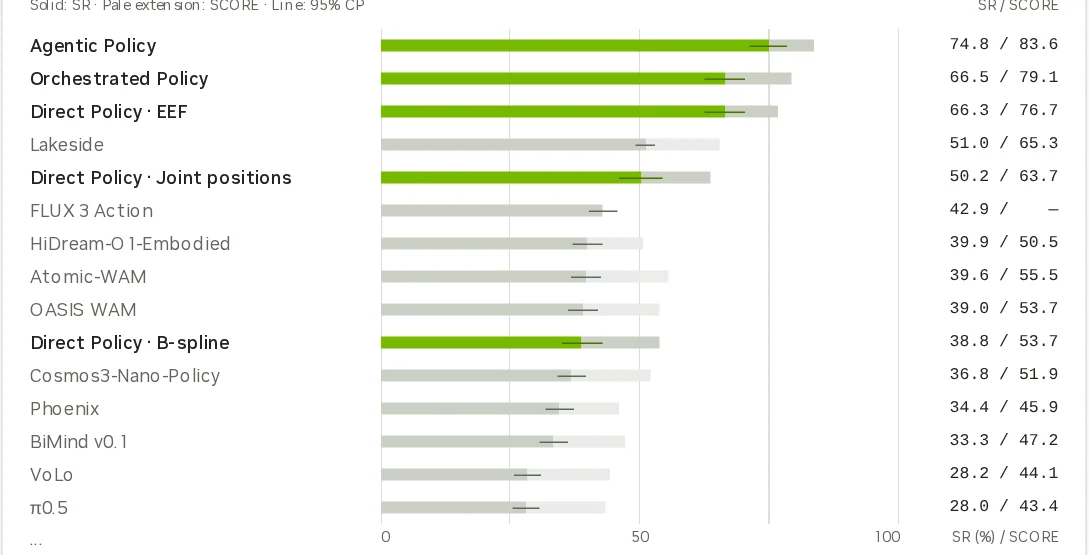
Guanya Shi, an assistant professor at Carnegie Mellon University's Robotics Institute, told Fortune that OpenAI's restructuring signals a belief that robotics is "no longer a special problem." Instead, OpenAI appears to treat physical manipulation as another downstream application of general intelligence, akin to how the same frontier models now underpin specialized coding assistants, legal software, and financial analysis tools. When a bottle sits in an unfamiliar spot, room lighting shifts, or a multi-step cleanup goes wrong mid-sequence, broad visual and causal reasoning lets a frontier model adapt on the fly where narrow robot policies previously needed task-specific retraining.
That framing directly challenges the thesis behind billions of dollars in recent venture funding. Many embodied AI startups pitched investors on the premise that text-and-code models lack spatial intelligence, making bespoke robotics foundation models an independent prize. If general frontier labs absorb high-level task planning and zero-shot scene understanding as a byproduct of scaling their flagship models, startups building general-purpose semantic planners from scratch face uncomfortable questions about differentiation.
What Paused Clocks Conceal: Real-Time Control and Factory Floor Data
Treating an org-chart merger as proof that cloud language models have solved robotics, however, confuses high-level reasoning with physical control. Reading Fortune's industry interviews alongside NVIDIA's test protocol reveals two structural barriers that general cloud models still do not cross.
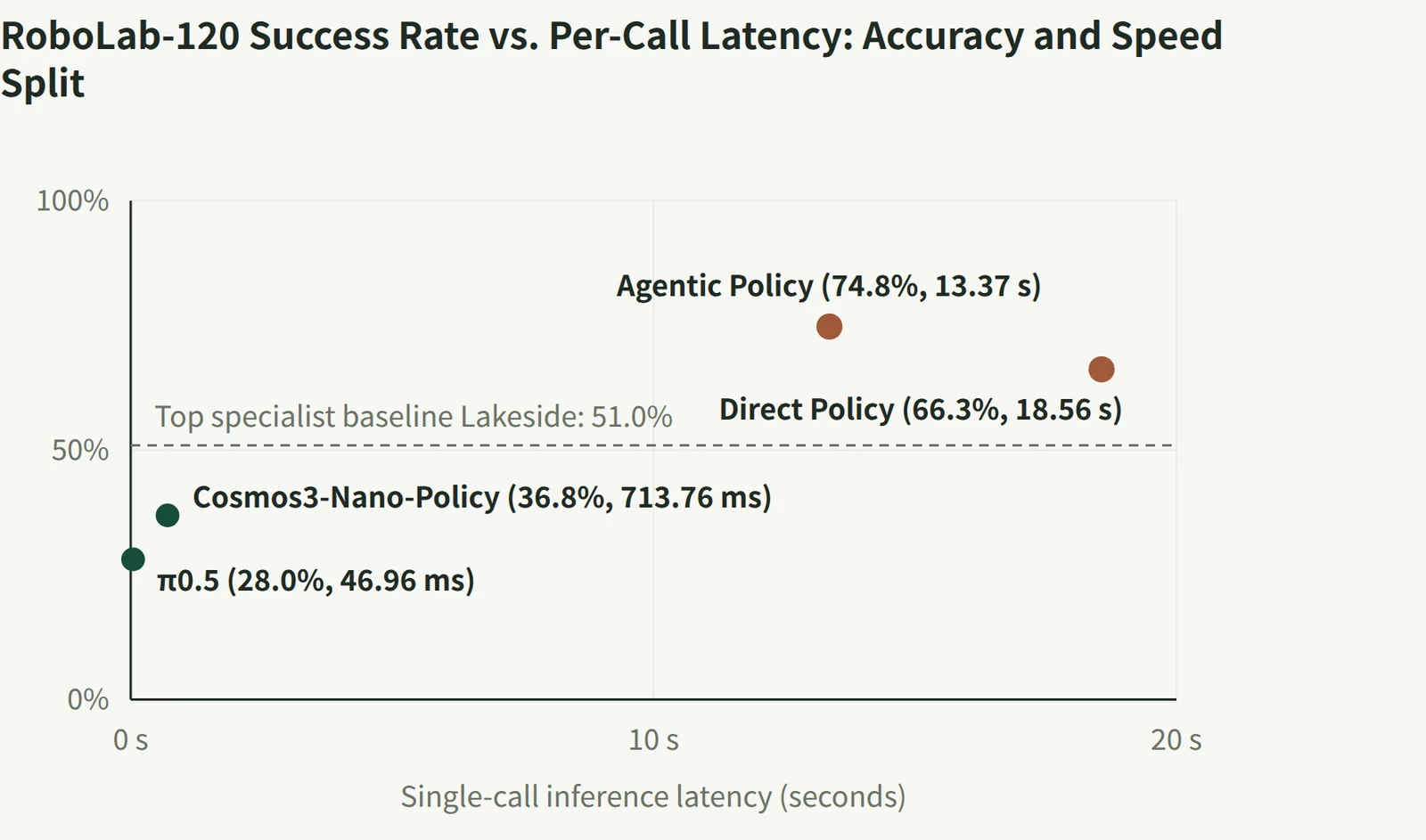
The first barrier is physical time and onboard autonomy. NVIDIA's RoboLab-120 benchmark ran its 15 Hz controller with the simulation paused during inference. Generating actions took GPT-6 Astra an average of 18.56 seconds per inference call in Direct Policy and 13.37 seconds per call in its top-scoring Codex Agentic mode -- a setup that also averaged 30.9M tokens ($36.40) per successful episode according to Figure 2 (summarized loosely as per episode in the study's key takeaways) -- whereas specialist policies π0.5 and Cosmos3-Nano-Policy responded in 46.96 milliseconds and 713.76 milliseconds per call. Real assembly lines do not freeze while waiting on a remote data center, nor can moving machines afford to stall whenever a wireless link drops. As Shi told Fortune, smaller, specialized models capable of running offline on a robot's onboard computer remain necessary.
The second barrier lies in real-world deployment loops. MIT professor Russ Tedrake, cofounder and CEO of Walden Robotics, argued to Fortune that robotics companies hold an asset frontier AI labs lack: machines already logging hours on real factory floors. Site-specific operational data teaches robots how to handle real friction, wear, and workplace edge cases, and stronger foundation models actually make that proprietary deployment data more valuable by helping robots learn from it faster. Pete Florence, cofounder of robotics model startup Generalist, similarly contended that it remains far from clear whether any existing model architecture will dominate robotics over the long haul.
OpenAI's stated bet is to fold robotics into core model research and Applied engineering so general-purpose frontier models drive hardware directly, rather than confining themselves to high-level planning. Yet in our assessment of the benchmark evidence, what cloud frontier models have actually proven so far is task reasoning and action generation inside paused simulations, leaving sub-second onboard control and offline reliability unresolved. Two concrete tests over the coming year will show how far that bet carries: whether OpenAI's targeted 2027 humanoid demonstration -- if it happens on schedule -- relies on a distilled onboard policy or a layered local-plus-cloud architecture, and whether independent robotics startups shift capital away from pretraining broad semantic backbones toward owning millisecond onboard execution and proprietary workplace data.
Sources & references
Copy the link to save or share this article.