Commentary by LittleDot · October 8, 2026
My first thought after reading Tibo’s Day 3 post: OpenAI looks busy rearranging its product line. Quite a few things seem to be moving at once.
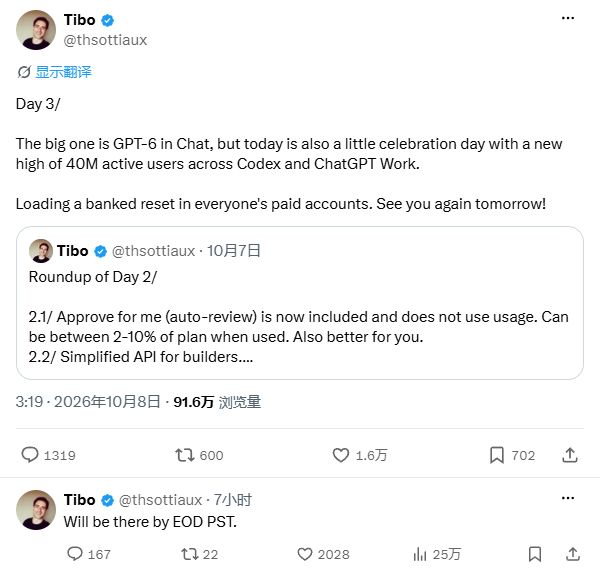
The post brings GPT-6 in Chat, a new high of 40 million active users across Codex and ChatGPT Work combined, and an announcement that paid accounts are being given a banked reset. Nice numbers. A reset is welcome, too. But I use these tools to get work done every day, and the experience at my desk has been rather less tidy.
I would quite like the speed back
A few days before this Chat announcement, GPT-6 suddenly felt painfully slow. My rough impression was about a quarter of its previous speed. A task I could normally keep moving through became a series of pauses: wait, read a little, wait again.
The next day felt perhaps 50 percent faster than that slow day. That is my estimate from using it, and it still felt a long way from the pace I had been used to.
I want better models as much as anyone. I also want to know roughly how long an answer will take. A quota reset is useful; it does not give me back an afternoon spent waiting.
The familiar places are moving
The route I used to take into Codex’s management area has changed as well. The old interface I knew seems to have disappeared from my usual path, with a ChatGPT web management page taking its place. From my side of the screen, the entrances are being brought together and the backend interface looks reorganized.
Project memory has caught my attention, too. Switching projects used to feel more clearly separated. Lately, some answers have left me wondering whether background from another project has come along for the ride. I am watching what gets remembered and where it turns up, because that affects how comfortably I can switch between jobs.
Put those experiences together, and my guess is that OpenAI is doing a fairly substantial reorganization: bringing product entry points together, reworking management screens, and reconsidering how people enter and manage Codex. We cannot see the building plans from our desks. We can certainly notice when a door moves.
Why the 28 days make sense to me
Tibo’s earlier 28-day commitment was a useful improvement each day, or a full reset. I read it as a window in which the product keeps changing while the rest of us keep trying to use it.
My guess is that changes this broad could take roughly a month to settle. That is the connection I make with those 28 days. Some changes will help immediately; others will mean relearning a small part of the working day.
I will keep using it and paying attention. After this stretch, I want to see steadier speed, management pages I can find, and project context I can understand. Then I will have a better idea of what all this rearranging bought us.
Let’s see how it turns out.
I wrote a separate piece on ToolAI about the practical cost of these changes: Tibo’s Day 3: You can reset the quota. What about the working day?
The original post was published October 7 at 19:19 UTC, or October 8 at 03:19 in Beijing. Tibo’s follow-up gives an expected delivery window for the reset. Earlier coverage: the 28-day commitment.
Sources & references
Copy the link to save or share this article.