JetBrains Junie
CodingJunie combines a coding agent with planning, model choice and JetBrains development workflows. Use the CLI, supported IDE integration or repository automation to work on scoped code changes.
Build, refine and publish applications in one cloud workspace with Replit Agent.
Replit combines an AI development agent with a cloud project environment and application hosting. You can describe a product, work on the generated code, inspect a running preview and publish it from the same workspace. That makes it useful when the difficult part is connecting a working interface to data and a usable deployment. Our suggested starting point is a modest internal tool or a clearly bounded product prototype. Replit provides substantial infrastructure, but you still decide what the app should do, who can access it and how much it may spend. A small, explicit brief is easier to verify and maintain than a request to build an entire business at once.
Booking and request tools
Campaign dashboards
Document portals
Scheduled reports
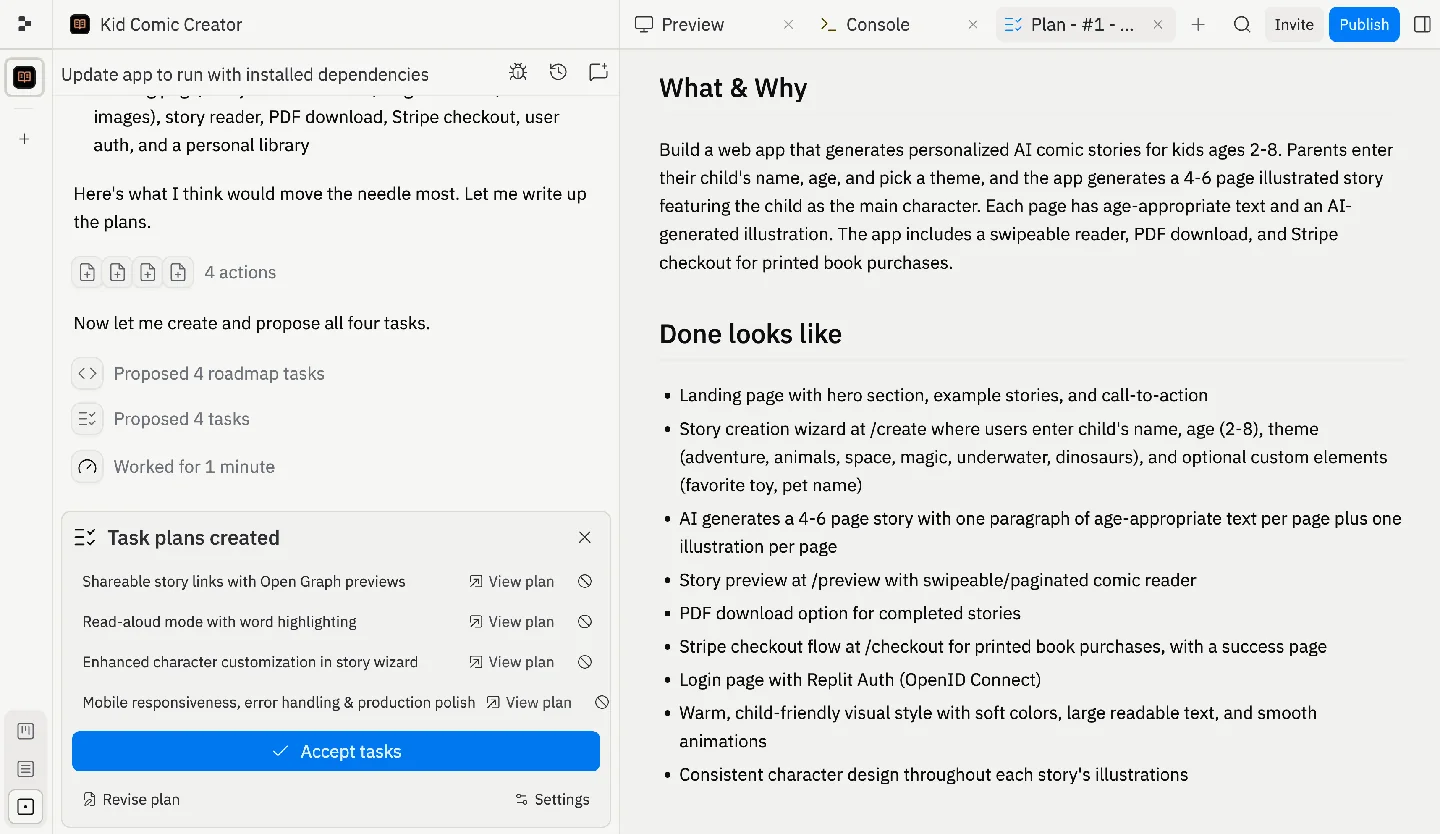
Official product image. Click to inspect the details.

For practical use, the combination matters more than any single button: a form needs persistence, a file upload needs storage, and a published page needs an operating budget. Agent overview.
Define one workflow and its data
Review the plan and build a small first slice
Check persistence, permissions and mobile behavior
Choose hosting, set a budget and publish
Example brief: “Create an equipment booking app for six staff. Show available items, a request form and an admin approval list. Use fictional records first. Prevent overlapping approved bookings. Explain the data model before changing code.”
This workflow is editorial guidance. It helps make the generated result reviewable without turning a first experiment into an open-ended project.
Starter publication expires after 30 days; cloud and Agent usage have separate limits.
Checked October 3, 2026: Starter includes capped Agent access and one published app whose link expires after 30 days. Core and Pro unlock broader capabilities. Subscription credits can cover Agent work and cloud services; paid Agent actions use effort-based billing. Current plans.
Set a budget before a long build. A successful request can consume more than a small edit, and paid planning can be billable without changing code. Hosting, storage and integrations remain relevant after development ends. Budget controls.
Yes. Replit provides a browser-based project environment. You still need an account and a network connection, plus access to any external service you connect.
The current Starter guide describes one published app with a 30-day lifetime. Do not use that trial-style link as an assumption of permanent hosting.
Only if the application uses persistent storage correctly. Ask for a database for records and appropriate object storage for files, then verify the actual save and reload behavior.
No. Publishing creates a running snapshot separate from the editor version. Check the public deployment after each release; changes in a preview are not evidence that production has changed.
The current publishing guide states US hosting by default. Enterprise customers can discuss EU hosting with sales. Confirm the arrangement before choosing it for a region-sensitive workload.
No. Model work, hosting and other services have usage rules. Inspect the billing view and applicable limits rather than counting prompts alone.
Replit’s terms say you retain rights to content you provide while granting permissions needed to operate the service. Check third-party assets and generated dependencies separately; this does not transfer ownership of Replit itself.
Explore platforms, inputs and outputs, licensing, and access requirements.
These are proposed workflows, not packaged features or measured success claims. Choose the one for which you already understand the data and the user.
Use the database for relational records and App Storage for binary files; they have different access patterns and billing. Replit’s database supports PostgreSQL-compatible clients and ORMs, while file storage has SDK and REST-oriented access. This distinction is useful when a prototype becomes a maintained product. Storage guide.
Connectors are conveniences rather than blanket access to another company’s data. Authorize only the accounts needed for the project and document the external API assumptions. For a handover, preserve source code, record environment variables securely, plan data exports and identify who owns domains and subscriptions. Moving files alone will not reproduce hosted databases or third-party configuration.
Replit’s privacy policy covers submitted code, files, prompts, generated content and interaction data. Its terms permit access to private app content for service operation, troubleshooting and safety. Do not infer that a private project means the provider never processes its contents. Privacy policy · Service terms.
Our operational recommendation is to use sample records first, store credentials through the intended secret-management mechanism, and confirm workspace access before uploading customer data. Source ownership, model processing and deployment region should each be reviewed on their own terms.
Checked October 3, 2026.
Loading experiences…
Saved tools are private. Approved comments are public; edits return to moderation. Comment counts include approved comments and replies. Each person has one rating. New ratings are automatically approved; withdrawn, unapproved or invalid ratings do not count. Share real experiences and avoid spam, private information or personal attacks.
For moderation appeals or data requests: support@findgoodai.com
Bring a real task and see how it fits the way you work.
User experiences