Murf
Audio & musicCreate voiceovers from scripts and refine delivery with voice, pronunciation and pacing controls. Murf Studio serves content production, while Murf’s API, dubbing and conversational-agent offerings address different workflows.
An open-source voice-cloning system that combines reference voice color with generated speech. OpenVoice supports multilingual workflows and style control through its underlying speech pipeline, with free MIT-licensed self-hosted models and code.
OpenVoice is a speech-generation project that separates aspects of a voice, such as its tone color, from the speech content and style produced by a base text-to-speech system. A short reference recording supplies voice characteristics that can be applied to generated speech, including cross-language experiments.
The project is better understood as a developer toolkit than a finished one-click production studio. The official usage guide describes model downloads, a Linux-oriented environment and example workflows. V2 adds native support for English, Spanish, French, Chinese, Japanese and Korean; quality and pronunciation still depend on the language and complete pipeline.
Prototype bilingual narration
Build a speech research demo
Prepare a creator voice workflow
Develop an internal audio tool
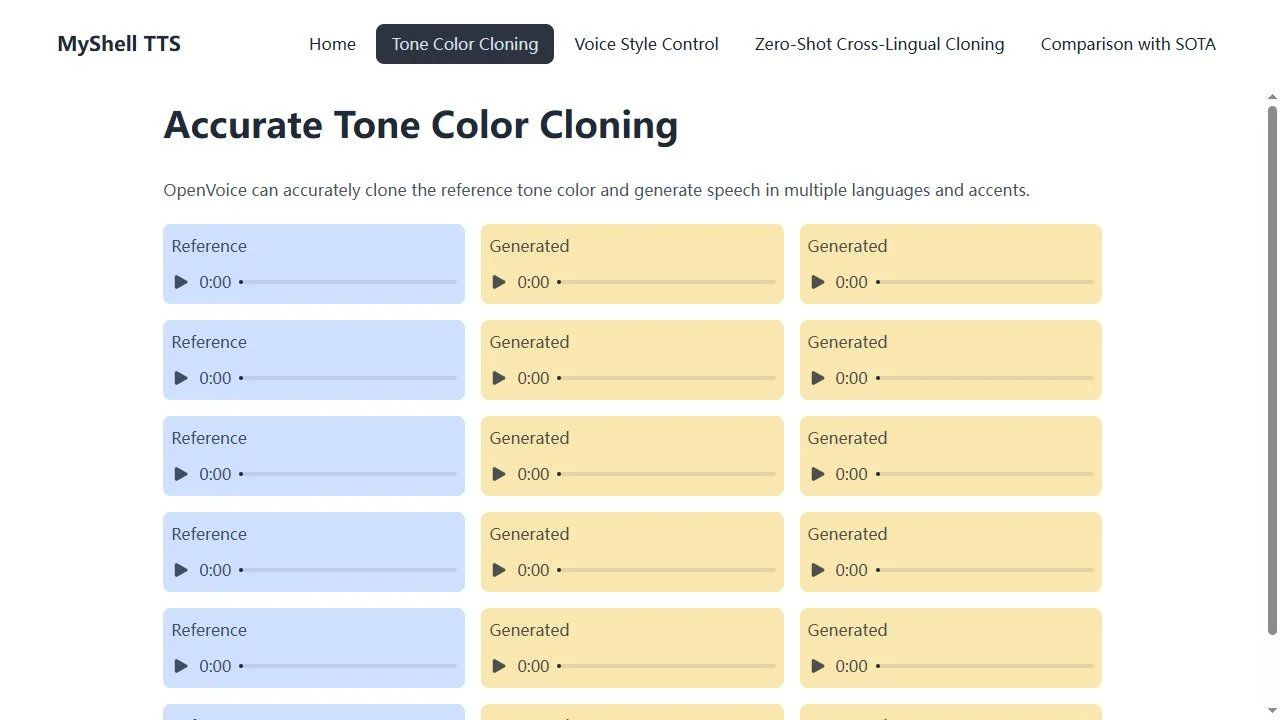
Official product image. Click to inspect the details.

Obtain an appropriate reference
Follow the matching setup guide
Generate a small comparison
Review before scaling
Example prompt or task: Create a short Chinese and English narration prototype using my own authorized reference recording. Keep the scripts equivalent in meaning and compare pronunciation, pause placement and volume before generating the full lesson.
This is an editorial starting workflow, not a measured performance result.
OpenVoice V1 and V2 are released under the MIT license, including research and commercial use as described by the project. The free claim here applies to the open-source self-hosted route, not to unlimited access to every hosted MyShell product.
Model downloads, compute, storage and any rented infrastructure remain separate. Additional text-to-speech components and distribution assets can have their own conditions. Budget for listening and editing time as well as inference when evaluating an audio-production workflow.
The project states that V1 and V2 are MIT-licensed for research and commercial use.
No. This listing's free classification applies to self-hosted code and models.
English, Spanish, French, Chinese, Japanese and Korean are listed in the repository.
Cross-language voice transfer is a documented research capability, with output quality requiring evaluation.
Treat translation as a separate step and verify meaning before speech synthesis.
No. The official setup is developer-oriented, with additional community routes.
Public availability is not permission. Use voices you own or are authorized to synthesize.
Explore platforms, inputs and outputs, licensing, and access requirements.
V2 examples use a base speech-generation component alongside the tone-color conversion model. Following the documented combination matters: a voice-cloning system is more than one file, and mismatched dependencies can affect setup and results.
The project includes Linux developer installation and links to community approaches for other platforms. It should not be presented as a guaranteed native desktop application for every operating system, nor as a universal real-time voice changer.
Reference recordings can identify a person. Obtain permission covering the intended synthesis and publication, and store those recordings with suitable access controls even when processing remains local.
Label synthetic narration where the context calls for it and avoid presenting generated speech as a recording of something the person actually said. The MIT software license does not grant rights to another person's voice, script or copyrighted source recording.
Reviewed October 3, 2026. Product facts come from the official sources below. Suggested projects, prompts and review methods are FindGoodAI editorial guidance, not measured performance results.
Loading experiences…
Saved tools are private. Approved comments are public; edits return to moderation. Comment counts include approved comments and replies. Each person has one rating. New ratings are automatically approved; withdrawn, unapproved or invalid ratings do not count. Share real experiences and avoid spam, private information or personal attacks.
For moderation appeals or data requests: support@findgoodai.com
Bring a real task and see how it fits the way you work.
User experiences