JetBrains Junie
CodingJunie combines a coding agent with planning, model choice and JetBrains development workflows. Use the CLI, supported IDE integration or repository automation to work on scoped code changes.
Google’s browser workspace for experimenting with model prompts, settings and small AI applications. Selected models have a free tier, while paid models, production usage and regional eligibility require separate checks.
Google AI Studio is a browser environment for exploring how a model responds to a task before building a full application around it. You can work with prompts, system instructions and run settings, then use the resulting experiment as a starting point for code. It is a different workflow from simply asking a general-purpose chatbot a one-off question.
The most useful first project is narrow: extracting a few fields, answering from a short approved document or producing a consistent structured response. A successful demonstration is not yet a reliable product. The next step is to test ordinary inputs, missing information and awkward edge cases so you understand when the model follows the intended contract and when it needs additional controls.
Extract fields from public text
Prototype a support assistant
Compare output formats
Build a small application draft
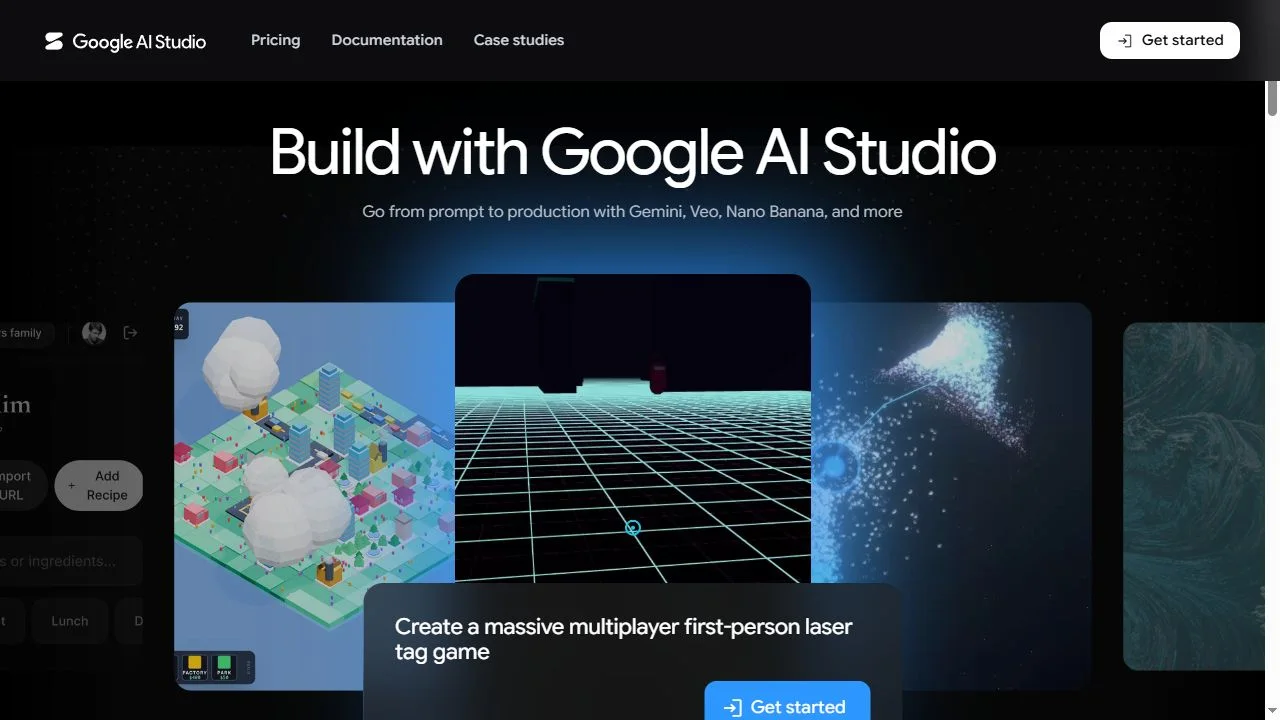
Official product image. Click to inspect the details.

Confirm eligibility and model
Define a small contract
Try varied examples
Integrate with controls
Example prompt or task: Extract title, publication date and organization from the supplied public announcement. Return a structured object. Use null for missing fields and do not infer a date from unrelated text.
This is a prototype task, not a claim that model output can replace application validation or source checking.
A visible model or media-generation entry point does not mean it has free quota. Check the model’s pricing row and project limits.
Google documents a free tier with limited access to selected models and free input/output tokens for eligible usage. Other rows can show no free availability, and advanced media or tool use may have separate charges. Consult the specific model row rather than treating AI Studio as universally unlimited and free.
Rate limits depend on the model and project tier and can involve requests, tokens and daily usage. Enabling paid billing changes the usage and data context; it is not the same as merely opening the playground. Monitor the actual project and do not assume a consumer Gemini subscription automatically pays for API work.
No. It is a development and prompt-experimentation workspace.
No. Free availability is specified separately in the pricing table.
No. Check the exact model and task before using it.
The current region guide specifies age 18 or older.
No. Mainland China is not in the current supported-region list.
Do not expose private credentials in public client code; use an appropriate protected integration.
The unpaid-service terms warn against submitting sensitive or confidential information.
Explore platforms, inputs and outputs, licensing, and access requirements.
The service requires users to be at least 18 and to access it from supported regions. Mainland China is not listed in the current available-region guide. Chinese-language model capability does not remove those geographic and account requirements.
Conversation history grows as a prompt develops, which can increase context consumption and eventually reach a model limit. Save the intended instructions and a compact test set separately so experiments can be repeated without relying on one increasingly long chat.
The pricing table and service terms distinguish unpaid and paid data handling. Unpaid-service content can be used to improve products, with specific regional and service exceptions described in the terms. Use public or synthetic examples and review the applicable terms before submitting any sensitive information.
An application built from a playground experiment needs its own permissions, retention choices and user disclosures. Protect API credentials, restrict external tool access and avoid assuming that a prompt instruction alone prevents private data from appearing in an output.
Reviewed October 3, 2026. Product facts come from the official sources below. Suggested projects, prompts and review methods are FindGoodAI editorial guidance, not measured performance results.
Loading experiences…
Saved tools are private. Approved comments are public; edits return to moderation. Comment counts include approved comments and replies. Each person has one rating. New ratings are automatically approved; withdrawn, unapproved or invalid ratings do not count. Share real experiences and avoid spam, private information or personal attacks.
For moderation appeals or data requests: support@findgoodai.com
Bring a real task and see how it fits the way you work.
User experiences