Murf
Audio & musicCreate voiceovers from scripts and refine delivery with voice, pronunciation and pacing controls. Murf Studio serves content production, while Murf’s API, dubbing and conversational-agent offerings address different workflows.
A free open-source speech toolkit for transcription, speech activity detection, punctuation and configurable speaker pipelines, with local and service deployment options.
FunASR is a speech processing toolkit rather than one universal recognition model. It provides interfaces and pipelines for tasks such as transcription, voice activity detection, punctuation and speaker-related processing. Current documentation distinguishes model checkpoints, Python interfaces and deployment runtimes so their capabilities are not accidentally combined into one promise.
It is useful for developers who want local transcription or an internal speech service and can maintain the environment. Start by deciding what the application needs: plain text, timestamps, live partial results or anonymous speaker segments. Those requirements should guide model and runtime selection before any speed comparison.
Prepare a transcript draft
Build subtitle preparation
Create a private transcription endpoint
Evaluate a multilingual archive
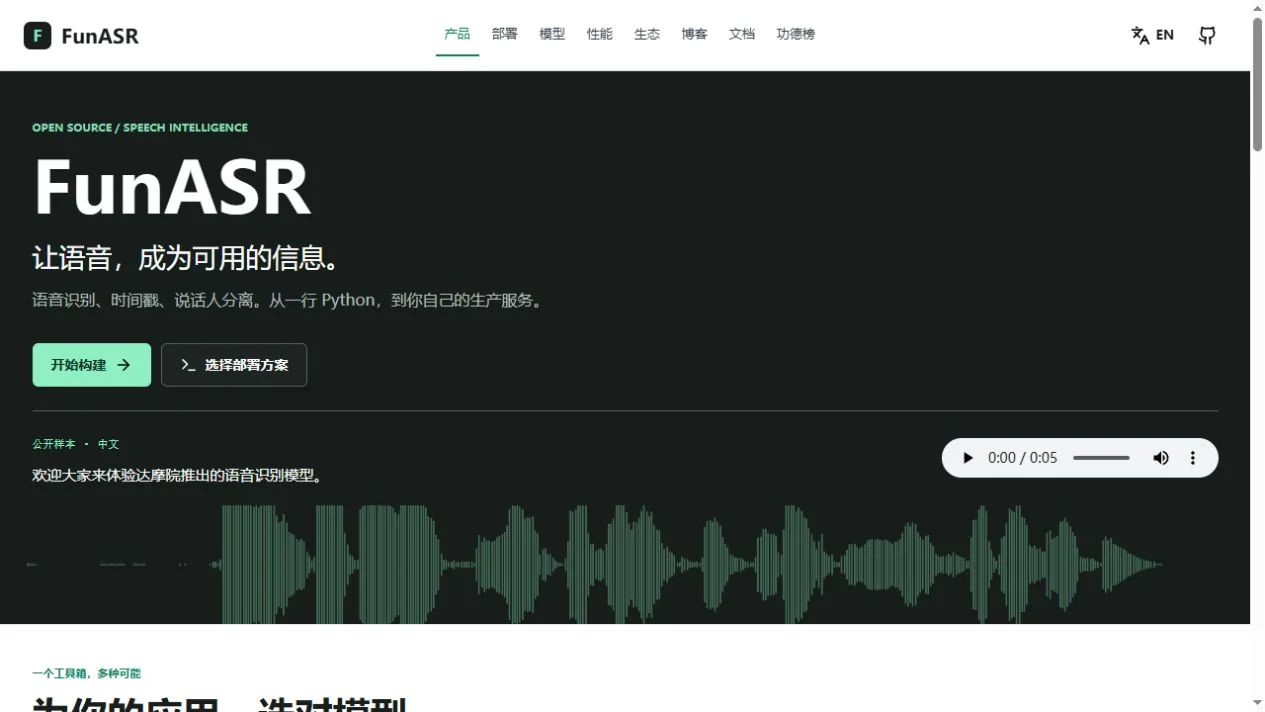
Official product image. Click to inspect the details.

Define the required output
Match model and runtime
Try a representative recording
Integrate with clear boundaries
Example prompt or task: Transcribe this permitted interview into a reviewable draft. Preserve supported timestamps and anonymous speaker segments when the selected pipeline provides them; do not invent names or missing output fields.
This is an editorial workflow example. No recognition-accuracy, throughput or capacity benchmark was performed for this listing.
The toolkit is free to self-host. A feature available in one checkpoint or adapter is not automatically available in every deployment backend.
FunASR’s toolkit code is MIT-licensed and offers a free local software route. The model catalog includes separately licensed weights, including third-party models, so model terms must be checked for the exact checkpoint used.
Local inference consumes hardware, storage and electricity. GPU rental, managed hosting and commercial transcription services can add costs. An OpenAI-compatible interface describes an API shape; it does not mean the computation is supplied by OpenAI or included in an OpenAI subscription.
The MIT-licensed toolkit can be self-hosted. Model terms and compute costs are separate.
No. Language coverage is checkpoint-specific, including distinctions between Nano and multilingual variants.
The documented diarization paths generally produce anonymous labels within a recording, not verified names.
No. Check the specific model, pipeline and serving path.
An HTTP endpoint alone does not create streaming recognition. Use a documented streaming route.
No. Compatibility concerns the interface, not a subscription or external compute entitlement.
No. Compare it with the recording, especially proper nouns, numbers and overlapping speech.
Explore platforms, inputs and outputs, licensing, and access requirements.
The Python toolkit provides a straightforward development entry point, while accelerated, streaming and edge deployments have their own dependencies. Choose a supported combination rather than mixing installation fragments from different runtime guides.
Typical input is an audio file or supported audio stream. Output can be plain text or structured results depending on the pipeline. Speaker labels, emotion tags and timestamps have different origins and meanings, and postprocessing may remove some fields or tags before they reach a client.
A self-hosted path can keep recordings and transcripts within your chosen environment. Review remote model downloads, storage, logs and any external summarization stage separately because the final workflow may include more than recognition.
Recordings and transcripts can contain personal or confidential information. Limit access and retention to the intended workflow, and avoid treating anonymous speaker clustering or emotion tags as reliable conclusions about a person’s identity or state.
Reviewed October 3, 2026. Product facts come from the official sources below. Suggested projects, prompts and review methods are FindGoodAI editorial guidance, not measured performance results.
Loading experiences…
Saved tools are private. Approved comments are public; edits return to moderation. Comment counts include approved comments and replies. Each person has one rating. New ratings are automatically approved; withdrawn, unapproved or invalid ratings do not count. Share real experiences and avoid spam, private information or personal attacks.
For moderation appeals or data requests: support@findgoodai.com
Bring a real task and see how it fits the way you work.
User experiences