Murf
Audio & musicCreate voiceovers from scripts and refine delivery with voice, pronunciation and pacing controls. Murf Studio serves content production, while Murf’s API, dubbing and conversational-agent offerings address different workflows.
A free self-hosted speech generation toolkit with reference-voice synthesis, multilingual models, instruction-based controls and streaming integration paths.
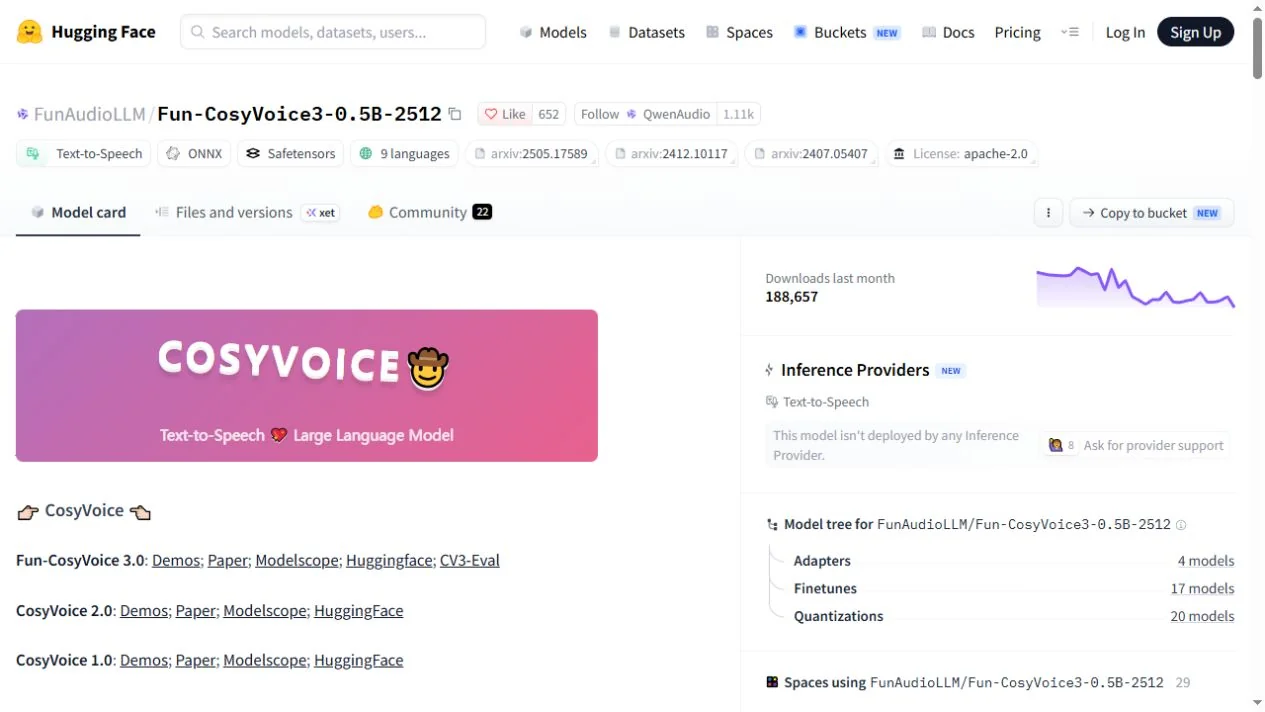
CosyVoice provides models and code for speech generation, with the current repository highlighting Fun-CosyVoice 3. Its official model card covers multilingual synthesis, reference-voice use and controllable delivery. Developers can work through Python examples or explore the documented serving implementations.
It is suited to people who need more control over inference and integration than a simple upload-and-download website offers. That control comes with setup work: choose the checkpoint, prepare its dependencies and understand which mode accepts reference text, audio or instructions. Evaluate the output on your own scripts instead of borrowing a headline latency claim.
Add speech to a prototype assistant
Create a multilingual narration draft
Test a pronunciation glossary
Explore speaking styles
Official product image. Click to inspect the details.

Choose the checkpoint
Prepare text and reference
Run one documented mode
Review and integrate
Example prompt or task: Generate a clear introduction from this approved script using my permitted reference voice. Keep the language explicit and compare a neutral delivery with one supported style instruction while preserving the words.
This is an editorial starter experiment. No FindGoodAI latency benchmark or voice-similarity measurement is claimed.
The reviewed model card identifies Apache-2.0. Check the exact checkpoint and any auxiliary resources rather than assuming every related download has identical terms.
The repository uses Apache-2.0, and the reviewed Fun-CosyVoice3-0.5B-2512 model card also identifies that license. This provides a free self-hosted route for the reviewed combination, subject to the actual license conditions and any separately included components.
You supply compute, disk space, electricity and maintenance. A cloud GPU, managed speech API or third-party interface may charge separately and has its own data policies. Public demonstrations and introductory hosting offers should not be interpreted as guaranteed unlimited free production capacity.
The reviewed code and CosyVoice 3 model provide an Apache-2.0 self-hosted route. Compute is separate.
No. Read the card and examples for the checkpoint you actually download.
Requirements depend on the inference mode. Follow the matching example.
Current documentation includes pronunciation-control paths; evaluate them on the complete phrase.
No. End-to-end behavior depends on the deployed runtime and application.
The repository mainly provides models, code and examples. Hosting and application operation are separate choices.
Only use reference voices and recordings with the required permission for your intended use.
Explore platforms, inputs and outputs, licensing, and access requirements.
The project is aimed at developers comfortable with Python environments, model downloads and audio tooling. Some accelerated runtimes have more restrictive dependencies than basic inference, so keep an initially working environment before evaluating an alternative backend.
Inputs vary by mode and can include target text, reference text, a voice recording and control instructions. Output is synthesized audio that can be saved or streamed through supported paths. Keep model versions, scripts and configuration together when preparing repeatable content or debugging differences.
Running inference on your own host gives control over where scripts and reference audio are processed. Downloads, remote storage or a third-party interface can introduce separate network paths, so document the configuration actually used.
Model licensing, recording rights and permission to reproduce a voice are different matters. Keep authorized source material and clearly distinguish generated audio from an authentic recording when that distinction matters to listeners.
Reviewed October 3, 2026. Product facts come from the official sources below. Suggested projects, prompts and review methods are FindGoodAI editorial guidance, not measured performance results.
Loading experiences…
Saved tools are private. Approved comments are public; edits return to moderation. Comment counts include approved comments and replies. Each person has one rating. New ratings are automatically approved; withdrawn, unapproved or invalid ratings do not count. Share real experiences and avoid spam, private information or personal attacks.
For moderation appeals or data requests: support@findgoodai.com
Bring a real task and see how it fits the way you work.
User experiences