Cartesia
Audio & musicCartesia builds ultra-low-latency State Space Model speech APIs—Sonic 3.6 TTS (~90ms), Ink 2 STT, and Managed Voice Agents—starting with a $0/month Free plan (20K credits).
A conversational speech model for Chinese and English research, with controls for speaker characteristics and delivery; the released weights are restricted to noncommercial educational and research use.
ChatTTS is a speech generation model designed around dialogue, including use in research on spoken assistants. The official repository provides the algorithm infrastructure and examples rather than positioning itself as a complete end-user narration application. Its documented language support is Chinese and English.
The key selection condition is licensing. The code is published under AGPLv3+, while the released model uses CC BY-NC 4.0 and is described for educational and research use. This listing’s free qualification is that noncommercial research route, not permission to build a paid voice service or monetize generated narration.
Study dialogue prosody
Build a classroom demonstration
Inspect bilingual behavior
Prototype a research playback interface
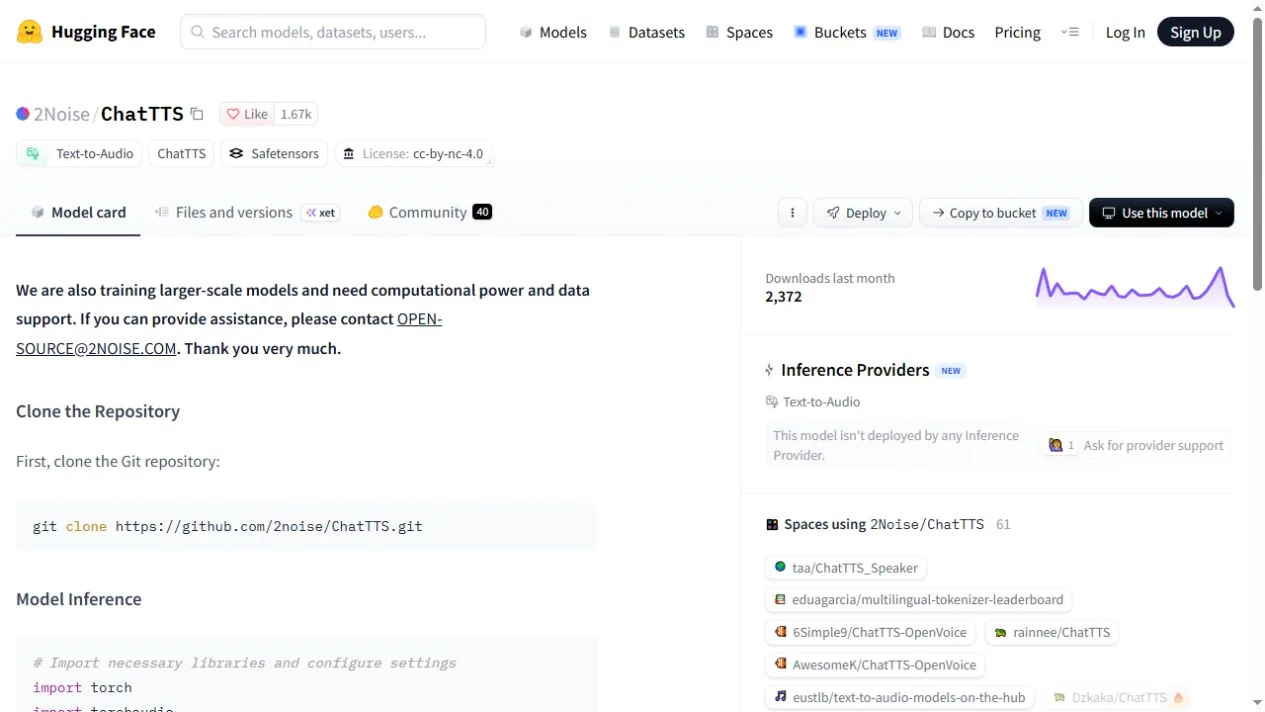
Official product image. Click to inspect the details.

Confirm the intended use
Use the current project example
Prepare a controlled script
Listen and document
Example prompt or task: For a noncommercial speech research exercise, synthesize a short Chinese and English dialogue from this approved script. Compare ordinary punctuation with one documented pause control and record the audible differences.
This is an editorial research exercise, not a measured comparison or a claim that FindGoodAI has generated these samples.
The official project distinguishes its code license from the released model’s noncommercial restrictions. Hosted clones do not change those underlying terms.
The software and released weights can be obtained without a software subscription for the permitted route, but the model’s noncommercial research conditions are central. The AGPL code license does not override the separate model license.
You still supply hardware, storage and electricity, or pay a host if using remote compute. A third-party website may charge for an interface or service, but that does not itself establish permission for every downstream use. This page intentionally does not describe ChatTTS as a free commercial narration platform.
There is a free noncommercial educational and research route. Compute costs remain separate.
The official model is restricted to noncommercial use; this listing does not grant commercial permission.
No. Code is AGPLv3+; the released model is CC BY-NC 4.0.
Chinese and English are explicitly listed.
The main repository provides infrastructure and examples; community applications are separate.
Documented controls cover aspects of conversational speech, but the actual output must be evaluated.
No. The presence of a website or paid interface does not replace the original model terms.
Explore platforms, inputs and outputs, licensing, and access requirements.
The official repository is a developer and research resource with Python examples. Environment requirements and optional components can change; follow the current supported path and keep the working configuration recorded.
Inputs are text and the supported generation parameters. Outputs are audio samples that need review and appropriate handling. A fluent voice does not prove the words match the input, and a successful small example does not establish suitability for a long conversation or a different machine.
Local experiments can keep scripts and generated audio on your machine. Community demos or hosted interfaces may receive the text and other supplied material, so check their policies separately from the model repository.
Use approved scripts and respect the rights of any contributed material. Keep research outputs clearly identified as generated speech, and retain the model and license information when sharing an experiment with others.
Reviewed October 3, 2026. Product facts come from the official sources below. Suggested projects, prompts and review methods are FindGoodAI editorial guidance, not measured performance results.
Loading experiences…
Bring a real task and see how it fits the way you work.
User experiences