
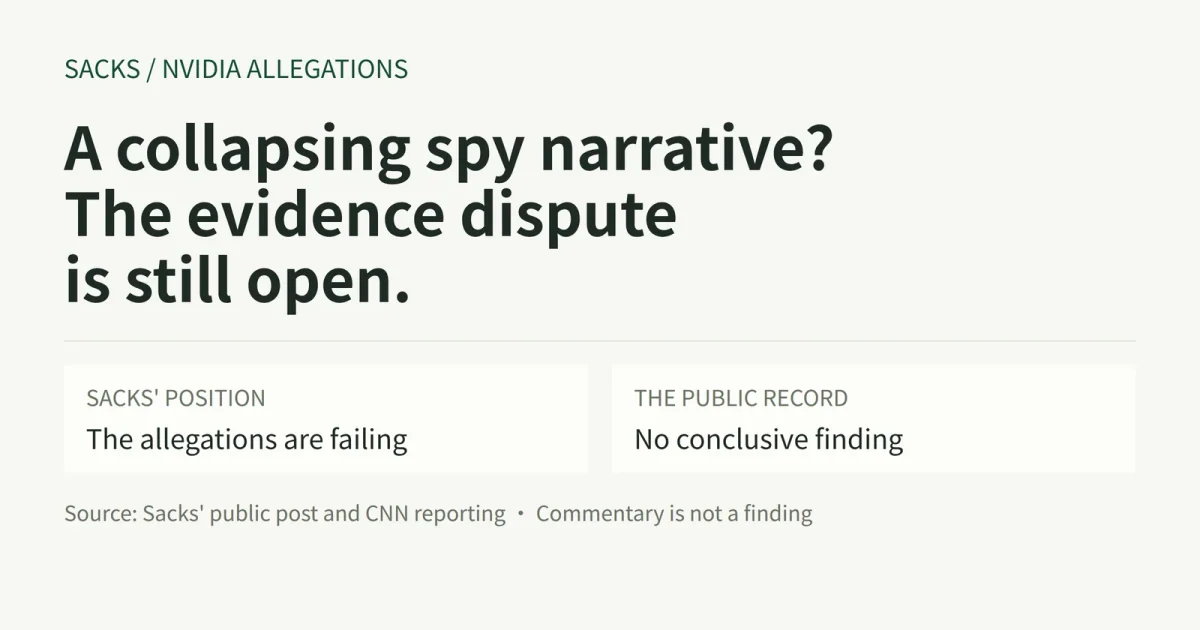
Doubts about the espionage allegations surrounding Nvidia are being turned into a claim that those allegations have collapsed. That is the move David Sacks makes in his November 13, 2026 post. The person accused, Alice Huang, has a commercial connection to the AI chip supplier: CNN describes her company, Megaspeed, as a major Nvidia chip buyer and reports her close relationship with Jensen Huang.
Reservations do not add up to a collective verdict
Sacks assembles remarks attributed to the attorney general, intelligence officials and Representative Jim Himes into a series of negative answers. But these are not equivalent forms of evidence or statements carrying identical institutional authority. An inability to determine someone's role is different from an affirmative finding that the person did not engage in the alleged conduct.
The CNN account also contains material that complicates the idea of a settled reversal. It describes anonymously attributed concerns about intercepted communications and reports that the FBI's counterintelligence inquiry remains active. Those accounts are not independently verifiable public evidence either. They cannot establish that Alice Huang carried out espionage.
Our reading is narrower than either confident verdict: the accessible record shows disagreement over how to interpret evidence. It does not show that either side has conclusively established its case. Rejecting an inference of guilt based on nationality or commercial success is justified.
The chip buyer raises a separate compliance question
The same CNN report, citing an unnamed person briefed on the investigation, says the Justice and Commerce departments began investigating Megaspeed in 2024. It describes that inquiry as part of a broader probe into foreign shell companies suspected of diverting restricted Nvidia chips to China. This remains a reported account of an investigation, not proof of wrongdoing by Megaspeed. But it gives the industrial concern a concrete focus: where chips went, rather than only who was close to whom.
At the company level, Nvidia's November 8 board statement placed its assessment at that time of risks to confidential information alongside a review process involving independent directors and external counsel. Sacks' demand for an investigation into the classified memo's disclosure does not answer whether transaction checks and internal controls were adequate.
For Nvidia shareholders and chip-trade compliance teams, our assessment is that two risks need separate examination: whether an individual engaged in espionage, and whether customer screening and transaction controls worked. Doubts about the first allegation leave the second question dependent on transaction records and review findings. The next useful disclosures would specify the scope of customer checks, chip destinations and any problems identified by the company or regulators. Support for or opposition to one person is a poor substitute for that information.