
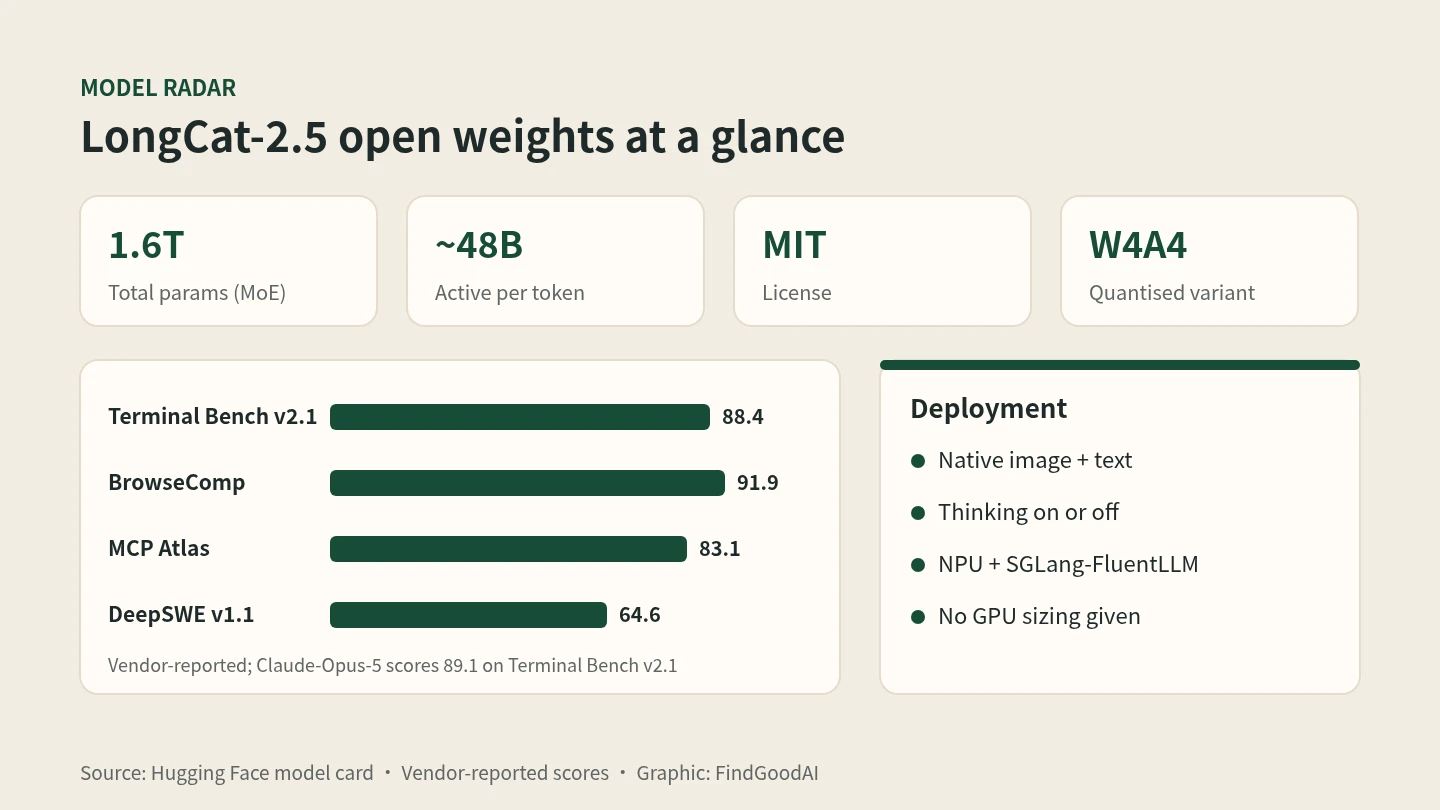
Meituan’s LongCat team has published the weights of LongCat-2.5 on Hugging Face. The team calls it a native multimodal mixture-of-experts model for long-horizon agent tasks: images are converted into discrete tokens at native resolution and processed together with text. The weights are under the MIT license, and a W4A4 quantised version is out as well.
Key specs
- Size: 1.6 trillion total parameters with about 48 billion active per token. The Hugging Face metadata shows 1.8T, which does not match the model card text.
- Modes: one model with thinking on or off (enable_thinking).
- Context: not stated on the card; its evaluations use sequence lengths of 256K, 512K and 1M.
- Deployment: officially supported on NPU platforms through SGLang-FluentLLM, with quantisation tuned for domestic AI accelerators. GPU requirements are not given.
- W4A4: accuracy comparable to the full model, per the team, with 43.3% higher prefill and 42.77% higher decode throughput than W8A8.
Reported results
The card lists 88.4 on Terminal Bench v2.1 (70.8 for LongCat-2.0), 64.6 on DeepSWE v1.1, 91.9 on BrowseComp, 83.1 on MCP Atlas and 63.1 on HLE with tools. In the same table Claude-Opus-5 scores 89.1 on Terminal Bench v2.1, so it does not lead every row. Starred scores come from public sources; the rest are in-house runs the card calls indicative only. The gains over LongCat-2.0 are largest on agent tasks such as Terminal Bench v4.0 (38.5 against 3.0) and DeepSWE, which is where the team focused this release.
Who it affects
Companies and developers that need private deployment get one of the most permissive licenses available, but 1.6 trillion parameters means cluster-scale hardware. Compare it with this week’s Kimi K3.1 Pro and Ripple-65B. Individuals cannot run it locally; tools like Ollama would need much smaller community versions.