
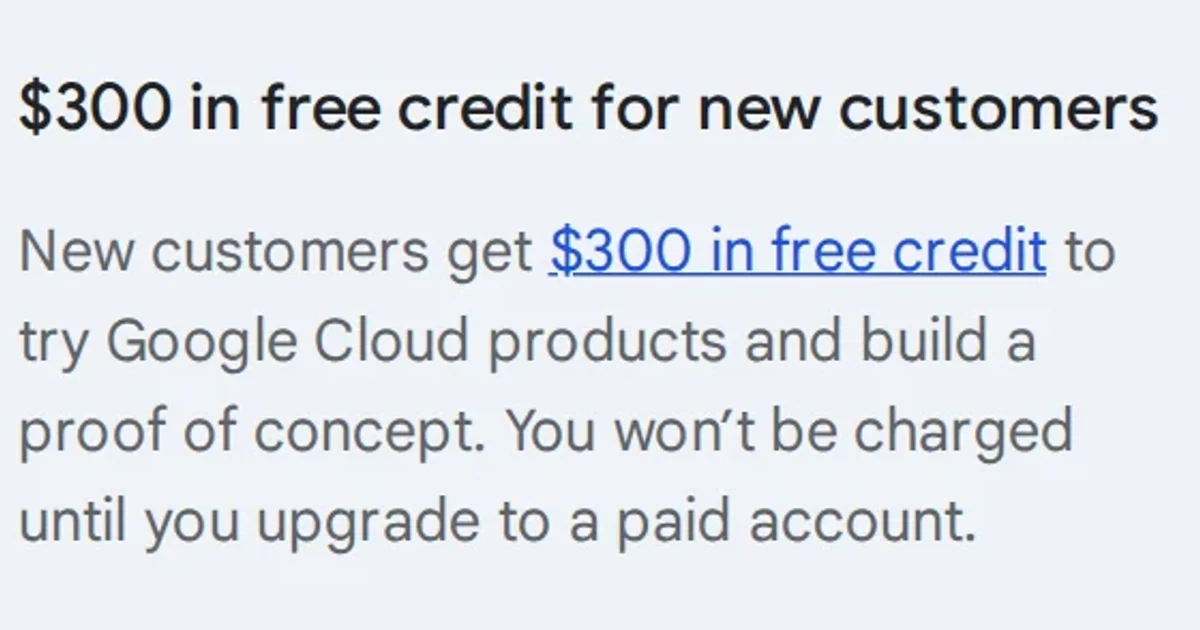
Developers counting Google Cloud's welcome offer toward an AI project now have a narrower subsidy to budget around. The $300 offer remains, but trial registrations and paid-account upgrades from November 16, 2026 will no longer qualify to spend that credit on the platform formerly called Vertex AI.
This is not an announcement of higher model prices. For affected developers, however, the same headline credit amount will no longer absorb the same AI testing expenses.
The offer survives; product eligibility does the work
Google's free-products landing page continues to promote welcome credit for proofs of concept alongside products with monthly free allowances. Its trial documentation supplies the narrower conditions. That page, marked last updated November 13, identifies Gemini platform as formerly Gemini Enterprise Agent Platform and Vertex AI.
Reading the pages together exposes an important distinction: a free cloud offer is not a common payment pool for every generative AI entry point. The documentation separately excludes Gemini API costs in AI Studio and partner generative models supplied as managed APIs. The new dated restriction adds another product-specific boundary.
Account age alone does not define the affected group
The policy covers upgrades as well as registrations. An existing trial user who converts to paid billing after the cutoff cannot assume that an earlier account creation date preserves eligibility. Equally, the wording does not establish that all existing accounts will lose access to the service on the effective date.
Access and subsidy are separate decisions. Google says moving to paid billing expands access to its products, while usage outside welcome-credit coverage or Free Tier allowances becomes chargeable. A broader set of accessible services does not mean a broader set of services that the remaining promotional balance can pay for.
AI experiments need a product-level budget
Our assessment is that affected teams should budget for model testing as a potentially out-of-pocket expense, rather than infer coverage from free infrastructure allowances. For example, Cloud Storage's Free Tier offers 5 GB-months of regional storage per month, limited to the US regions us-east1, us-west1 and us-central1, with usage combined across those regions.
The available documents also do not establish why Google made the change; they do not justify attributing it to capacity shortages or a particular category of users.
The next useful evidence will be whether charges for specific services receive credit after the cutoff, not whether the headline welcome amount remains on the landing page. Teams approving an experiment should request separate estimates for model calls and other cloud resources, with the promotional conditions supporting each estimate made explicit.