
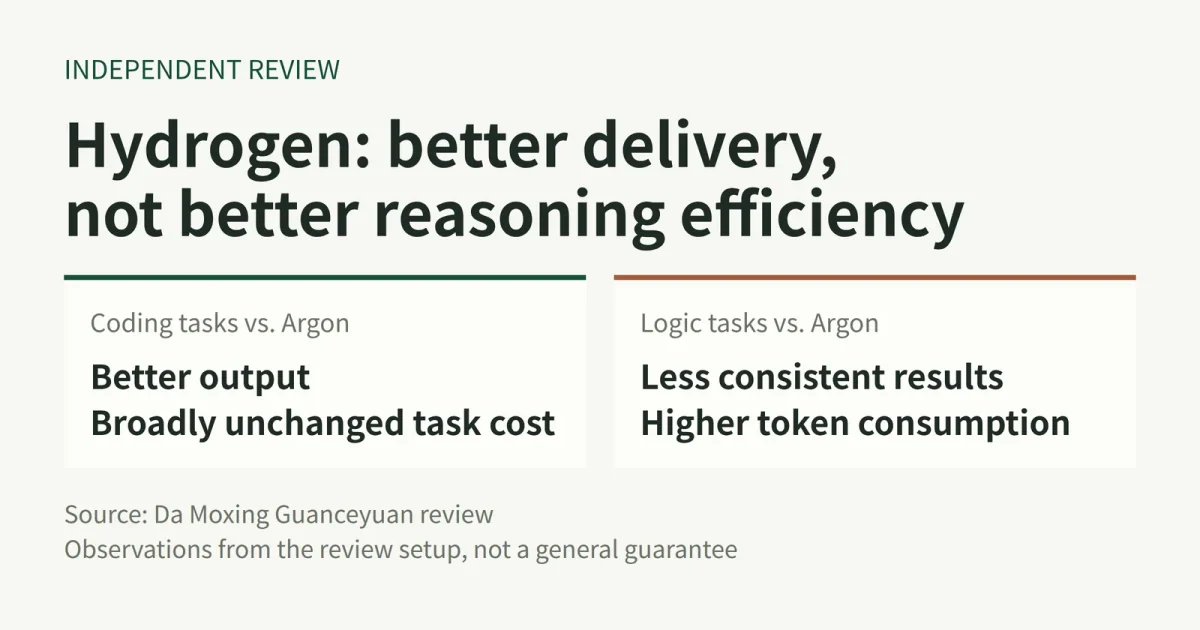
Teams choosing a default AI worker have a reason to look beyond a single intelligence score. An independent Gemini 4 Hydrogen review describes a split result: coding work improved against Argon, while logic-heavy tasks showed less consistent performance and higher token use. Those observations favor evaluating a workflow, not buying a model's reputation.
The review, published by Da Moxing Guanceyuan, reports reasoning token consumption averaging 30% to 50% above Argon. Separately, it describes better coding deliverables at broadly unchanged cost. The two findings concern different task categories.
The agent environment changed too
The coding assessment used OpenCode 2.3.0, an upgrade to the evaluator's previous setup. The reviewer attributes some improvement to more self-testing, while still finding defects that the model failed to catch. That distinction matters: a system can deliver better work through additional checks without producing better initial code.
It also limits the comparison. Because the surrounding software changed, this is not a clean experiment isolating the model upgrade. The account is useful evidence about a working agent configuration, but it does not establish how much improvement came from the model alone. Nor does it support the review's broader causal explanation about Google's training choices without additional evidence.
Google describes a division of labor
In its model card published on November 12, Google places Hydrogen in rapid execution across varied agent workflows, reserving Carbon and Argon for difficult, long-horizon reasoning. It also warns that higher thinking settings can increase token consumption. This positioning is consistent with specialization.
Our reading is that this review offers a practical lesson for selection: compare which system completes a particular job economically, rather than asking only which model answers the hardest questions. The distinction affects application builders assigning routine work and buyers deciding whether a default model should also handle their most demanding reasoning tasks.
The next informative comparison would hold the agent software, task set and acceptance criteria fixed, then report completion rates, total spend and remaining human repair work together. Until that evidence is available, the review supports a targeted trial, not wholesale replacement of a team's reasoning model.