
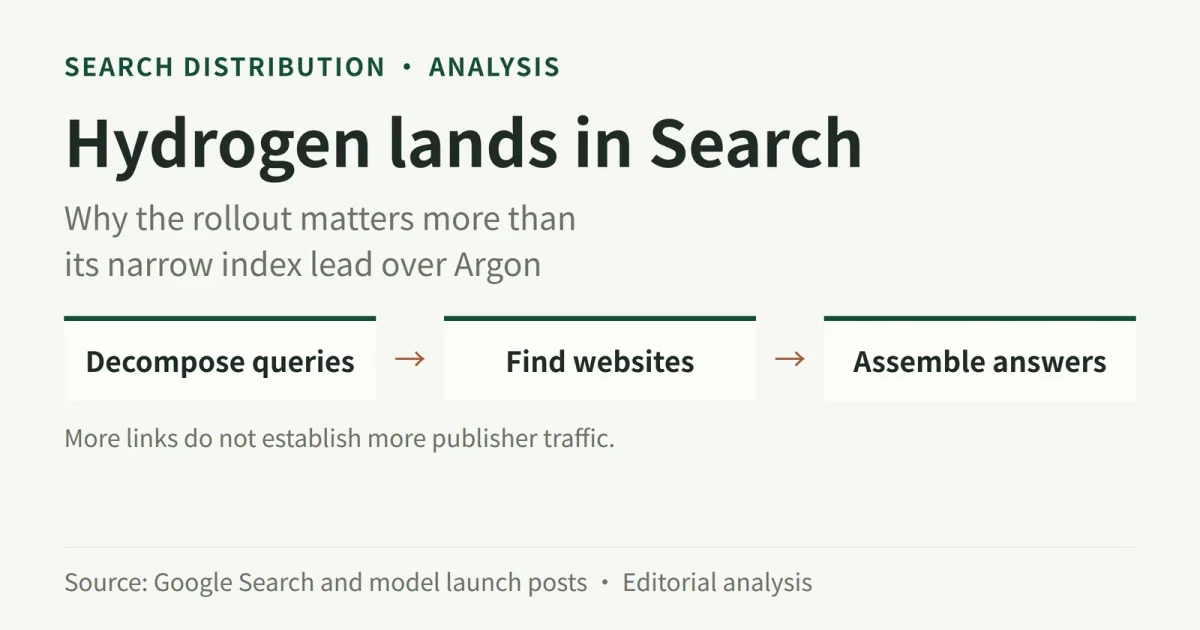
For websites that depend on search to reach readers, Gemini 4 Hydrogen matters because it helps determine how questions are decomposed and which pages become part of an answer. Google announced its global Search deployment on November 12, 2026. This is not merely a change to conversational writing quality. It reaches into the process by which content is discovered and presented.
Reasoning now shapes which content gets assembled
The Search team's announcement explains the deployment more clearly than the score comparison. Google emphasizes improvements to query fan-out: understanding the complete question, searching relevant subtopics in parallel, and returning a broader range of links. It also promises more images, comparison tables, and custom tools, with language improvements across the languages already supported by AI Mode.
Our reading is that Google is applying reasoning to Search's organizing function, not simply to sentence generation. How a system interprets constraints affects what it looks for. How it combines the resulting material affects which sources a reader encounters. For a publisher, that is a more immediate concern than a few points gained by another conversational model.
There is an important gap between the product claim and the business outcome, however. A wider range of links does not establish an increase in visits to the websites behind them. Google has not published referral conversion or outbound-click data in this announcement.
Structured answers could help readers discover and visit useful sources. They could also satisfy a request without the reader leaving Search. Neither outcome should be reported as an observed effect of this rollout yet.
The index lead is context, not proof of better search
Google's launch article reports Artificial Analysis Intelligence Index scores of 51 for Hydrogen at its default high setting, 50 for Argon, and 54 for Hydrogen at xhigh. That establishes a reported lead on this index, not better answers to every search question. Google still positions Carbon and Argon for difficult, deep, long-horizon reasoning and Hydrogen for rapid execution. Trading places on an aggregate evaluation does not erase those different roles.
The development to track is therefore distribution, not the reasoning label alone. Hydrogen is being offered to all Search users, but the announcement does not tie that access to a selectable xhigh mode. The next useful checks are whether complex queries surface a more varied set of sources and whether readers actually visit them, rather than whether the model gains another position on a leaderboard.