
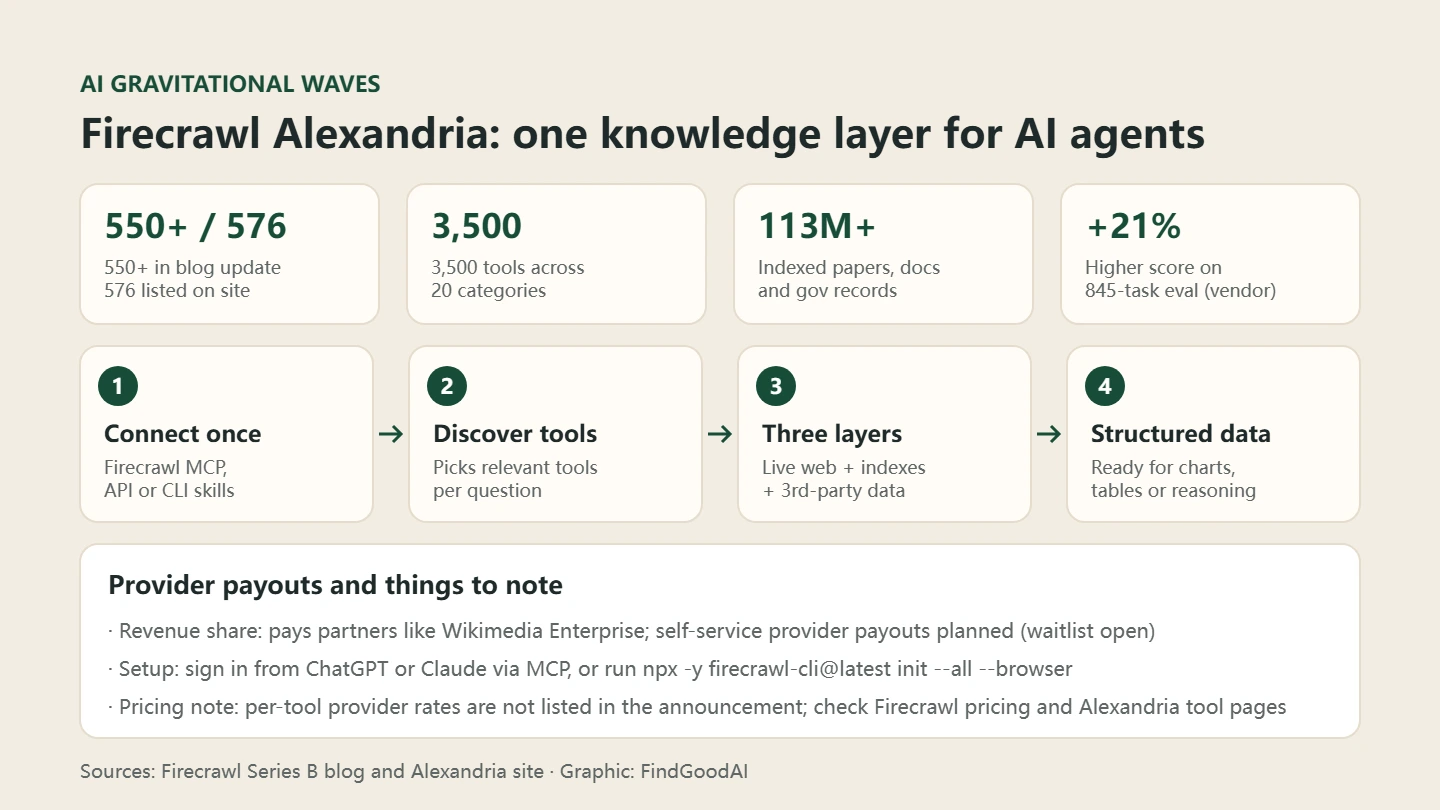
Following its $75 million Series B announcement and launch of Alexandria, Firecrawl updated its release post in November 2026 to note that the knowledge library now includes 550+ data providers (the Alexandria site currently lists 576 providers, 3,500 tools across 20 categories, and 113M+ indexed sources). Rather than treating web scraping and specialist datasets separately, Alexandria gives AI agents one layer to discover and query both.
What changed
Previously, Firecrawl focused on turning individual URLs into clean markdown or JSON; whenever an agent needed SEC EDGAR filings, Fiscal.ai market data, company registries, or clinical trial records, developers had to integrate and maintain separate vendor APIs. Alexandria brings together the live web, Firecrawl’s own indexes (Research, Developer, and Government indexes), and hundreds of external data providers behind one discovery flow. Instead of loading hundreds of tool schemas into the prompt, an agent searches for the few tools each question requires. In vendor-reported blind evaluations across 845 tasks using the same model and prompts, agents with Alexandria scored 21% higher on answer quality than built-in web tools.
How developers and researchers can use it
For quick research in ChatGPT or Claude, you can sign in through Firecrawl’s MCP without juggling third-party keys, or load CLI skills via npx -y firecrawl-cli@latest init --all --browser. Engineering teams can keep using the existing Firecrawl API. In a typical workflow—say, checking competitors and finding early buyers before building a product—one agent session can query startup directories and company registries to inspect what rivals actually ship, then call people-enrichment providers to identify target buyers without rewiring data connectors.
Provider payouts and limits
Firecrawl already pays data partners such as Wikimedia Enterprise under direct agreements and plans a self-service system so creators and organizations earn when agents pull their data (provider onboarding is currently a waitlist on Alexandria). The blog does not list per-tool pricing or rate limits, so check Firecrawl’s pricing page and individual Alexandria tool listings before running high-volume jobs. To compare agent search stacks, see Tavily, Perplexity, and more updates in AI Gravitational Waves.
Sources: Firecrawl Blog: Introducing Alexandria and our $75M Series B; Firecrawl Alexandria